



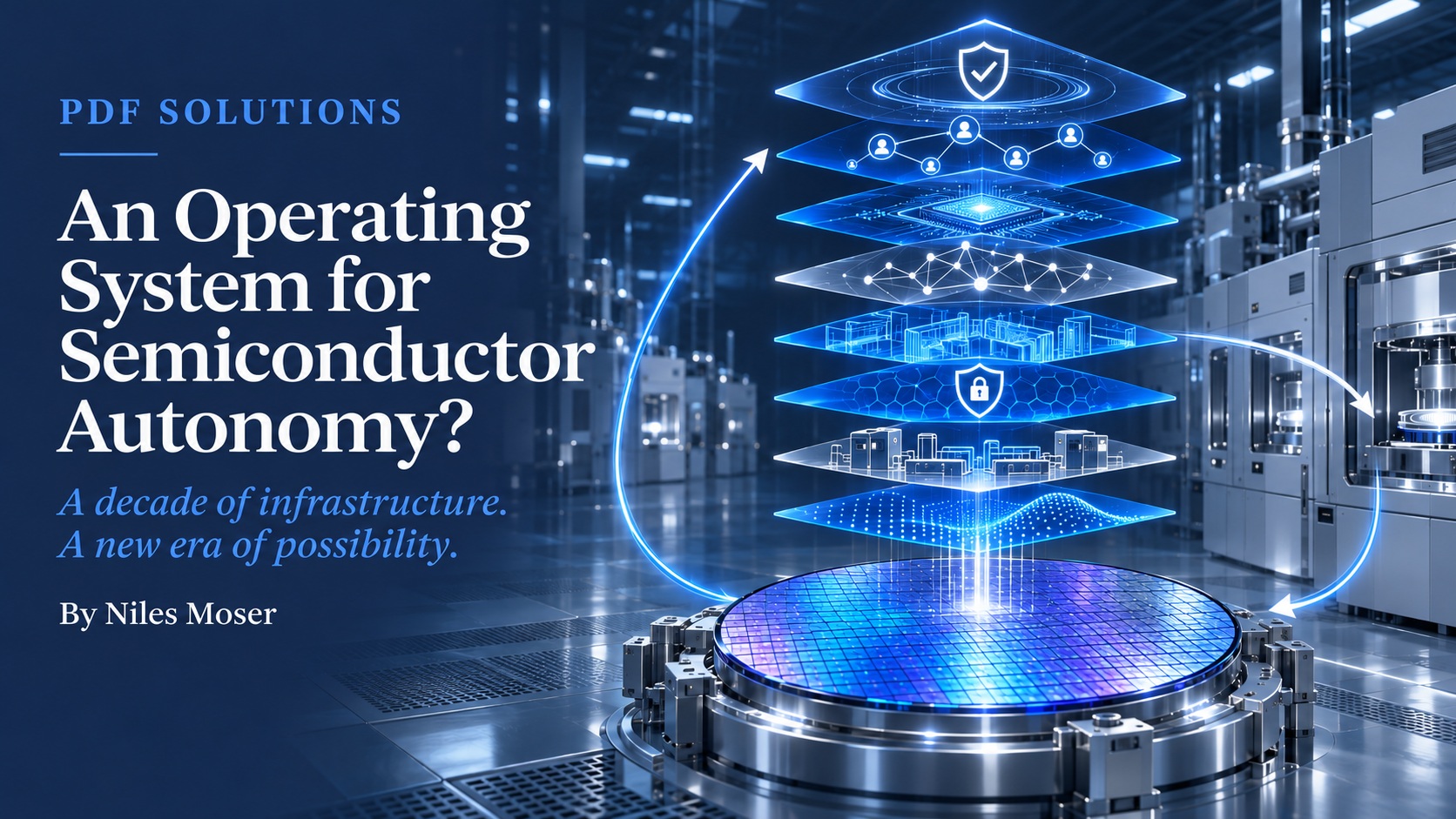
How a decade of seemingly niche investments may have created the infrastructure for an operating system for semiconductor autonomy
For more than a decade, PDF Solutions has been skating to where the puck was going rather than chasing the puck where it was.
This essay will try to make the case that the puck has finally arrived where PDF Solutions is.
John Kibarian and Kimon Michaels, together with the rest of the PDF Solutions team, have spent more than a decade building and acquiring what, viewed individually, can look like a collection of highly specialized businesses serving different corners of the semiconductor manufacturing supply chain.
Yield analytics. Manufacturing data. Equipment connectivity. Secure remote access. Electrical characterization. Supply-chain data exchange. Process and equipment intelligence.
At various points along the way, each could reasonably have been viewed as another niche added to an increasingly complicated semiconductor software company.
But that interpretation may have missed the bigger picture.
Because something important has changed.
The semiconductor industry is rapidly moving toward a world in which artificial intelligence will not simply analyze manufacturing data. Increasingly capable AI agents will be expected to monitor manufacturing processes, identify anomalies, diagnose problems, coordinate information across organizational boundaries and, eventually, take increasingly autonomous actions.
That creates a very different infrastructure problem.
The question is no longer merely: who has the best analytics?
The more important question may become:
Who can give AI agents the data, context, connectivity, domain knowledge, security, governance and ability to interact with the physical semiconductor manufacturing environment required for those agents to actually do useful work?
Viewed through that lens, the pieces PDF Solutions has assembled begin to look much less like a collection of niche businesses.
They begin to look like an architecture.
And that architecture raises a provocative possibility:
Has PDF Solutions spent the last decade assembling something approaching an operating system for semiconductor autonomy?
The Semiconductor Industry Doesn’t Have a Lack-of-Data Problem
It has almost the opposite problem.
Modern semiconductor manufacturing produces extraordinary quantities of data. The challenge is making that data useful.
When PDF Solutions introduced Exensio Aurora in September 2026, the company said that, based on its experience, less than 5% of semiconductor manufacturing data is analyzed with conventional tools.
Put differently, more than 95% of the data may remain effectively dark to conventional analysis.
That distinction matters. The semiconductor industry’s problem is increasingly not a lack of data, but its inability to extract useful intelligence from the overwhelming majority of the data it already produces.
Information is generated by manufacturing equipment, sensors, inspection and metrology systems, wafer tests, final tests, design systems, yield-management applications and many other sources. Much of that information exists in different formats, at different stages of production and inside the security boundaries of different companies.
An engineer can certainly analyze pieces of it.
An autonomous agent has a harder problem.
For an agent to determine what is happening in a manufacturing process, it first needs access to the relevant information. It needs that information normalized so disparate data sources can be interpreted together. It needs to know what the information means. It needs semiconductor-specific context. It needs to understand relationships among equipment, process history, wafer genealogy, test results and manufacturing outcomes.
And if the goal progresses from observation to action and ultimately to closed-loop manufacturing, the problem becomes harder still.
The agent needs connectivity into the manufacturing environment. It needs permission to take an action. Its identity and authority need to be established. Its actions need to be controlled and auditable. And companies must be willing to allow all of this to occur around some of their most valuable intellectual property.
That is why the transition from conventional analytics to agentic manufacturing is much more important than simply placing an LLM on top of a manufacturing database.
The model may be the most visible component.
The infrastructure underneath it may prove far more consequential.
Then Came This Slide
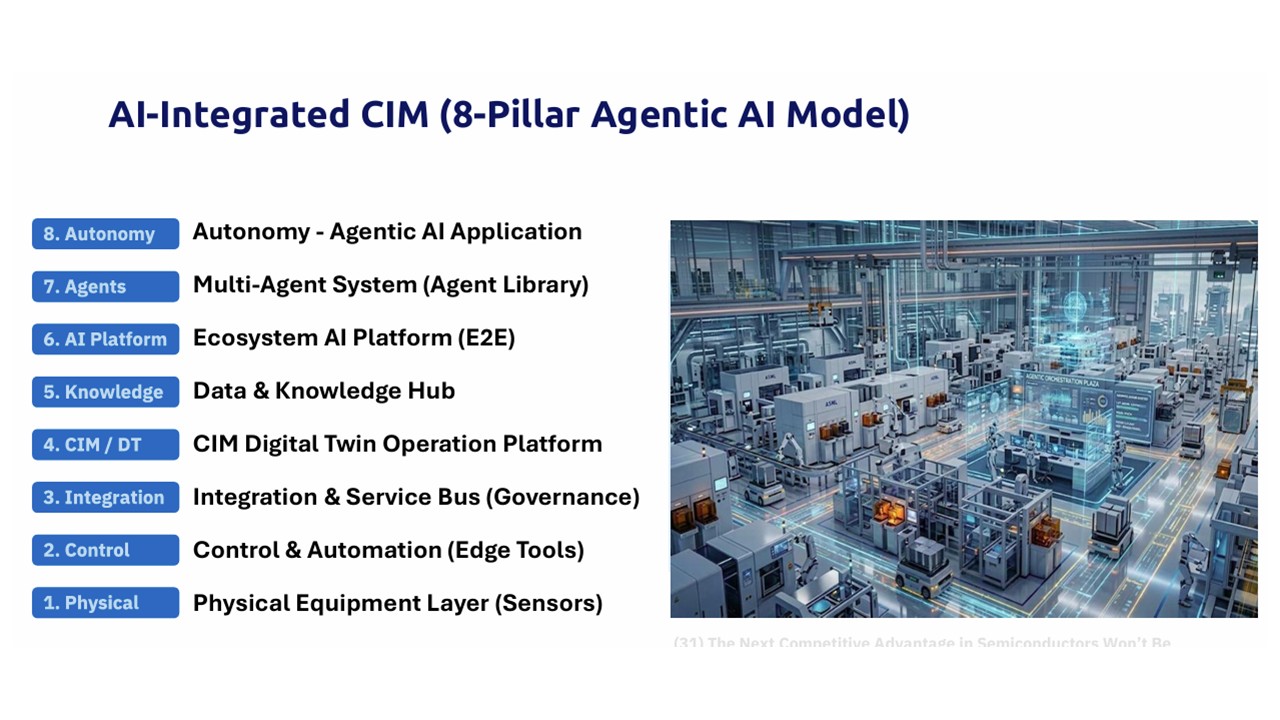
The slide is titled “AI-Integrated CIM (8-Pillar Agentic AI Model).” It presents eight vertically dependent layers, beginning with sensors and physical equipment and culminating in autonomous agentic applications.
The significance of the slide is not simply that PDF Solutions presented eight categories.
It is the architecture created by the relationship among them.
Agents are Pillar 7, not the foundation. Six underlying layers must exist before the architecture reaches a multi-agent system, and autonomy appears only at Pillar 8.
Agents do not create autonomous manufacturing by themselves. Agents require physical observability, equipment control, integration, governance, common operational state, authoritative contextualized data and an AI execution environment beneath them.
That is why the slide should be read as a system architecture rather than merely an AI-product roadmap.
And when the eight pillars are mapped against the capabilities PDF Solutions has assembled, the larger picture begins to emerge.
Pillar 1: Physical Layer, Equipment Layer / Sensors
Applicable PDF Solutions capabilities: eProbe / DirectScan + external equipment and sensor data
The operating system begins with the physical world.
Agents cannot optimize semiconductor manufacturing if the system cannot accurately observe what has physically occurred. PDF Solutions’ eProbe/DirectScan technology contributes differentiated electrical observations, while the broader PDF Solutions environment collects manufacturing, test, assembly, packaging, process-control and equipment information.
This layer is therefore broader than eProbe alone. Every manufacturing tool, inspection system, metrology system, tester, sensor and other relevant physical data source contributes observations.
But strategically, eProbe is unusual because PDF Solutions owns an important part of the physical sensing layer itself.
Physical manufacturing state → Observable data
Pillar 2: Control & Automation / Edge Tools
Applicable PDF Solutions capabilities: Cimetrix Connectivity & Control
This is where physical equipment becomes software-addressable.
Cimetrix provides equipment connectivity and control infrastructure around semiconductor equipment standards and tool interfaces. PDF Solutions’ own Sapience overview says the company has hundreds of different equipment models connected across manufacturing, test and assembly, and tens of thousands of process tools controlled by PDF-related technology.
That makes Cimetrix analogous to the driver/interface layer in an operating system.
The agent does not need to understand every equipment vendor’s implementation independently if a standardized equipment software layer can expose relevant equipment state, events, process information, data and control interfaces.
Without this layer, scalable autonomy becomes an integration problem tool by tool.
Pillar 3: Integration & Service Bus / Governance
Applicable PDF Solutions capabilities: secureWISE + Sapience + DEX, with Cimetrix at the equipment boundary
This may be the most strategically important layer.
The slide explicitly combines integration and governance. That is significant because autonomous execution requires more than moving data. The system must also control who or what is permitted to access systems and participate in workflows.
PDF Solutions has publicly described secureWISE as expanding equipment providers’ and fab operators’ ability to securely exchange data with, optimize and control equipment and processes.
Sapience contributes the application and system integration component. PDF Solutions describes Sapience as an EAI platform capable of connecting data sources, applications, devices, tools, databases, MES, ERP, PLM and other systems through connectivity, orchestration, transformation and storage layers.
DEX extends the integration problem across outsourced manufacturing. PDF Solutions explicitly calls DEX the “execution backbone for the outsourced semiconductor supply chain.”
Historically, secureWISE connected equipment suppliers to their tools inside semiconductor fabs, while DEX extended secure data exchange into the OSAT portion of the supply chain. Combining the two could create a seamless, end-to-end secure data network spanning the semiconductor supply chain. In an agentic world, that network could become the communications fabric through which agents and the data they require move securely across organizational boundaries.
Collectively, Pillar 3 represents the architecture required to answer a fundamental question:
Who or what may communicate with whom, and under what rules?
That is quintessential operating-system behavior.
Pillar 4: CIM Digital Twin Operation Platform
Applicable PDF Solutions capabilities: Exensio + Sapience + equipment/manufacturing context
The digital-twin layer requires software to maintain an intelligible representation of what is happening in the physical operation.
A manufacturing agent needs more than telemetry. The manufacturing environment needs context: product, lot, wafer, process, equipment, test, assembly/package, WIP, genealogy and operational state.
PDF Solutions publicly says its platform spans manufacturing, assembly and test and supports end-to-end control/data integration across semiconductor manufacturing.
Sapience adds operational state between enterprise and manufacturing systems. SAP describes Sapience as keeping S/4HANA synchronized with shop-floor reality, including semiconductor-specific WIP events such as lot splitting, merging, scrapping, unscrapping and rework.
The system must maintain a sufficiently accurate digital representation of physical manufacturing before higher-level agents can reason about what action should occur.
Pillar 5: Data & Knowledge Hub
Applicable PDF Solutions capabilities: Exensio Aurora / Manufacturing Data House / semiconductor semantic model
This is arguably PDF Solutions’ deepest historical competency.
PDF Solutions says Exensio supports more than 50 data formats spanning FDC, test, assembly and packaging and harmonizes them into a high-performance semantic model suitable for analytics and machine learning.
The distinction between data and knowledge matters.
An agent cannot reason safely merely because petabytes of raw data exist.
This is why ontology and domain expertise matter, and why frontier-model providers cannot independently own the entire semiconductor agentic layer simply by having better models. The knowledge required by an agent exists partly outside the model weights, in the live, semiconductor-specific operational context.
Raw observations → Relationships → Semantics → Manufacturing knowledge
Pillar 6: Ecosystem AI Platform, End-to-End
Applicable PDF Solutions capabilities: Exensio Aurora + StudioAI + Sapience + secureWISE/DEX reach
“Ecosystem” and “E2E” are two of the most important words on the slide.
This is explicitly not labelled merely “Fab AI Platform.”
PDF Solutions publicly describes itself as a platform spanning the semiconductor and electronics ecosystems, creating and collecting data across the supply chain and using AI to improve yield, quality and operational efficiency.
Aurora supplies scalable analytics and semantic context. StudioAI supplies model lifecycle capabilities. Sapience links manufacturing with enterprise systems. secureWISE and DEX supply connectivity extending beyond a single organization’s boundary.
That ecosystem dimension is critical because the semiconductor product increasingly moves through multiple enterprises.
Local fab autonomy can optimize a fab.
Ecosystem autonomy can optimize the manufactured product across its lifecycle.
Pillar 7: Multi-Agent System / Agent Library
Applicable PDF Solutions capabilities: Aurora agentic workflows + StudioAI/BYOM + first- and third-party agents
The wording here strongly reinforces the model-agnostic interpretation.
The slide says “Multi-Agent System (Agent Library).”
It does not say “PDF Solutions Agent.”
That implies an architecture in which numerous specialized agents coexist above the common infrastructure: fab agents, OEM agents, test agents, inspection agents, supply-chain agents, PDF Solutions agents and third-party agents.
This is strategically attractive for PDF Solutions because the company does not need to win the frontier-model race or even dominate agent development.
Innovation above the system can increase the economic value of the system beneath it.
More agents → More data consumption → More workflow execution → More system interactions → More infrastructure utilization
Pillar 8: Autonomy / Agentic AI Application
Applicable PDF Solutions capabilities: the completed closed loop, not one individual product
This is the crucial conceptual point.
There is no standalone PDF Solutions product that equals Pillar 8.
Pillar 8 is what happens when Pillars 1 through 7 work together.
That is governed closed-loop autonomy.
And that is why describing PDF Solutions merely as an analytics company misses the architectural whole.
Sense → Connect → Contextualize → Reason → Govern → Act → Measure → Learn → Repeat
Why This Is Properly Viewed as an Operating System
An operating system does not need to manufacture the hardware or own every application running above it.
The operating system provides the common environment that allows heterogeneous components and applications to interact reliably.
Physical abstraction: Equipment and sensors become software-addressable.
Connectivity/control: Heterogeneous physical tools expose standardized interactions.
Integration/governance: Systems and enterprises communicate under defined authority.
State: The physical manufacturing environment has a corresponding operational/digital representation.
Knowledge: Raw data becomes contextualized and semantically meaningful.
Execution environment: Models and AI applications operate against that state.
Applications: Specialized agents run above the common environment.
Closed-loop execution: Authorized software decisions affect the physical world and receive feedback.
Whether management calls that a “platform,” “AI-integrated CIM,” or something else is essentially irrelevant.
It is an operating environment between physical manufacturing and autonomous software.
And PDF Solutions itself has already used remarkably strong adjacent terminology, including “secured data infrastructure” and “execution backbone.”
The Architecture Is Greater Than the Sum of the PDF Solutions Products
This explains why a conventional product-by-product analysis can miss the opportunity.
eProbe as inspection hardware.
Cimetrix as embedded equipment software.
secureWISE as secure remote access.
Exensio as yield analytics.
Sapience as ERP/MES integration.
DEX as supply-chain data exchange.
StudioAI as ML infrastructure.
Aurora as faster analytics.
Each description can be individually accurate.
But the eight-pillar architecture says something else happens once they are combined.
They form sequentially dependent layers:
Physical world → Control → Governed integration → Operational state → Knowledge → AI environment → Agents → Autonomy
This is the architecture of the whole.
And importantly, PDF Solutions is not assembling it from an entirely greenfield position. Its public Sapience presentation describes more than 300 equipment models connected across manufacturing, test and assembly, more than 40,000 process tools controlled using PDF Solutions technology, and over 125,000 equipment-factory connections.
That installed history is strategically important because manufacturing infrastructure must be trusted before customers permit it to participate in consequential production decisions.
The implication is therefore not simply that PDF Solutions possesses attractive individual products.
The products collectively form the vertically integrated infrastructure required for agentic workflows to observe, understand and safely act upon the physical manufacturing world.
That is the operating-system thesis.
No single PDF Solutions product is the operating system.
The integrated architecture created by the layers is the operating system.
Has the Puck Finally Arrived?
For years, it was possible to look at PDF Solutions and see a collection of specialized businesses addressing highly specific problems in semiconductor manufacturing.
eProbe.
Cimetrix.
secureWISE.
DEX.
Sapience.
Exensio.
Aurora.
StudioAI.
Viewed independently, the pieces can look like a collection of semiconductor niches.
Viewed through the architecture PDF Solutions presented at CONNECT, they look very different.
Physical.
Control.
Integration and governance.
Digital operational state.
Knowledge.
AI platform.
Agents.
Autonomy.
The significance is not that PDF Solutions has a product participating in each category.
The significance is that the categories are vertically dependent.
The physical world feeds the control layer.
The control layer feeds governed integration.
Governed integration supports operational state.
Operational state becomes contextualized knowledge.
Knowledge feeds the AI environment.
Agents operate above that environment.
And together the layers make governed closed-loop autonomy possible.
That is why the collection of businesses PDF Solutions has assembled can look very different when viewed as an integrated architecture rather than as a portfolio of products.
It is also why the distinction between a “platform,” an “infrastructure layer,” and an “operating system” ultimately matters less than it appears.
The functional question is what the architecture does.
And the CONNECT slide depicts an architecture extending continuously from the physical semiconductor manufacturing environment through control, integration, governance, operational state, knowledge and AI to agents and ultimately autonomy.
For more than a decade, John Kibarian, Kimon Michaels and the PDF Solutions team have been assembling the pieces.
Perhaps those pieces were simply an unusual collection of semiconductor niches.
Or perhaps something much larger was hiding in plain sight.
Maybe PDF Solutions has been skating toward this moment for more than a decade.
And maybe the puck has finally arrived.
Author’s Note
The author (Niles Moser) is a long-term shareholder of PDF Solutions. The views expressed here are the author’s own and are intended as an examination of the company’s technology architecture and the evolution of the semiconductor manufacturing supply chain. Niles Moser.
Also Read:
The AI-First Platform the Disaggregated Semiconductor Industry Needs
PDF Solutions CONNECT 2026 Trip Report
Who Gets to Move the Recipe? How Autonomous Agents Earn Decision Authority in the Fab
Share this post via:


Comments
There are no comments yet.
You must register or log in to view/post comments.