





The semiconductor industry is entering a new era in which advanced packaging and chiplets-based architectures are becoming the primary drivers of system-level innovation. As traditional process-node scaling becomes increasingly complex and expensive, manufacturers are turning to heterogeneous integration, combining multiple dies within a single package to deliver higher performance, lower power consumption, and greater design flexibility.
This architectural shift is transforming semiconductor test.
Compared to traditional monolithic devices, chiplets-based products generate much larger volumes of data across multiple manufacturing and test stages, including wafer fabrication, wafer sort, assembly, package test, final test, and system-level validation. Each stage produces information that can influence downstream decisions. Yet in many manufacturing environments, that information remains trapped within the operation that generated it.
As advanced packaging grows in complexity and chiplets-based architectures become common, the challenge is no longer simply collecting data. It is making that data available where and when it can improve manufacturing outcomes.
This is where PDF Solutions believes the industry needs a new approach: Data Feed Forward (DFF).
The Need for Data Feed Forward
Chiplets-based manufacturing introduces more dies, more interfaces, more test insertions, and more opportunities for variation. Decisions made during wafer sort can affect assembly outcomes. Assembly choices can influence package test results. Information gathered early in the flow may be critical to optimizing downstream operations.
At the same time, semiconductor manufacturing is increasingly distributed across a global ecosystem of foundries, OSATs, integrated device manufacturers, and OEMs. Data generated at one site often does not follow the product to the next stage of production.
The result is a fragmented environment in which valuable intelligence remains isolated in local databases and AI models operate with only a partial view of device history.
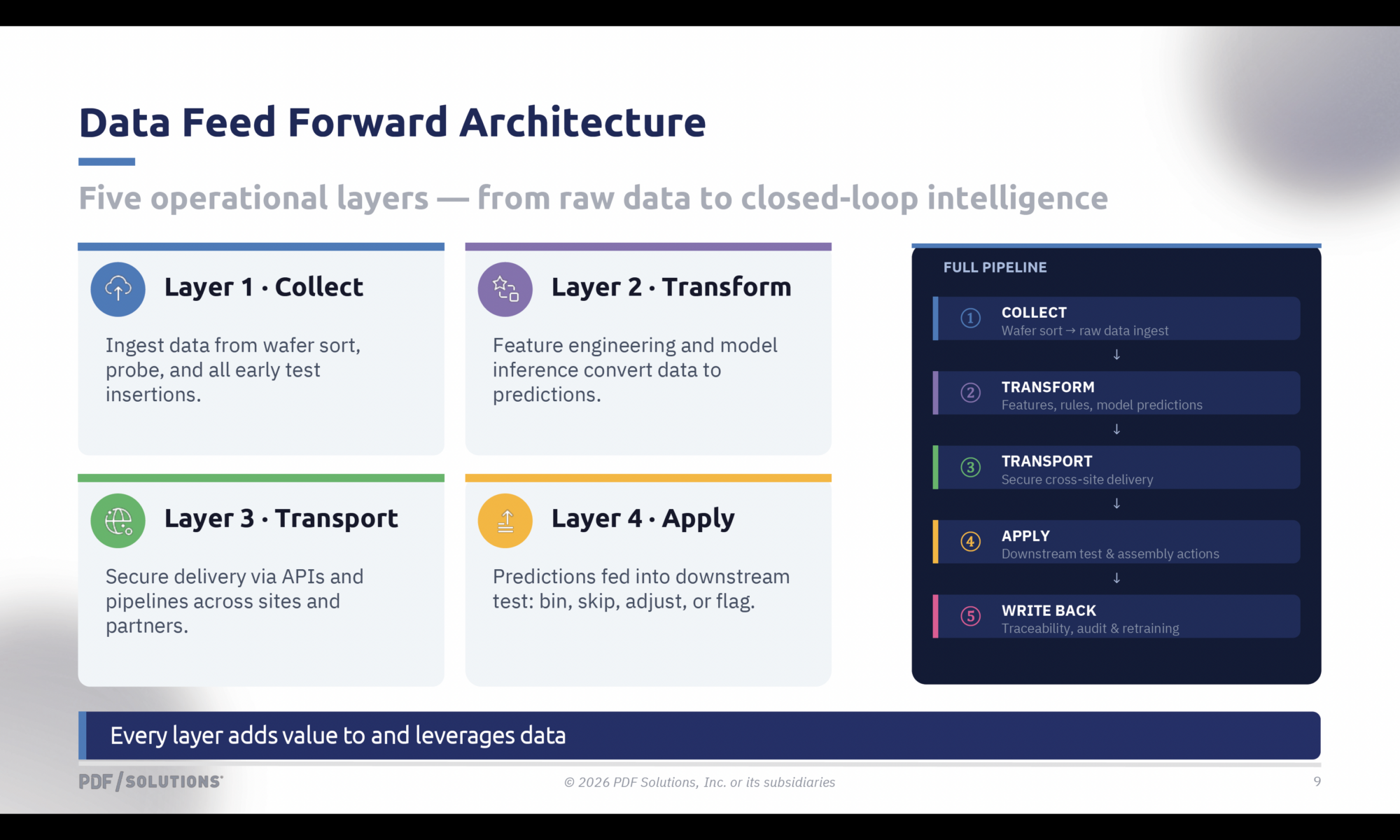
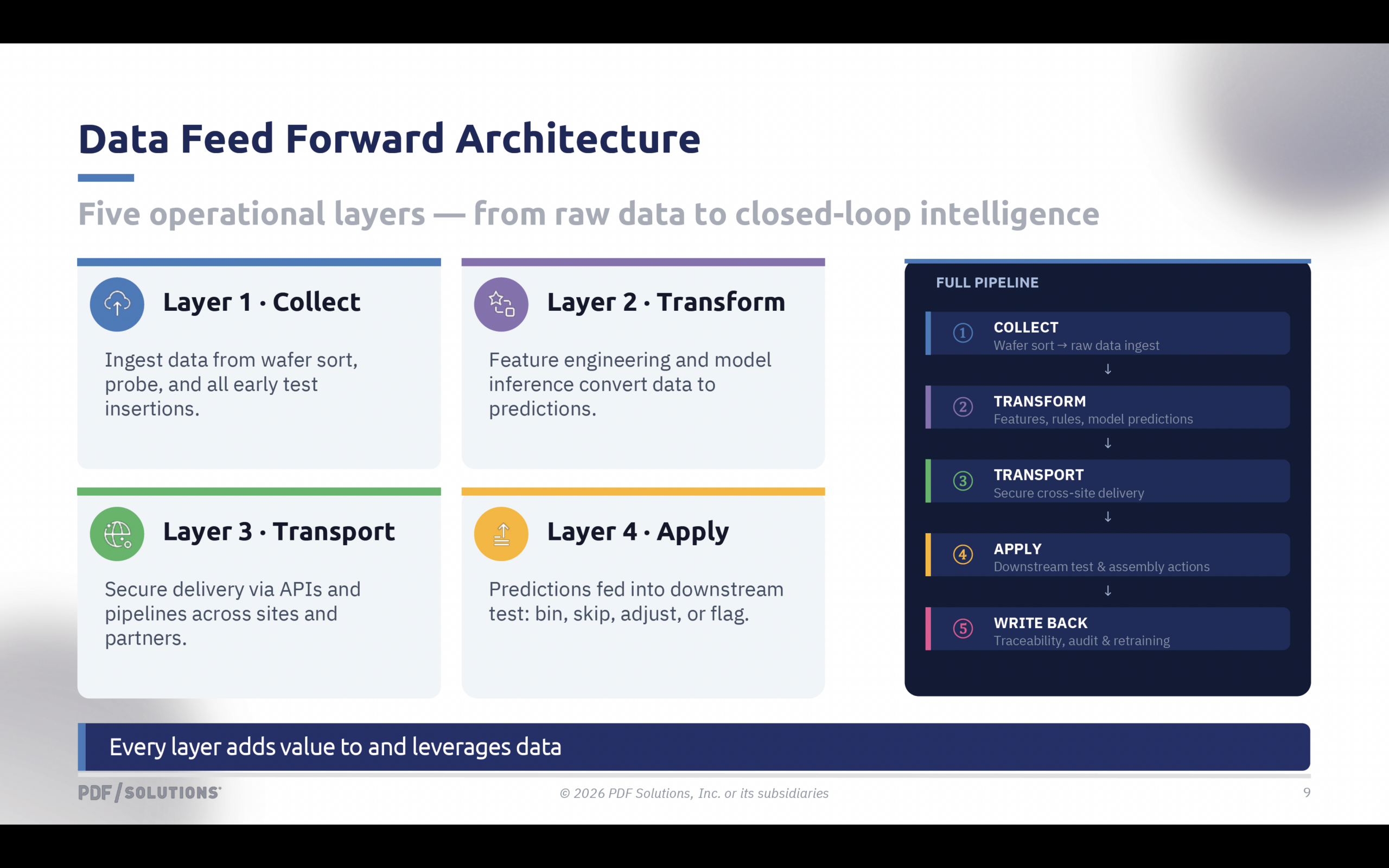
PDF Solutions addresses this challenge through its Data Feed Forward (DFF) architecture. DFF is designed to collect, transform, transport, and apply manufacturing and test information throughout the semiconductor supply chain. Rather than treating each test insertion as an isolated event, it enables intelligence generated upstream to be used in downstream decisions, even when those decisions occur at different facilities or organizations.
The goal is straightforward: turn upstream test results into downstream process intelligence.
Operationalizing AI Across the Manufacturing Flow
DFF is more than a data movement framework. It is an operational infrastructure for deploying AI-driven test methodologies at scale.
The process begins by collecting manufacturing and test data from production operations. That information is then transformed into actionable intelligence through analytics, feature engineering, business rules, or machine-learning models. Predictions and recommendations are securely transported to the next point of use and applied directly to manufacturing and test decisions.
Most importantly, outcomes are written back into the system, creating a closed-loop environment for traceability, model validation, and continuous improvement. This write-back capability allows manufacturers to compare predictions with actual outcomes, refine models over time, and continuously improve operational performance.
The result is an infrastructure that moves AI from experimentation into production.
Exensio as the Foundation
Central to this approach are PDF Solutions’ products Exensio® Test Operations and Exensio® StudioAI.
Exensio Test Operations provides the operational foundation for collecting, monitoring, controlling, and optimizing semiconductor test processes in real time. By ingesting data from test and manufacturing equipment across multiple sites, the platform creates a trusted repository of information that supports feed-forward intelligence throughout the production flow.
Exensio StudioAI extends these capabilities through what PDF Solutions describes as ModelOps for Test. The platform enables data scientists and engineers to train, validate, deploy, govern, and continuously improve machine-learning models using manufacturing data collected throughout the supply chain. Whether customers use open-source algorithms or their own proprietary models, StudioAI provides a framework for operational deployment and lifecycle management.
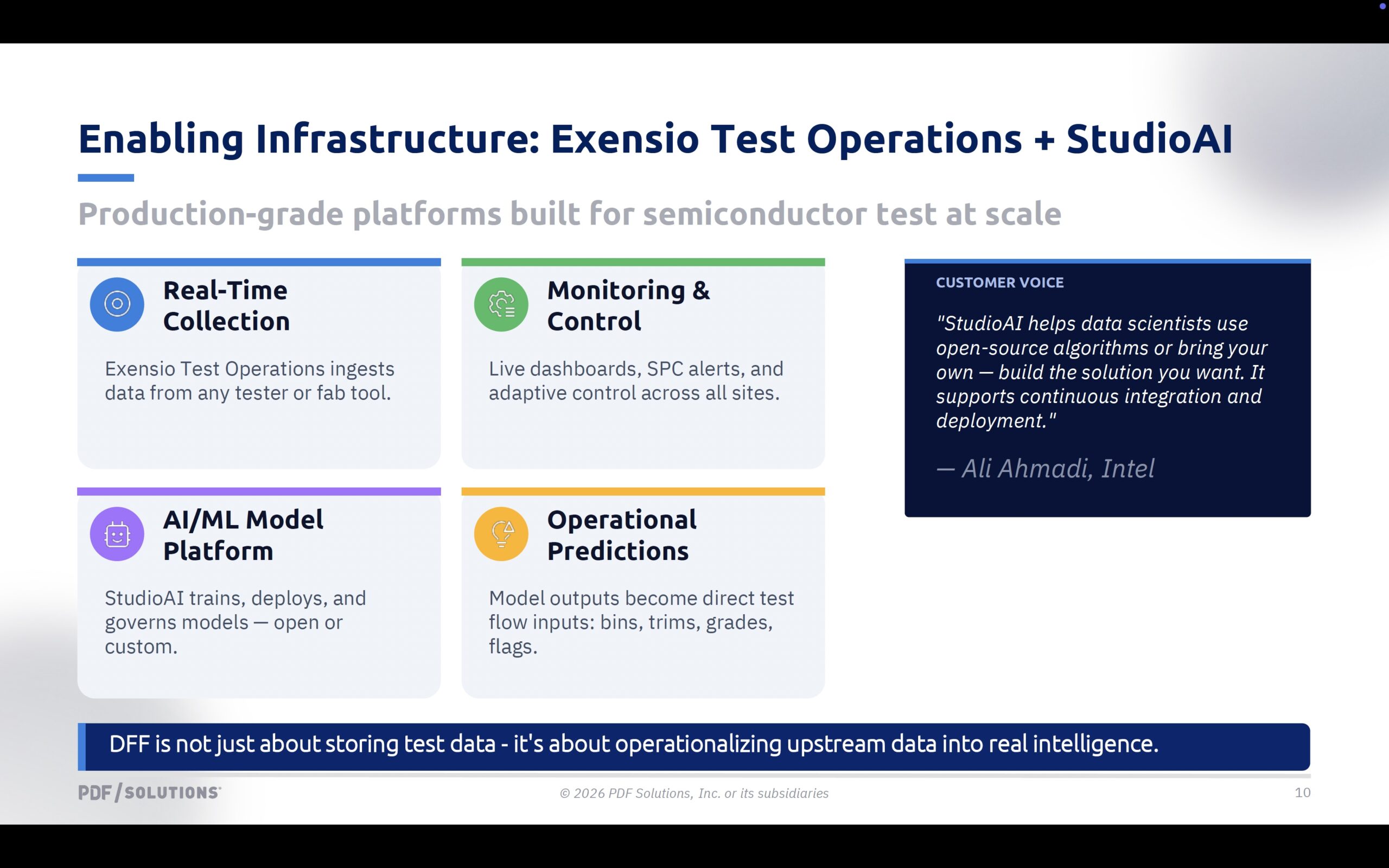
Together, the two platforms create the infrastructure required to operationalize AI within semiconductor test environments.
From Lot-Level Decisions to Per-Device Intelligence
One of the most significant outcomes of DFF is the ability to make decisions at the individual device level.
Historically, many manufacturing decisions were based on aggregate information from lots or wafers. Feed-forward intelligence enables manufacturers to evaluate each device according to its unique manufacturing history and predicted behavior.
This creates opportunities to optimize testing, quality screening, and product configuration. Test coverage can be adjusted based on predicted risk. Devices can be graded according to expected performance. Burn-in resources can be allocated selectively rather than uniformly. AI models can predict trim targets before execution, helping prevent costly errors and improving process control.
The objective is simple but powerful: apply the right test to the right device at the right time.
Benefits Across Efficiency, Quality, and Performance
The value of DFF can be viewed through three lenses: efficiency, quality, and performance.
From an efficiency standpoint, feed-forward intelligence enables manufacturers to reduce redundant testing, optimize coverage, and lower test costs. Predictive burn-in is a particularly compelling example. By analyzing upstream manufacturing and test data, AI models can identify devices likely to pass burn-in, devices likely to fail, and devices that genuinely require additional screening. This improves resource utilization while maintaining quality objectives.
Quality benefits arise from connecting information across the production flow. Predictive trim targeting, drift detection, and improved visibility across manufacturing sites allow engineers to identify issues earlier and respond more quickly. In increasingly distributed supply chains, DFF helps ensure that quality becomes a coordinated, end-to-end process rather than a series of isolated inspections.
Performance improvements stem from richer and more contextual AI models. By combining signals from wafer fabrication, wafer sort, assembly, package test, and final test, manufacturers can create more accurate predictions than would be possible from any single insertion. This cross-stage signal fusion supports advanced applications such as package grading, assembly optimization, adaptive test strategies, and real-time AI inference at the tester.
Building the Future of Semiconductor Test
As advanced packaging continues to reshape the semiconductor industry, competitive advantage will increasingly depend on the ability to operationalize intelligence across the manufacturing ecosystem. The challenge is no longer collecting more data. It is ensuring that information generated anywhere in the supply chain can influence decisions everywhere it matters.
PDF Solutions’ Data Feed Forward architecture, together with Exensio Test Operations and Exensio StudioAI, is designed to provide the operational backbone for this new generation of AI-driven test methodologies. By connecting manufacturing intelligence across sites, organizations, and test insertions, DFF enables semiconductor companies to improve efficiency, enhance quality, and optimize performance in increasingly complex chiplets-based systems.
In the advanced packaging era, the winners will not simply be the organizations that collect the most data. They will be the ones that can transform that data into actionable intelligence and feed it forward throughout the lifecycle of every device.
Learn more at
Also Read:
From Point Solutions to Agentic AI Ecosystems: Semiconductor Process Control Depends on Its Past
Two Paths for AI in Semiconductor Manufacturing: Platform Integration vs. Point Solutions
WEBINAR: Beyond Moore’s Law and The Future of Semiconductor Manufacturing Intelligence
Share this post via:



Comments
There are no comments yet.
You must register or log in to view/post comments.