



On October 13, 2026, the opening day of SEMICON West, the ESD Alliance hosted a full-day program of presentations and in-depth discussions on the theme “Bridging Design and Manufacturing with AI.” Among the speakers was Kimon Michaels, co-founder and Executive VP of Products and Solutions at PDF Solutions, who presented “From Front-End to Advanced Packaging: Scalable AI-Ready Data Platform, Secure Data Exchange and Ecosystem Collaboration.”
Michaels’ premise is easy to state and hard to execute. Packaging now drives leading-edge innovation. Manufacturing is spread across continents and companies, the boundary between front end and back end is blurring, and increasingly complex systems with tighter tolerances demand system-technology co-optimization (STCO). In that world, AI is no longer a nice-to-have, and using it well requires a new kind of platform, along with a new way for companies to collaborate across a disaggregated supply chain.
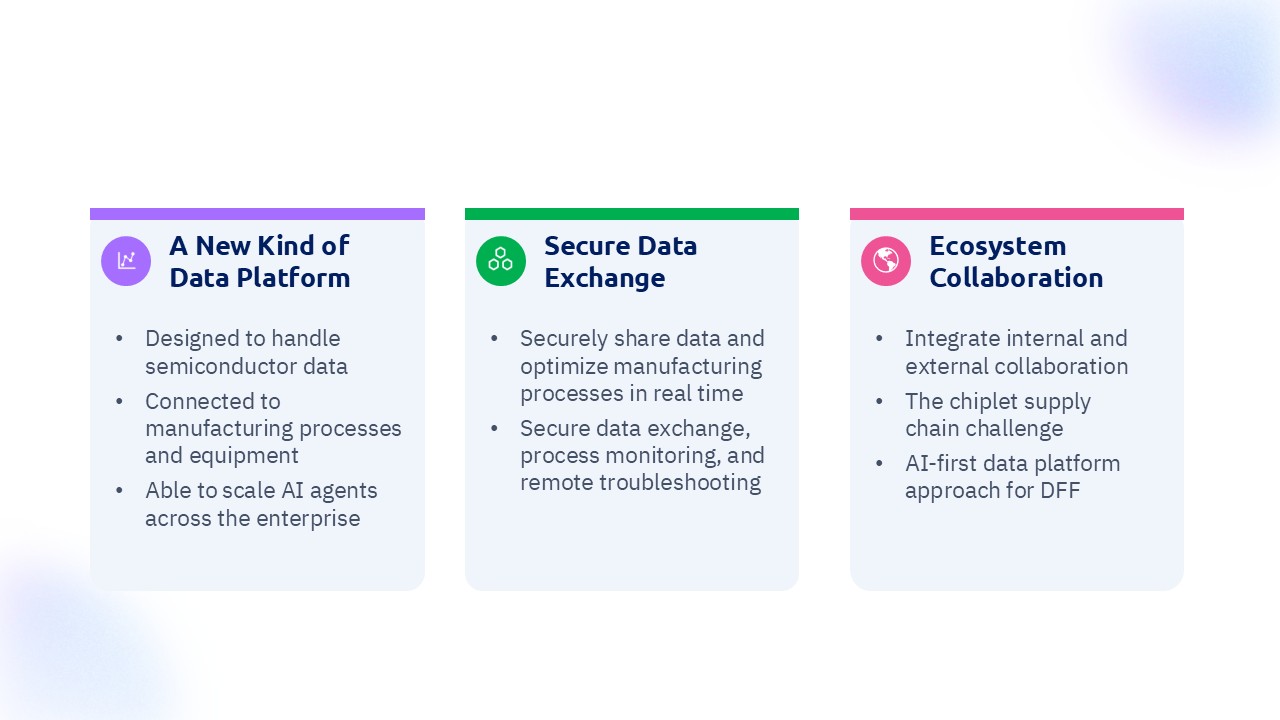
Michaels spent little time on product features. Most of his talk addressed the structural forces that, in his view, make such a platform unavoidable: the shift to advanced packaging, the explosion and unusual shape of manufacturing data, and an industry that, in his words, “is not built on trust.” PDF’s answer, Exensio Aurora, was announced on September 9 and shown publicly for the first time two days after his talk, at PDF Solutions CONNECT, held in San Francisco on October 15–16, 2026. This article draws on both the October 13 talk and Michaels’ technical keynote at CONNECT.
Data, analytics, collaboration
Michaels framed the problem around three pillars that, he said, apply to the whole industry and not just to PDF Solutions.
The first is data. AI needs lots of data, but volume alone is not the point. What matters is data that reveals relationships and cause and effect. “Just collecting more of the data you already have generally doesn’t move the needle much,” he said. The data has to reach much further.
The second is analytics, in two places. At the factory or product-group level, data is aggregated for diagnosis and forward-looking analysis. At the edge, which in this industry means the equipment, models and data have to be pushed onto the tools for real-time AI. Both feed the cloud and the factory floor for analysis over longer time scales.
The third is collaboration: turning insight into business results. Companies already do this internally, joining engineering and manufacturing data with financial and engineering operations. What is new is doing it across the supply chain. As the industry disaggregates, that requires secure networking. Leveraging AI in an agentic world, Michaels concluded, means spanning all three pillars at once.
Packaging rewrites the data problem
The trends are familiar, and Michaels covered them quickly. Geometric scaling in two dimensions “may not be dead,” he said, “but it is certainly not scaling at the same rate as before.” The industry still needs Dennard-style electrical scaling, and it is getting it from new materials, gate-all-around devices, and on-wafer 3D structures driven by design-technology co-optimization, with backside power as the most visible example. Because the reticle still caps how much fits on one die, the next step is system-technology co-optimization: disaggregating the system into chiplets and recombining them through heterogeneous integration.
Advanced packaging is expected to grow at 26% going forward. Today the leading-edge high-performance segment drives it: AI accelerators and CPUs. Michaels expects the original chiplet promise, an efficient implementation with much broader use, to arrive and accelerate that growth.
The consequence is a data problem. Judging the yield, performance and quality of a 3D-integrated package means aggregating data from every chiplet, design data at both die and package level, back-end manufacturing data, and second-order effects such as interposer-induced stress. Michaels recalled that at PDF’s 2025 Users Conference, Mike Campbell of Qualcomm reported that Qualcomm’s data had grown 600% since 2022.
The shape of the data matters as much as its size. An advanced part can carry 1 million to 10 million parameters, because it goes through tens of test insertions. The result is gigabytes of extremely wide but shallow data that keep shifting as processes drift or change. Tools designed for tall, narrow business data handle that shape poorly.
Exensio Aurora: five pillars on one data house
When PDF Solutions asked what an AI-first data platform requires, it built Exensio Aurora around five pillars sitting on the Exensio Manufacturing Data House: Scalable Analytics, Enterprise MLOps, Agentic, AI-First Interactivity, and Edge Deployments.
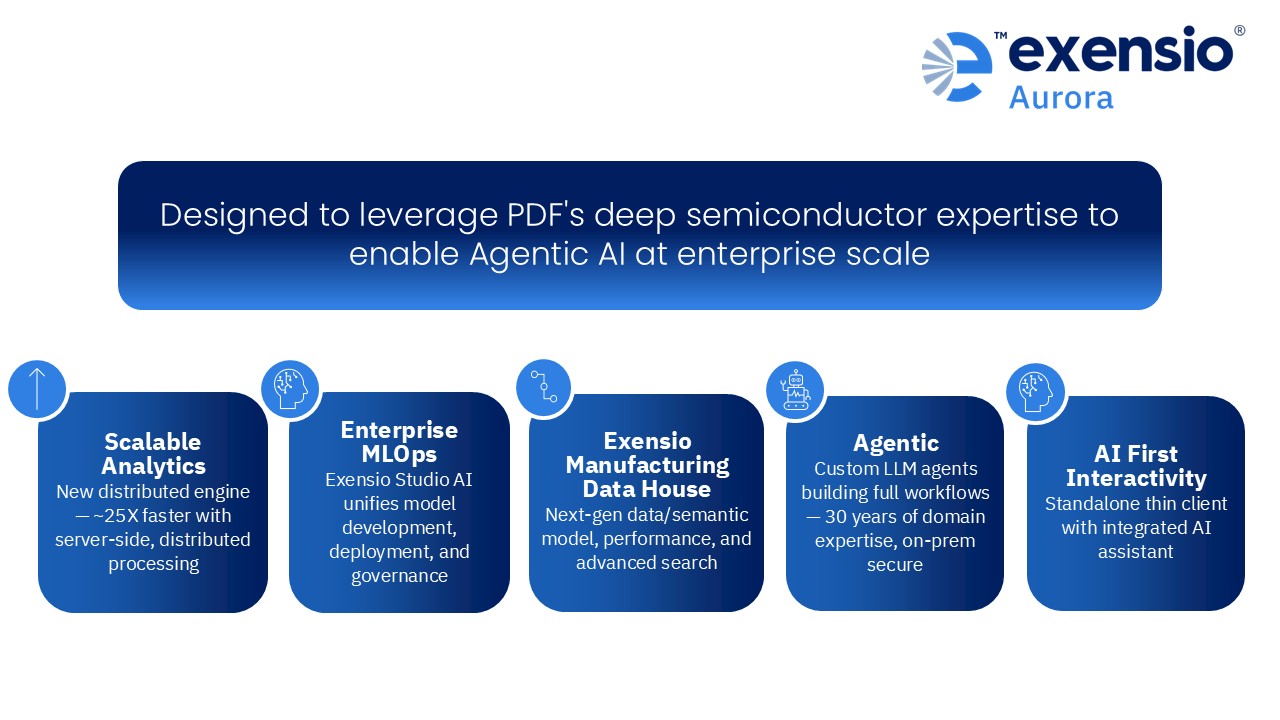
Scalable analytics. Michaels noted that even a simple correlation analysis can crawl in a classic, single-threaded BI tool. Aurora replaces that with a parallel, distributed analysis layer that partitions dynamically, caches in the data layer, and pre-computes analytics through automation, so the system works on “all the data, all the time.” The thin client never pulls raw data, only what a visualization needs. Underneath is FUSE, a new compute engine that PDF says it designed from scratch because “no distributed computation engine supports the specificity of semiconductor data.” FUSE runs complex workflows, including custom Python scripts and custom models.
The headline is roughly 25x faster at the same cost or energy level. In his CONNECT keynote, Michaels broke the gain down by use case:
| Case | Data shape | Result |
| Data egress, wide data | 25K–250K columns | 18–40x faster |
| Compute vs. prior Exensio, cost parity | 5K columns × 500K rows | 16x faster |
| Compute vs. prior Exensio, cost parity | 10K columns × 500K rows | 12x faster |
| Compute vs. prior Exensio, cost parity | 1M columns × 60K rows | Now feasible |
| NPI, large fabless (characterization) | 2M columns, full lot (500–1K rows) | ~8 minutes to load and summarize |
| High-mix IDM | 5K–20K columns, hundreds of wafers | 15x faster for yield, Cpk, correlation |
| HVM, large foundry | 2M columns × 60K rows (1,200 wafers) | ~10 minutes to load and summarize |
These are PDF’s figures. As with any vendor benchmark, independent customer data will tell the fuller story.
Enterprise MLOps. Building a model is the easy part. Shipping it to production across the supply chain, monitoring upstream data and returning results is the hard part. Exensio StudioAI is pitched to train and serve tens of thousands of models across an enterprise, with bring-your-own-model support and Kubernetes deployment.
Agentic and AI-first interactivity. Michaels was candid about Exensio’s place in the stack. At customers it is usually the manufacturing source of truth, but it is not the PLM, MES or design data. Agents therefore need to work across several data houses. “Five years from now, no one is going to care about the user interface,” he said. What will matter is whether the platform exposes what agents need to act on the data. In Aurora, workflows serve as the system language: rules, ML pipelines and batch analytics are all workflows. They can be built from natural language through an LLM, they encode guardrails against hallucination, and they become the system’s long-term memory. The architecture hosts an orchestrator LLM, PDF’s own LLMs, public models and customer models side by side.
A supply chain without trust
The most interesting part of the October 13 talk was about the supply chain, not the software. “If you are a Marvell or a Broadcom making an advanced chip,” Michaels said, “that chip is never in a factory with your name on it.” A 3D-integrated product passes through foundries, multiple OSATs, materials and tool suppliers, and finally a system maker. Along the way dies are singulated, reconstituted into wafers, and bonded die-to-die and die-to-wafer. Traceability gets harder at every step.
Today, he observed, most cross-company collaboration runs on email and phone calls. It is manual and unstructured, and it is breaking down under that complexity. Fixing it is not only a plumbing problem: “We are not an industry built on trust.” Each party needs control planes it is comfortable with, spelling out who can access which data, what is transmitted, and how it may be used. In PDF Solutions’ portfolio, the secureWISE remote-connectivity network spans the supply chain, Cimetrix handles equipment integration at the edge, and the Sapience Manufacturing Hub orchestrates links to ERP and other enterprise systems.
The payoff is feed-forward: of data, and increasingly of AI models. Everyone has long known that wafer-sort results can make final test more efficient. Across multiple sites, though, gaps, misalignment and inconsistent access get in the way. Michaels described the target as a closed-loop framework that:
- collects upstream data automatically, from your own fab or a supplier’s;
- transforms raw data into model inputs and indicators for downstream steps;
- delivers them to the right place at the right time, meeting each step’s time constants;
- applies the model, for example at package sort or test;
- returns the results to the originating database, so you know what the model did.
The benefits he listed are efficiency (optimized test flows, better OEE and process control), quality (using upstream data to avoid burn-in or understand its effect), and performance. With chiplets, known good die is no longer enough. Chiplet matching and the interaction between chiplets and the package decide whether the finished part works. “You can’t throw out a $10,000 or $20,000 part at the end if you can avoid it.”
Who owns the data?
The Q&A sharpened the point. An audience member who had worked on supply-chain policy at the Department of Commerce drew a distinction between data sharing and secure data exchange, “because ultimately data is gold that people monetize.” AI vendors want enterprise data because it makes their models better. But as happened when EDA moved to the cloud, he predicted resistance. A platform that can secure the agents as well as the data could act as the gateway that decides what is shared. His question: how do enterprises think about data sovereignty?
Michaels agreed that the issue goes beyond secure transfer to ownership and tracking. Permissions have to travel with the data across the network, and databases have to enforce them, sometimes by expiring access. He suggested AI may help, since models inherently obfuscate the data they learn from. The harder obstacle is the business model. In a fabless–foundry relationship the foundry is a contract manufacturer. Sharing data beyond product qualification, and how that could affect future acceptance, “is not something we have thought through collectively as an industry.” The minimum, he said, is systems that track sovereignty, enforce role-based access control, and keep auditable logs.
The questioner described a model he had promoted at Commerce: each enterprise in the chain issues a product certificate that encrypts and decrypts data downstream and supports monetizing digital-thread analytics. Michaels added one requirement. The system must be decentralized, “because no one party controls our industry.” The industry’s task, he said, is to work out collectively how to reach a “don’t trust, verify” stage.
What ships, and what it means
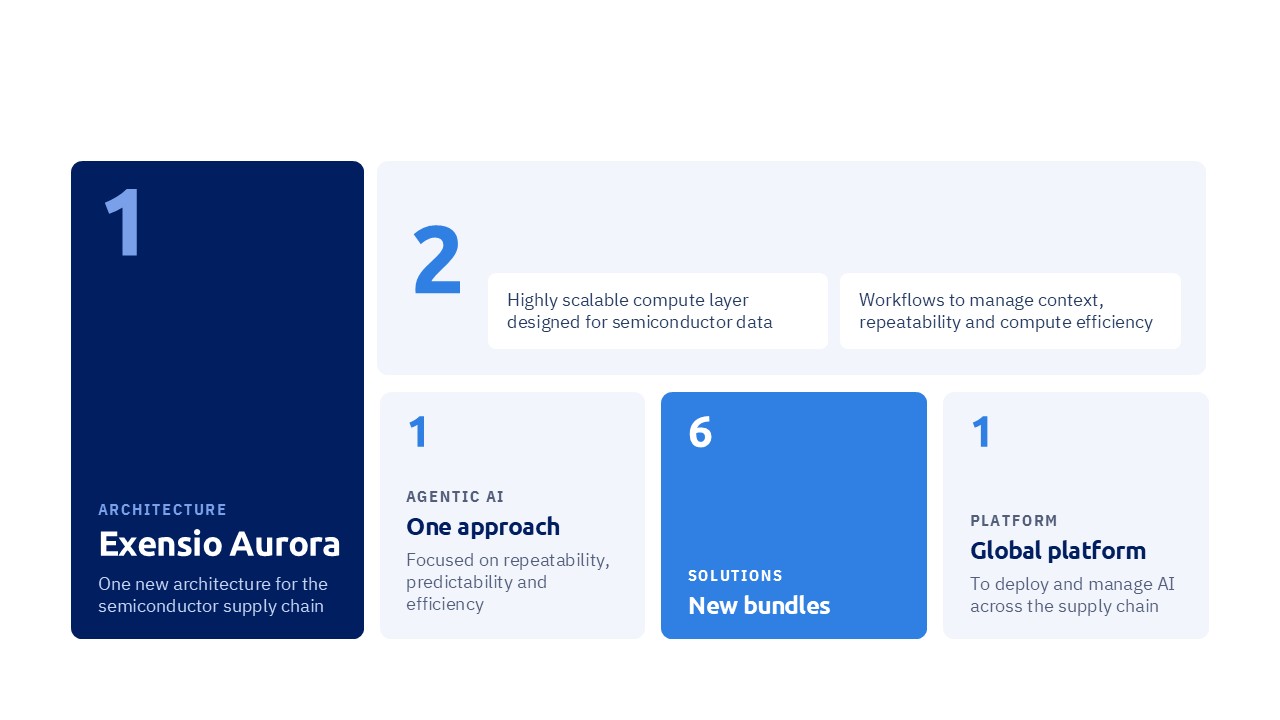
The first release of Exensio Aurora comes as six solution bundles: Scalable Analytics, Scalable Data APIs, Manufacturing Data House, Automated Analytics, StudioAI, and Advanced Feed Forward. It will be available first through an early-adopter program. At CONNECT, PDF summarized the announcements as one new architecture, two major innovations (a compute layer built for semiconductor data, and workflows to manage context, repeatability and compute efficiency), one approach to agentic AI focused on repeatability and predictability, and a global platform to deploy and manage AI across the supply chain.
The technical claims will be judged in the field, and the early-adopter results are what to watch. The more durable contribution of Michaels’ talks is the diagnosis. Moore’s Law economics now run through the package, and the package runs through a chain of companies that do not fully trust one another. If that is right, the competitive edge in yield, quality and performance goes to whoever moves data, and eventually models, across company boundaries securely and with little human intervention. Michaels called that capability necessary, not optional. With cross-company collaboration still running largely on email and phone calls, the gap between that ambition and current practice is large.
Also Read:
PDF Solutions CONNECT 2026 Trip Report
Who Gets to Move the Recipe? How Autonomous Agents Earn Decision Authority in the Fab
Share this post via:


Comments
There are no comments yet.
You must register or log in to view/post comments.