






The semiconductor industry doesn’t have a shortage of data. It has a shortage of ways to turn that data into useful manufacturing insights quickly enough to matter.
That is the problem PDF Solutions’ Exensio solution has addressed for years. Built specifically for semiconductor manufacturing, Exensio brings together manufacturing data, analytics and domain-specific applications to help engineers understand processes, equipment, products and test results.
But the problem is changing in scope, complexity and scale.
Advanced packaging, globally distributed manufacturing and growing product complexity are generating enormous amounts of increasingly multidimensional data. Conventional analytics tools can force engineers to limit the data they analyze because of constraints on scope, size and data processing time.
The advent of AI has created an opportunity to address the above challenge. Based on the current excitement AI is receiving, the tempting answer could be: “Put all the data in one place, give an LLM access to the data and let AI figure it out. Semiconductor Intelligence should hopefully follow.” This above approach can be useful for experimentation. But semiconductor manufacturing is a mission-critical industrial environment, with careful controlled IP, enormous datasets, specialized engineering knowledge and requirements for reliability, repeatability, deployment flexibility and cost. It requires industrial-strength AI. That is the premise behind PDF Solutions Exensio Aurora. Exensio Aurora is a new highly scalable architecture for its Exensio analytics solution. It is purpose-built to handle semiconductor manufacturing data at petabyte scale and to securely deploy agentic AI across manufacturing operations and the supply chain.
The first public demonstrations of Exensio Aurora will take place at the PDF Solutions CONNECT 2026 event to be held on October 15–16 in San Francisco, CA.
Visit PDF Solutions CONNECT 2026 conference website to learn more about the agenda, speakers, location, logistics and registration : https://events.pdf.com/connect2026/
PDF Solutions CONNECT provides a unique opportunity to meet with the team that developed Exensio Aurora and to hear from customers who were early adopters of some of its capability.
AI Needs More Than Data
For AI to become useful in semiconductor manufacturing, data is only the beginning. It needs scale, context, expertise and control.
Scale
AI can’t be useful if the data it needs takes hours to analyze or the data should be scaled down because of system limitations.
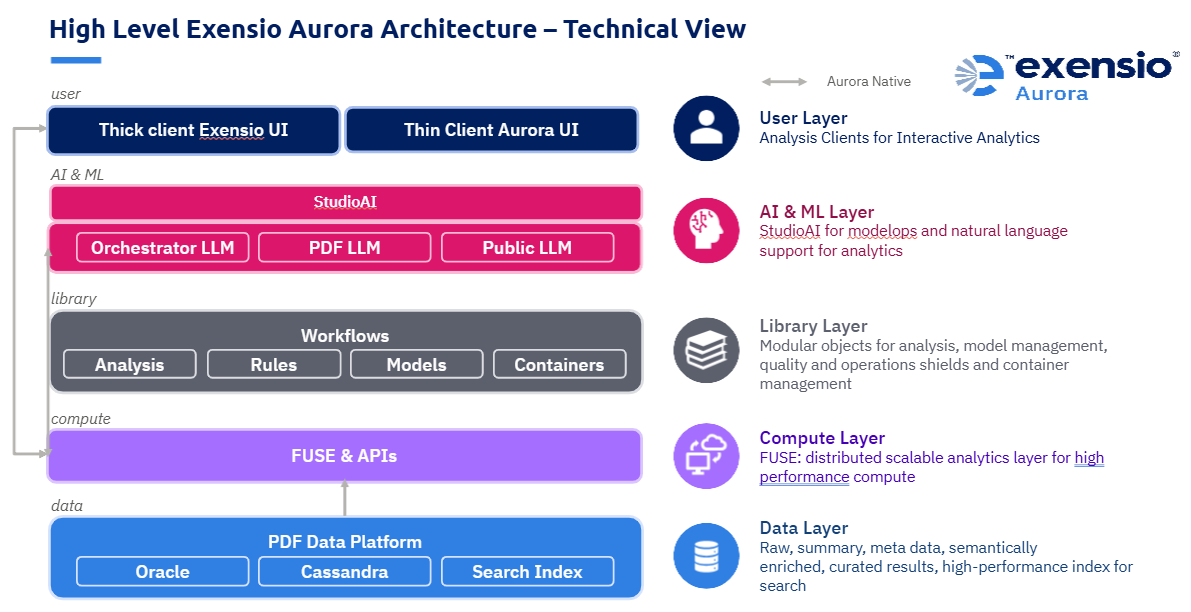
Exensio Aurora distributed analytics architecture is designed for semiconductor-scale workloads, using distributed computation, dynamic partitioning, caching and precomputed analytics. PDF Solutions cites roughly 25× faster performance at comparable hardware cost for large data sets that would otherwise be very hard to analyze with conventional tools. The goal is to move the constraint from “the maximum the system can handle” to “the right data for the outcome we want.” That changes what engineers can practically ask.
Context and expertise
Scale alone doesn’t create intelligence. Exensio Aurora’s Manufacturing Data House extends the Exensio data and semantic model with higher-dimensional data, richer metadata, custom data models and search. That provides the manufacturing context needed to move beyond simply finding data.
An engineer doesn’t really want to ask: “What does this dataset contain?” The engineer wants to ask: “Why is yield declining?” or “What factors are driving these failures?” Answering those questions requires understanding relationships among products, lots, wafers, equipment, processes and test results. It also requires engineering expertise.
Exensio Aurora’s workflows can encode analytics, rules, ML pipelines and best-practice playbooks. They preserve semiconductor-specific context, provide visibility into how a result was achieved, and act as guardrails that improve repeatability and reduce AI hallucination. In other words, engineering knowledge can get embedded and become executable rather than remaining solely in people’s heads.
Control and trust
Semiconductor manufacturers need to protect proprietary IP, control access to data, understand where information comes from and have confidence that essentially the same question will follow a consistent analytical process. They also need flexibility in how and where the system is deployed, including secure on-premises options where required. A general-purpose cloud LLM may be excellent for experimentation but not for deploying AI across an engineering and manufacturing organization.
From “Run This Analysis” to “Help Me Find the Answer”
Today, an engineer might ask: “Run this analysis on this dataset.” This assumes the engineer already knows which analysis to run. With Exensio Aurora the goal is to enable a much more open question: “Over the past two days, what factors are contributing the most to test failures on this new product?” This allows the engineer to ask the platform to help determine how the problem should be investigated. The value-add is fundamentally different. The longer-term goal described by the PDF Solutions team is an agentic virtual senior engineer that can reduce manufacturing issue resolution time by determining and running whatever analyses may be needed.
Closing the Loop
Aurora connects model development with the Manufacturing Data House, allowing model outputs to be written back into the environment and made available to other analytics and applications. The intended flow is: Data -> Model Creation -> Model Inference -> Insights -> Actions.
The significance is that AI doesn’t have to remain an application sitting beside the manufacturing system. The models are developed based on the data available in Exensio, they can be deployed at whatever edge locations they need run, and the inference outputs can become part of the broader manufacturing intelligence environment.
The Real Test Isn’t the Architecture.
Aurora the new highly scalable architecture for the Exensio solution. But customers don’t buy architectures, they experience what the architecture makes possible.
They experience: “I can analyze more of the data that matters.” “My analysis runs much faster.” “I can ask questions I couldn’t practically ask before.” “I don’t have to know exactly which analysis to run.” “The system can incorporate our engineering knowledge.” “The system can help me solve the manufacturing problem.” That is the real promise of Exensio Aurora.
Summary
Exensio Aurora isn’t simply more scalable Exensio with AI added to it. PDF Solutions is re-architecting Exensio to address a fundamental challenge: how to make AI useful, trustworthy and scalable in the complex world of semiconductor manufacturing. It is an attempt to create an industrial-strength AI environment built around the realities of semiconductor manufacturing. Exensio Aurora delivers a scalable path to controlled action, leveraging semiconductor context, engineering expertise, AI, and workflows. Exensio was built for semiconductor analytics. Exensio Aurora is built for semiconductor intelligence.
The Aurora architecture matters not because the architecture itself is valuable, but because it can change what the Exensio platform is capable of doing: Turning semiconductor manufacturing data and engineering knowledge into intelligence and actions.
Also Read:
From Process Learning to Production Control: Characterization for the Era of Heterogeneous Systems
The Yield Partnership: Intel and PDF Solutions Tackle Advanced Nodes
Feed Forward Intelligence: Enabling Testability in the Chiplets Era
Share this post via:



Comments
There are no comments yet.
You must register or log in to view/post comments.