





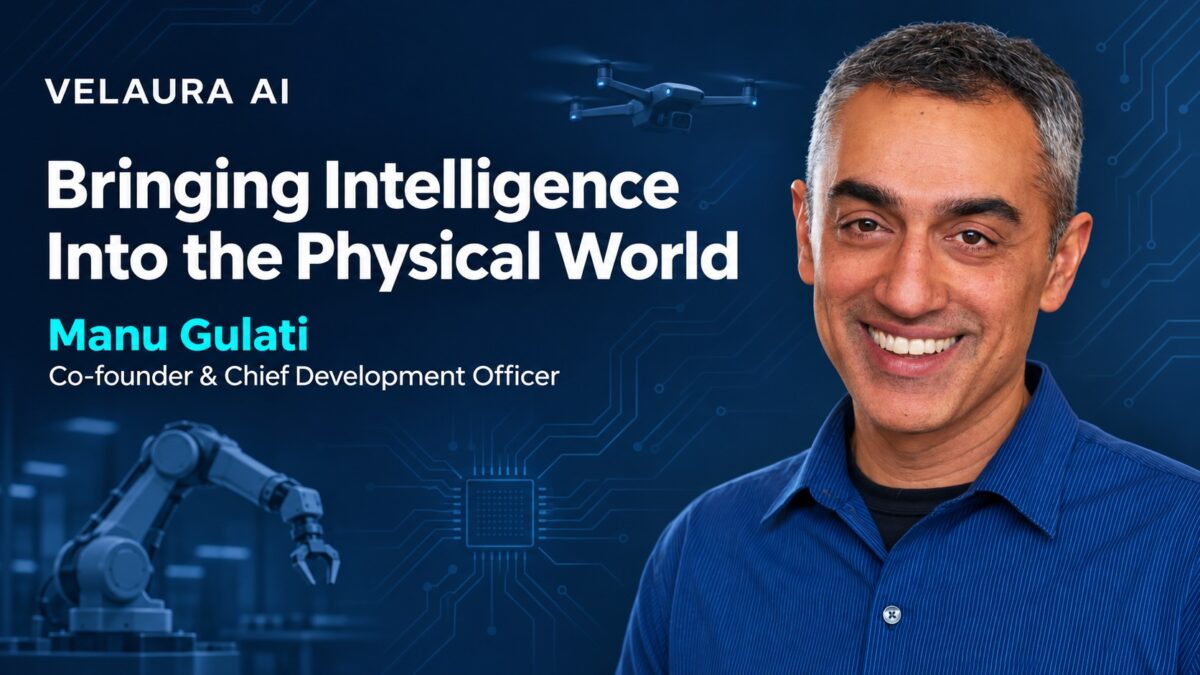
Manu Gulati serves as Co-founder & Chief Development Officer at Velaura AI. Manu is an industry-renowned silicon architect and engineering leader whose work spans Apple, Google, Qualcomm, and NUVIA (the high-performance silicon company he co-founded, which was acquired by Qualcomm for approximately $1.5B). Having led large-scale AI CPU and SoC products powering billions of devices. Manu will lead Velaura AI’s architecture, hardware, and software engineering efforts.
Tell us about your company.
Velaura AI is an AI compute company developing technology to bring more intelligence into the physical world. We’re building purpose-built silicon for robots, drones, and other intelligent machines in the premium market that need to understand their surroundings, make correct, safe real-time decisions, and act within tight power and thermal limits.
The opportunity is enormous. For these machines to become useful in everyday work, they need sophisticated intelligence onboard, fast responses, and the ability to operate safely around people. Those requirements shape how we’re designing our technology.
We spun out of Auradine in March 2026, building on energy-efficient silicon expertise developed for blockchain computing. We saw an opportunity to apply that foundation to AI, where power increasingly determines what’s possible.
Alongside Physical AI, we’re applying our low-power expertise to IP and a design platform for hyperscalers developing their own AI processors.
What problems are you solving?
Physical AI needs to move from compelling demonstrations to machines that can reliably do useful work. That brings a very different set of compute challenges.
The real world is constantly changing. A robot can’t rely entirely on a predefined sequence of actions. It needs to interpret what’s happening around it, respond to unfamiliar situations, and make decisions quickly. Increasingly sophisticated AI models can enable that intelligence, but they also demand more compute.
At the same time, many robots and drones run on batteries. They have limited space for cooling and larger batteries, and additional hardware can add weight. A machine that works briefly and then spends hours charging has limited practical value.
At Velaura AI, we’re developing silicon that brings high performance per watt, low latency, and integrated safety together. The goal is to enable more intelligence directly on the device while respecting those physical constraints.
Our data center work addresses the same underlying challenge at a different scale: getting more AI compute from the power available.
What application areas are your strongest?
We’re particularly well-suited to applications that need substantial onboard compute, real-time responsiveness, and autonomy at the edge, but are constrained by power, heat, or weight.
That includes industrial robotics, autonomous mobile robots, humanoids, and commercial and industrial drones. Across these areas, customers are looking for machines that can handle more complex tasks and autonomously adapt to changing environments instantly.
For a mobile robot, greater compute efficiency can support more intelligence within its battery budget. For a drone, reducing the heat generated by compute can also reduce the cooling hardware required, creating opportunities to lower weight.
Humanoids are an exciting longer-term opportunity. There’s a lot of attention on what they can demonstrate today, but useful deployment requires intelligence, responsiveness, and safety to work together consistently. We’re focused on the compute foundation that can help make that possible.
The common thread is real-time practical autonomy: giving machines the ability to do valuable work within the constraints of their environment.
What keeps your customers up at night?
Executing a given customer’s primary use case reliably and consistently is their chief concern. Prospective customers need to feel confident in the hardware and IP they’re adopting to know whether they can build a machine that performs useful work time and time again and is economically feasible to deploy.
Once their confidence is initially secured, addressing power, safety, compute, and predictable response times become key in allowing the customer to execute.
As it applies to physical AI, a robot that takes several minutes to complete something a person can do in seconds may be an interesting demonstration, but it’s difficult to build a business around it. Customers need enough intelligence and speed to deliver real productivity.
They also need that performance onboard. Offloading computation to the cloud can introduce delays and dependence on connectivity. If a connection drops or a response arrives too late, that can affect both the machine’s usefulness and its ability to respond safely.
Safety is especially important because these systems interact with people and physical objects. It needs to work alongside intelligence so that a machine can recognize a hazard, respond appropriately, and continue operating productively when conditions allow.
Those are interconnected requirements. Customers need confidence that performance, battery life, responsiveness, and safety can coexist in a deployable product.
What does the competitive landscape look like, and how do you differentiate?
Physical AI is attracting significant investment, and there are strong companies serving the market. Many existing compute solutions draw on architectures originally developed for data centers or mobile devices.
We’re starting with the requirements of Physical AI itself. That gives us the opportunity to design power efficiency, thermals, latency, and safety into the architecture from the beginning.
That approach becomes increasingly important as world models and vision-language-action models grow more sophisticated. A machine needs to process information about its surroundings and turn that understanding into timely action, within the power and thermal budget of the device.
Our low-power design expertise is a key foundation, but differentiation also comes from understanding the complete application. Reducing compute power can affect battery requirements, cooling, weight, and the overall system design. Those benefits matter to customers building real products.
We also bring a team with experience developing complex silicon at scale. Combining that execution experience with a clean-sheet approach gives us an opportunity to build for where Physical AI is heading.
Our focus is straightforward: enable intelligent machines to do more useful work, with greater efficiency and the responsiveness and safety their applications require.
Also Read:
CEO Interview with Khaled Alashmouny of AIDAChip
CTO Interview with Dr. Valerio Tenace of ChipNexus
CEO Interview with Daisuke Okanohara of Matlantis
Share this post via:


After Jensen: A Window for Nvidia’s Rivals, a Problem for Its Suppliers