





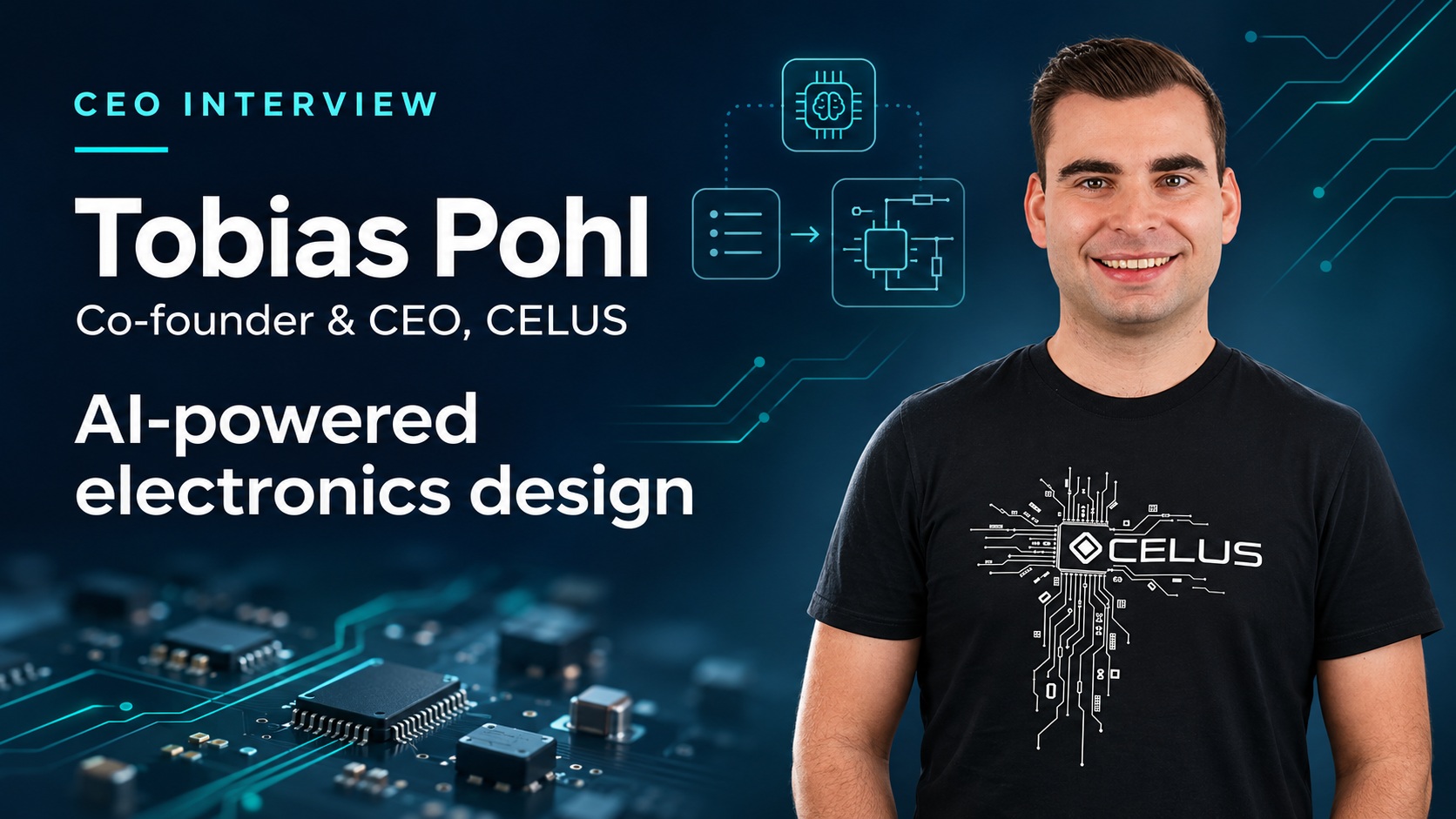
Tobias Pohl is co-founder and CEO of CELUS, a Munich-based company that builds an AI-powered electronics design platform used by more than 70,000 engineers. He studied mechanical and automotive engineering at the Technical University of Munich, where he worked in an automotive research project and built software and custom boards for an electric vehicle research project. After finding electronics tooling far behind what software engineers had, he founded CELUS in 2018 with his co-founders.
Tell us about your company?
CELUS automates the early phase of electronics design. Our platform takes an engineer from functional requirements to a first schematic and bill of materials. Our Design Assistant allows the engineer to describe a board, approve a plan, and review what gets built. Each recommendation traces back to a CUBO, a digital datasheet containing schematics, BoMs, footprints and more. We also connect to tools engineers already work in, including Siemens EDA, so a design carries over.
What problems are you solving?
The early phase of electronics design is slow and mostly manual. An engineer reads dozens of datasheets to choose parts, then draws the connections by hand, and sometimes finds out weeks later that a component is near end of life or are incompatible with each other. A large share of that effort is repetition. We take on that front section of the process so engineers can spend their time on architecture decisions and less on searching PDFs.
What application areas are your strongest?
CELUS works across all applications and industries. The top verticals where we currently have most usage is in IoT, Automotive and Industrial applications.
What keeps your customers up at night?
An engineer who signs off on a design owns every error in it, so they want to know where each decision came from before they accept it. Schedule pressure and component availability come next, and both get worse when a mistake surfaces late in a project.
What does the competitive landscape look like and how do you differentiate?
Established EDA vendors have mature schematic tools and are adding AI features on top of them. General-purpose language models can describe a circuit convincingly but have no grounding in manufacturer data. Our recommendations each point back to a cited CUBO or datasheet, so the engineer can follow a decision to its source. The plan is also shown to the engineer for approval before anything gets built, and the system checks its own output and presents the evidence for that check.
What new features/technology are you working on?
- Full agentic design flow
- Connecting many different tools together via MCP
- CELUS CAD will expand to cover a broader segment of the workflow
How do customers normally engage with your company?
We allow engineers to sign-up for free on Celus.io or via our Partner platforms such as the NXP Block Diagram Designer powered by CELUS. We also offer more advanced engineering solutions to enterprises and professionals.
On top of that CELUS works directly with suppliers to integrate their portfolio or connect to distributor shopping carts.
Also Read:
CEO Interview with Khaled Alashmouny of AIDAChip
CTO Interview with Dr. Valerio Tenace of ChipNexus
CEO Interview with Daisuke Okanohara of Matlantis
Share this post via:


After Jensen: A Window for Nvidia’s Rivals, a Problem for Its Suppliers