


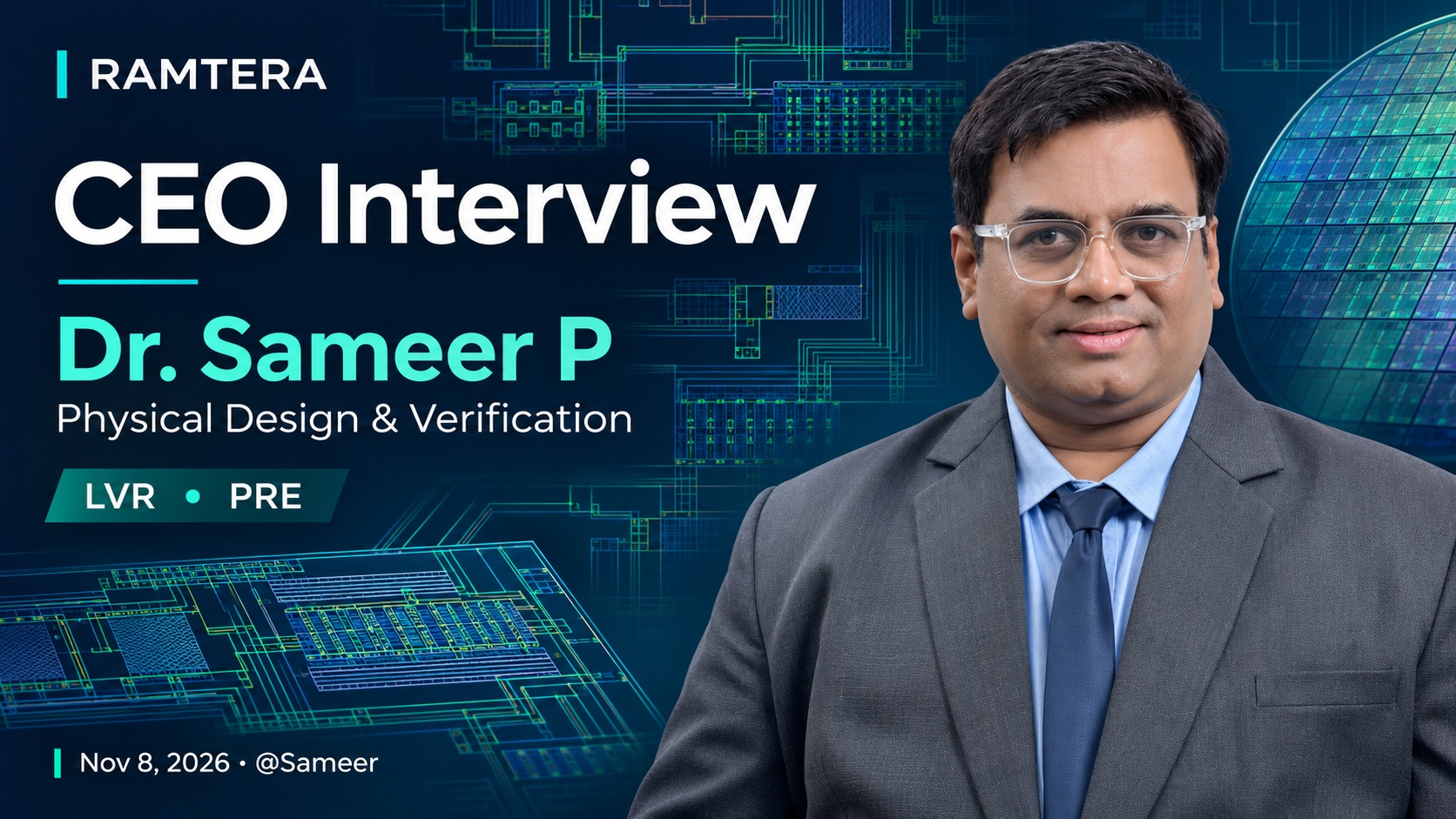



Dr. Sameer Pawanekar is the founder and CEO of Ramtera Inc., an EDA company building physical design and physical verification software. He is the architect and principal developer of both Ramtera products: LVR, for DRC, LVS and ERC, and PRE, for place-and-route.
Sameer holds a PhD in VLSI placement and partitioning and an MTech, both from IIT. He was a postdoctoral researcher with the OpenROAD team at the University of California. He has also worked in functional verification with SystemVerilog and UVM, and is based in Bangalore, India.
Tell us about your company?
Ramtera builds physical design and physical verification software for semiconductor design teams. We are incorporated in the US, and our R&D center is in Bangalore, India.
We have two products. LVR is our physical verification engine, covering DRC, LVS and ERC. PRE is our place-and-route engine, and together they take a design from netlist to verified layout.
Both engines were developed in-house over the past six years. My background is in placement and partitioning: a PhD from IIT, then a postdoc at the University of California with the OpenROAD team. We hold five granted patents in India, and LVR and PRE are our trademarks.
What problems are you solving?
We make accurate physical verification and place-and-route easier to adopt and to scale. Three problems stand out.
- Verification capacity at crunch time. Signoff-class licenses are expensive, so teams ration them, and runs queue up in the final weeks before tapeout. We license LVR so capacity grows with the work and teams can verify as often as they need.
- The cost of switching. A new tool usually means new rule decks, new scripts and retraining. LVR runs on LRF, our own rule language, into which existing foundry decks convert line for line. It is invoked the way engineers run signoff today, and it writes results in formats their debug tools already read.
- Confidence in the result. A fast tool is worthless if its answers disagree with signoff. That is why correlation against the reference signoff tool gets most of our engineering effort.
What application areas are your strongest?
LVR’s strongest ground is digital and mixed-signal design on 22nm FD-SOI and 12nm FinFET processes. These nodes carry much of today’s low-power IoT, RF, automotive and edge-AI silicon.
On these nodes LVR goes well beyond basic width and spacing rules. It covers density, latchup, ESD and double-patterning decomposition, along with LVS and ERC. Our LVS and ERC were validated on a foundry mixed-signal reference design, including tests where we planted deliberate errors and confirmed LVR caught them.
PRE is strongest on digital blocks and test chips. Its placer has delivered 24–51% shorter wirelength than OpenROAD on benchmark designs. PRE is also useful early in a project, for estimating die size before full implementation.
What keeps your customers up at night?
Above all, tapeout risk. A DRC or LVS problem found late can slip the schedule or force a re-spin, and both cost more at every new node.
Much of that risk comes down to turnaround. Full-chip runs take hours or days, and debugging the results often takes longer than running them. Every loop between place-and-route and signoff eats into the schedule.
License capacity adds pressure. In the final weeks everyone needs runs at once, and a fixed pool of licenses becomes the bottleneck.
Underneath it all is confidence: will today’s clean result still be clean when the foundry runs its signoff checks at tape-in?
What does the competitive landscape look like and how do you differentiate?
Three large EDA vendors dominate physical verification and place-and-route. Their tools are proven and define signoff, but they are expensive and sold as bundles of separately licensed options.
Open-source tools such as KLayout, Magic, Netgen and OpenROAD are free and improving fast. But they don’t run the commercial rule decks foundries ship for production nodes.
Ramtera sits between the two. LVR complements final signoff rather than replacing it: teams run it throughout design and arrive at signoff clean. We differentiate in four ways:
- Proven correlation. LVR matches the reference signoff tool 100% across 42 test designs on three advanced nodes.
- A complete tool, not just an engine. LVR includes a waiver database, a results database, ECO support and its own layout-debug GUI. Its results also load as markers in standard custom-layout editors.
- Place-and-route and verification from one vendor. PRE and LVR are designed to work together, with one team supporting both.
- Simple licensing. One LVR license covers DRC, LVS and ERC, with no per-feature add-ons.
What new features/technology are you working on?
We are widening LVR’s rule coverage to antenna, PERC and DFM checks, and building out the rest of the flow:
- LVR-PEX. Our new parasitic extraction tool writes standard SPEF and DSPF output.
- Agent-native verification. An MCP (Model Context Protocol) server lets AI agents run LVR’s DRC and LVS directly, on the customer’s own machine or cloud account.
- Distributed runs. Full-chip jobs will split across a compute farm through schedulers such as LSF, so one run can use hundreds of cores.
- Closed-loop routing. LVR’s results will feed back into PRE, so the router fixes violations found by the full foundry deck, not just its own simplified rules.
- Our in-house static timing engine matches IBM’s EinsTimer on the TAU timing-contest benchmarks. We are evaluating bringing it into the flow.
In parallel, we are pursuing foundry certification for LVR.
How do customers normally engage with your company?
We start each engagement with a trial on a block the customer has already signed off. LVR ships as a container that runs on their own machine or cloud account, so their design data stays with them. They compare our results with their signoff reports, which is the fastest way to build trust.
After the trial, customers license LVR and PRE by term, with floating or node-locked seats. For agent-driven flows, LVR is also available per run. Either way, customers work directly with the engineers who wrote the engines.
We also offer hands-on training in place-and-route with PRE and in DRC/LVS with LVR. And we take on short engineering engagements, such as estimating die size for a new chip.
Also Read:
CEO Interview with Khaled Alashmouny of AIDAChip
CTO Interview with Dr. Valerio Tenace of ChipNexus
CEO Interview with Sergiy Nesterenko of Quilter on AI PCB Layout
Share this post via:


After Jensen: A Window for Nvidia’s Rivals, a Problem for Its Suppliers