





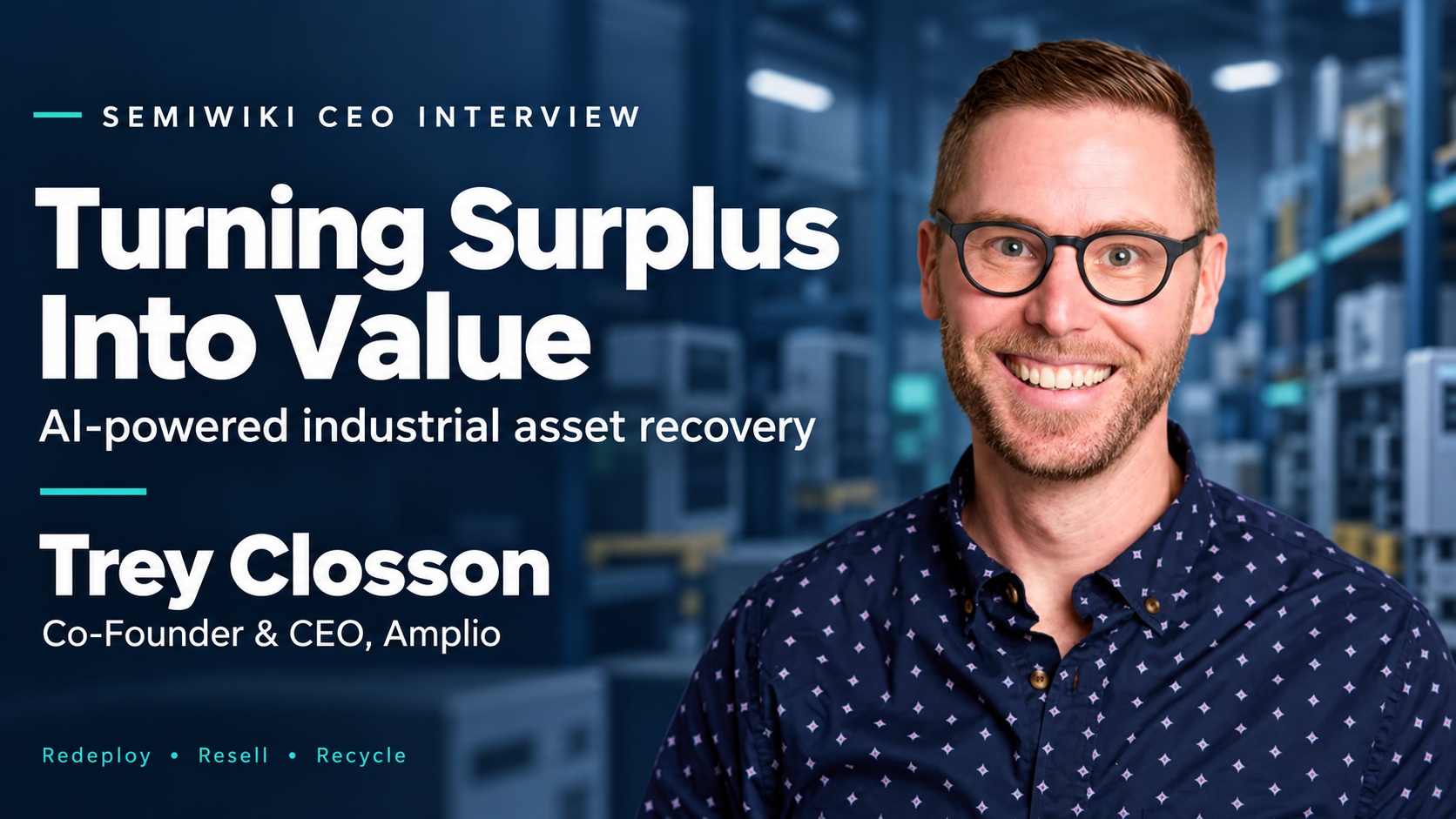
Trey Closson is the Co-Founder and CEO of Amplio, an AI-powered industrial asset recovery company helping manufacturers recover value from surplus equipment and inventory. With over a decade of experience in global logistics, supply chain strategy, and operations, Trey previously led international logistics at Georgia-Pacific and helped establish Flexport’s Atlanta team. He holds an MBA in Strategic Entrepreneurship and Operations Management from Georgia Institute of Technology and a BA in Philosophy and Urban Studies from Furman University.
Tell us about your company.
Amplio helps manufacturers turn surplus equipment and spare parts into cash. We use AI to catalog and value idle inventory, assign every item its highest-value path (redeploy, resell, recycle, or dispose of compliantly), and then execute that plan as one accountable partner, from appraisal through settlement.
Taha Zinifi and I founded Amplio in 2021. We’re based in Atlanta and San Francisco, and in September 2025 we closed an $11.1M Series A led by Hitachi Ventures and Yamaha Motor Ventures, with Construct Capital, Slow Ventures, Alpaca VC, and High Alpha participating. Our clients are most typically global manufacturers such as Georgia-Pacific, General Motors, Anheuser-Busch, and NCR Voyix.
What problems are you solving?
US manufacturers invest roughly $1.5 trillion a year in equipment and parts, and a meaningful share never earns a return. Cancelled projects strand equipment. Facility closures create one-time disposition events. MRO storerooms quietly fill up, often with 25 to 40 percent dormant inventory. The waste we can directly observe runs from $60 billion to $100 billion-plus a year.
The root cause is incentives, not ignorance. Plant teams overstock to protect uptime, operations is measured on throughput, and finance defers write-offs. Nobody owns surplus, so the default outcome is abandonment, not recovery. When companies do act, the current market works against them. Fewer than 1 in 10 manufacturers have a dedicated investment recovery function; a plant closure can take four to six separate vendors, and liquidators take the best assets and leave the rest. In contrast, we solve the whole problem as a turnkey solution.
Which asset categories and industries are your strongest?
We’re strongest where lists are large, diverse, and messy: MRO spares, capital equipment, IT and electronics, and raw materials, spread across multiple sites and ERPs. Most of our clients are enterprise manufacturers in paper and packaging, consumer products, food and beverage, energy, and electronics.
For semiconductor and electronics manufacturers, the sweet spot is everything around the process tools: spare parts storerooms, facilities and subfab equipment like pumps, chillers, valves, power, and controls, plus test equipment and IT hardware. Unlike legacy liquidators that specialize in one asset category and thus are unable to address the breadth of a client’s investment recovery opportunity, our technology and wide network enable us to solve the whole problem.
What keeps your customers up at night?
Uptime, first and always. Nobody gets fired for overstocking a spare that prevents a line-down, so storerooms stay full. Second, space and capital. Sites need floor space for new lines, and leadership wants working capital back. A $30 million dormant MRO inventory looked tolerable at near-zero rates. At 5 to 6 percent, wasted carrying costs bite much harder.
What does the competitive landscape look like, and how do you differentiate?
Our biggest competitor is doing nothing. After that, companies turn to cherry-picking liquidators, local dealers, auctions, large full-service disposition firms, or DIY listings. Each works for a slice. Auctions work for liquid categories like rolling stock and struggle with custom or thin-market parts. Category specialists will buy pumps, motors, or automation controls, but they leave behind a still-stuffed storeroom. Full-service firms focus only on the very top of the market and offer rigid buyouts that only work for them.
We differentiate four ways. The answer comes first, and it’s free: every item gets a value and a disposition path before the client commits, including what should be scrapped. We solve the whole problem instead of skimming the best assets. Our AI prices from real secondary-market comparables and treats liquidity as a primary input, and a human expert reviews every valuation before it goes back to the client. And our incentives match theirs: no upfront fees, and in a profit share we earn when they earn. Clients are seeing recovery up to 5x industry standards.
What are you building next?
Orchestration across the full surplus lifecycle. Legacy liquidators have time-intensive handoffs between cataloging, appraisal, channel routing, buyer engagement, invoicing, logistics, and execution. We’re building agentic systems that manage that sequencing end to end, with people stepping in only where strategic judgment makes the difference. To give a few examples of what our tools do today to speed up the process: we turn photos and documents into a usable catalog in minutes instead of days, and every completed deal feeds SKU-level outcome data back into our models, so each valuation sharpens the next.
How do customers normally engage with your company?
Send us whatever list you have, in any format. Within 48 hours, we return a line-item valuation and disposition plan for every item, at no cost. No list? Our AI cataloging tools build one on site.
From there, the client picks the structure that fits: profit-share consignment or an outright buyout. We handle listing, selling, logistics, and settlement, and we can coordinate demolition, remediation, and hazmat contractors when a site is closing. Finance gets SKU-level reporting at the end. Many clients start with one site and expand to an enterprise agreement once they see the results. Get a free valuation at amplio.com.
Also Read:
Share this post via:


The $725 Million Chip Development: Why Execution Risk, Not IP Cost, Now Dictates Advanced-Node Survival