


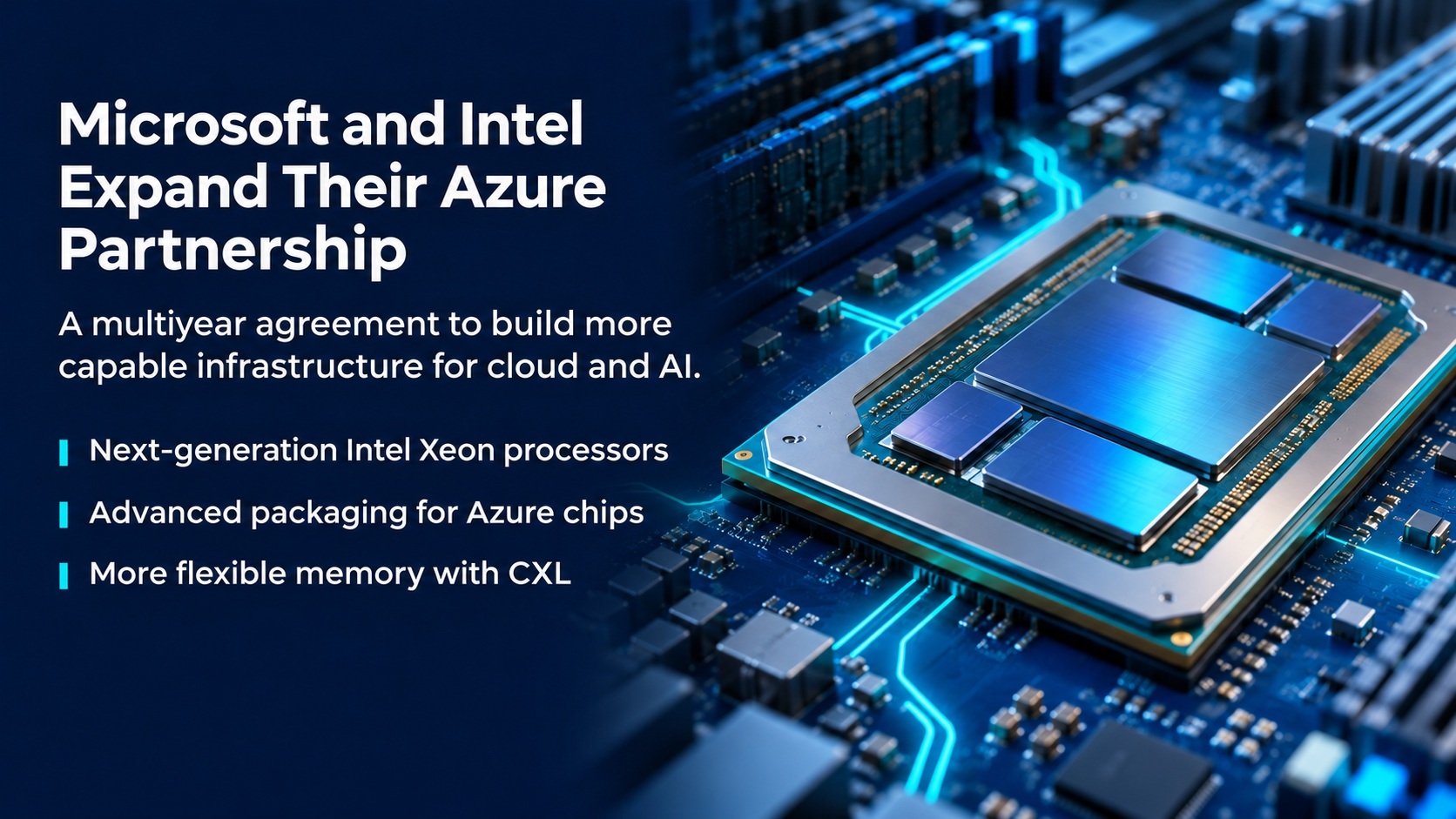

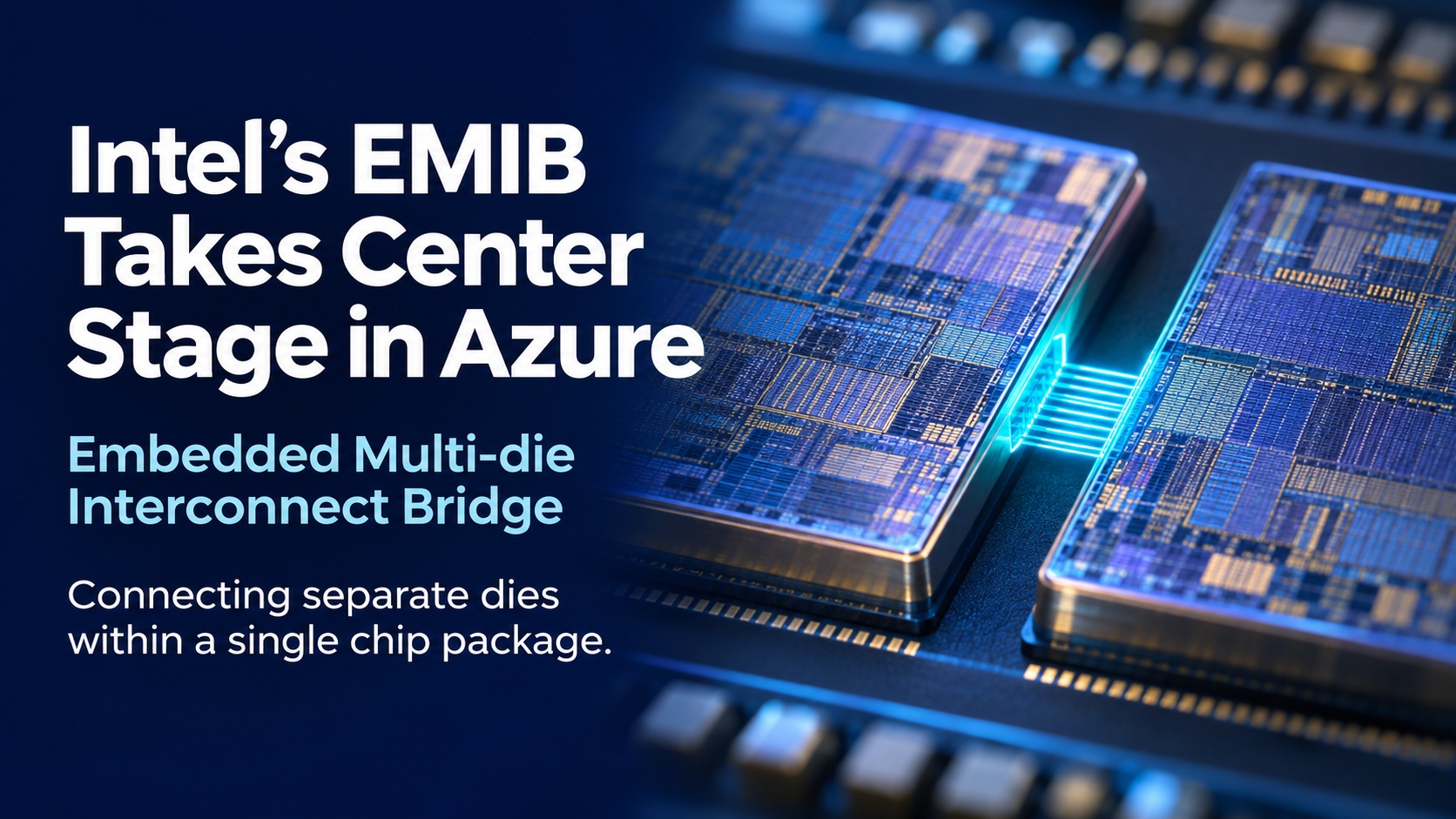
Microsoft and Intel are expanding their decades-long partnership, and the most consequential part of the multiyear agreement may be how Microsoft puts its future Azure chips together. Microsoft is the first company to announce plans to use Intel Foundry’s Embedded Multi-die Interconnect Bridge, or EMIB, for silicon it designs for Azure. The technology gives Microsoft more freedom to combine different pieces of silicon within one package and tailor those designs to the demands of its cloud and AI services.
EMIB uses a small bridge embedded in the chip package to connect separate dies, the individual pieces of silicon that perform different functions. Think of a design that needs one die for computation and another to handle connections to the rest of the system. A bridge lets the two exchange data across a short, dense connection inside the package. That gives engineers more flexibility to decide which functions belong together, which can be developed separately, and how much bandwidth they need between them.
That flexibility matters because cloud workloads put different demands on hardware. An AI service may spend much of its time moving data between memory and compute. Another application may need to handle frequent requests without letting response times climb. When Microsoft can make packaging decisions alongside its server and software designs, it has more ways to address those constraints. A future design could devote more resources to moving data where bandwidth is the bottleneck, for example. The opportunity is to design the connections between components as deliberately as the components themselves.
There’s also a longer-term design advantage. Breaking a design into dies gives engineers the option to revisit one part as requirements change while carrying forward parts that still meet their needs. A future generation might need a different balance of compute and connectivity, for instance. The ability to consider those changes at the package level gives Azure engineers more options as workloads evolve. The agreement brings Intel’s packaging expertise into that process alongside Microsoft’s knowledge of how its services run at cloud scale.
The broader deal gives Microsoft several other ways to improve Azure while that custom silicon work progresses. It secures multiyear supply capacity for Intel Xeon processors, including the next-generation Diamond Rapids family. The companies are also collaborating on more flexible server memory through Compute Express Link, faster SQL backups through Intel QuickAssist Technology, and support for moving confidential virtual machines between hosts while keeping memory and processor state encrypted. Those efforts can benefit customers through more flexible virtual machine configurations, shorter backup windows, and easier maintenance for sensitive workloads.
Why it matters
Cloud customers will experience the value of EMIB through the Azure services built on it. If packaging gives a workload a faster path between the components it uses most, customers could see that translate into more work completed in the same amount of time or more consistent performance as demand rises. Those outcomes would matter to a team scaling an AI service as much as they would to a team trying to keep an established application responsive during its busiest hours.
Bottom line: For Intel Foundry, Microsoft’s announcement puts EMIB on the roadmap of a major cloud provider’s own silicon program. For Microsoft, it expands the set of design choices available when a workload pushes against the limits of existing hardware. The companies have yet to detail which Azure services will use the packaged silicon or what gains customers should expect. The reason for optimism is the specificity of the opportunity. Microsoft knows where its cloud workloads strain today’s systems, and Intel brings a way to change how the silicon inside those systems fits together. Designing those pieces together gives Azure a practical route to making future infrastructure faster and more efficient as customer needs evolve.
Also Read:
Intel’s Tiny Bridges Could Lead to Very Big Paychecks
How AI is Reshaping Semiconductor Design and Manufacturing
Why America’s Semiconductor Manufacturing Capacity Matters
Share this post via:


Comments
There are no comments yet.
You must register or log in to view/post comments.