





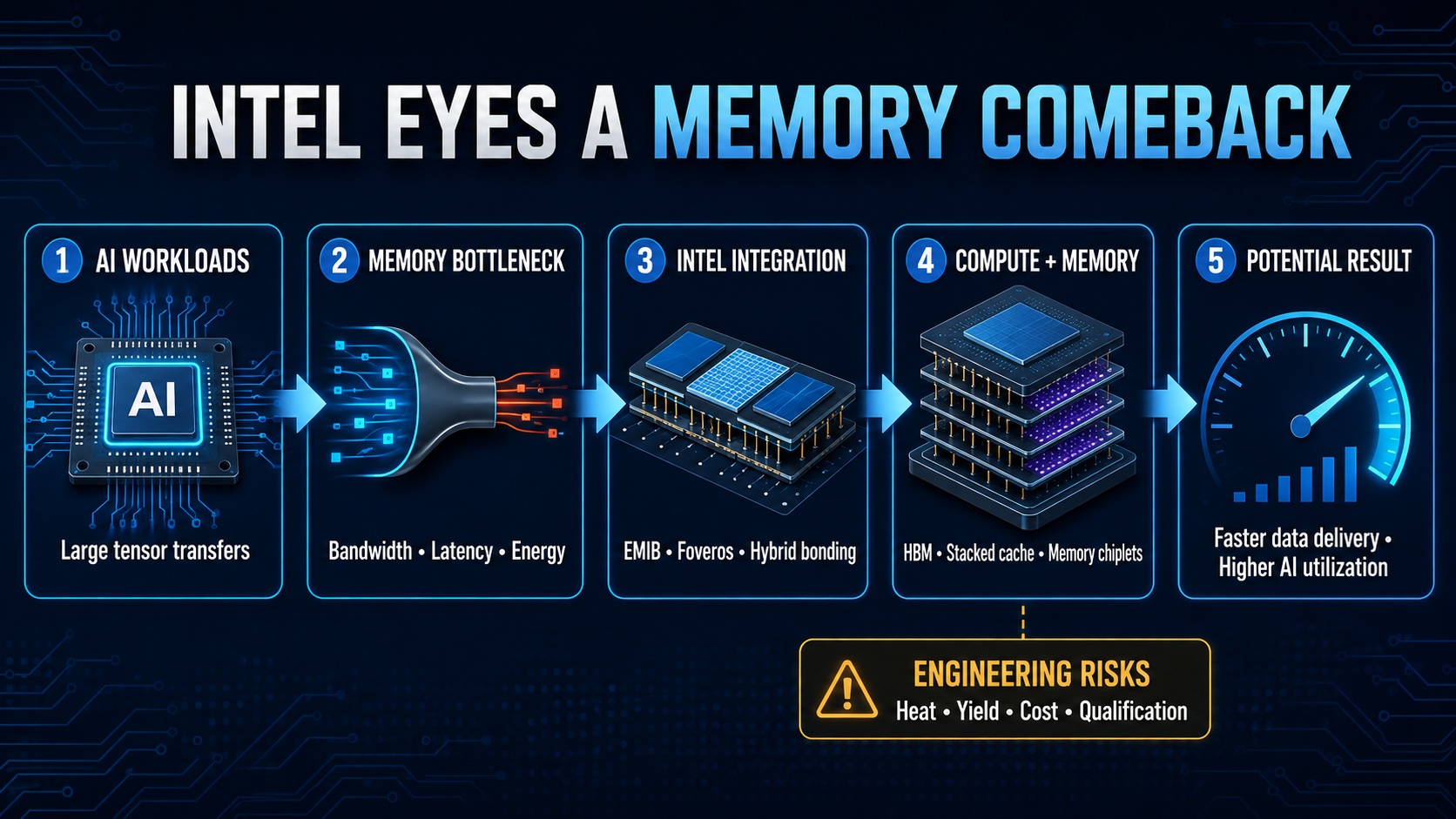
Intel is considering a return to memory technology decades after abandoning mainstream DRAM and, more recently, selling its NAND business. Chief executive Lip-Bu Tan has argued that memory should no longer be viewed simply as a low-margin commodity. Artificial intelligence is turning bandwidth, latency and data movement into primary determinants of system performance, creating an opening for architectures that integrate memory more closely with processors.
The idea would reconnect Intel with its origins. Founded in 1968 as a memory company, Intel produced early SRAM and DRAM devices before Japanese competition and deteriorating margins drove its transition toward microprocessors during the 1980s. Its later storage strategy included NAND flash and 3D XPoint-based Optane products. Neither produced a durable position: Intel agreed to sell its NAND and SSD operation to SK Hynix in 2020, with the business subsequently becoming Solidigm, while Optane was discontinued after limited adoption.
A new effort would probably differ substantially from those earlier businesses. Entering conventional DDR DRAM or NAND production would place Intel against Samsung, SK Hynix and Micron, companies possessing specialized process technology, enormous fabrication capacity and mature customer relationships. Instead, Intel’s opportunity lies at the boundary between compute, memory and advanced packaging.
AI accelerators repeatedly move large tensors between processing units and memory. Because arithmetic throughput has increased faster than off-chip bandwidth, many workloads are constrained by data delivery rather than computation. High-bandwidth memory addresses this imbalance by stacking DRAM dies vertically with through-silicon vias and connecting multiple stacks to a processor over extremely wide interfaces. The result is much higher bandwidth and lower energy per transferred bit than conventional DIMMs, although capacity, thermals, packaging complexity and cost remain significant constraints.
Tan has specifically raised the possibility of stacking memory directly with processors. Technically, that could encompass several approaches: placing HBM stacks beside compute tiles, bonding cache or memory dies above logic, or developing specialized embedded-memory chiplets. Shorter interconnects reduce capacitance and power while enabling thousands of parallel signal paths. The trade-offs are difficult. Memory positioned above hot CPU or accelerator cores faces thermal limits, and combining dies makes yield, testing and repair more complicated. Logic and DRAM also favor different fabrication processes, making heterogeneous integration more practical than manufacturing both on one monolithic die.
Intel already owns useful integration technology. Its EMIB platform embeds silicon bridges in the package substrate to connect logic and HBM without requiring a full-size silicon interposer. EMIB-T adds through-silicon vias for power delivery and signal routing, while Foveros Direct uses fine-pitch hybrid bonding for vertical die stacking. Intel says its planned 18A-PT process can connect to a top die at an interconnect pitch below five micrometres. These capabilities could let Intel supply complete compute-memory packages even if an external manufacturer produced the DRAM dies.
The recruitment of former SK Hynix chief executive Seok-Hee Lee adds credibility to the exploration, but Intel has not announced a product, fabrication plan or commercial timetable. A full return to memory manufacturing would demand billions of dollars, extensive process development and long qualification cycles. It could also distract from Intel’s processor roadmap and the difficult expansion of its foundry business.
The more plausible strategy is therefore not a simple revival of commodity memory. Intel could pursue differentiated cache, stacked-memory or packaging products that improve effective bandwidth for AI systems. It might co-design memory interfaces with CPUs and accelerators, manufacture selected logic or controller dies, and integrate third-party HBM through EMIB or Foveros.
Bottom Line: Intel’s prospective comeback is ultimately a systems-engineering bet. In contemporary AI hardware, the winning processor is not necessarily the chip with the most arithmetic units; it is the platform that keeps those units supplied with data. If Intel can turn packaging, interconnect and memory architecture into one optimized system, memory could again become central to its identity—without repeating the commodity-market battles that forced its original exit.
Also Read:
Comparing Intel EMIB and Intel Foveros
Intel Foundry and the DAC2026 Ecosystem
TSMC CoPoS Versus Intel EMIB Semiconductor Packaging
Share this post via:



Comments
There are no comments yet.
You must register or log in to view/post comments.