



While AI is transforming nearly every industry, some of its most significant advances are happening inside the semiconductor factories building the chips that power it. If you design AI systems, those manufacturing advances directly influence your performance, efficiency, and path to market.
The message from the recent Global Semiconductor Alliance European Executive Forum was clear: Scaling AI requires more than smaller transistors. You must also address power delivery, connectivity, advanced packaging, and supply chain resilience. These factors increasingly determine how effectively you can turn silicon innovation into system performance.
According to a presentation by Prashanth Aprameyan, Intel Foundry supports this strategy on two fronts: Advanced process and packaging technologies that enable more capable systems, and AI-enabled manufacturing that improves quality and accelerates yield learning.
Three forces shaping your designs
Three AI trends are changing what you need from silicon.
Agentic AI introduces multistep reasoning workloads that are less predictable than traditional computing. As you deploy autonomous agents, efficient power delivery and high-performance connectivity become essential to scaling their capabilities.
Physical AI brings intelligence into edge devices and real-world systems. You need architectures that balance capability, efficiency, and cost, supported by manufacturing approaches that use automation and modeling to improve yield.
Sovereign AI adds another consideration: where and how your chips are manufactured. Secure, resilient, geographically diverse supply chains support business continuity and national security requirements. Intel Foundry’s capabilities across North America, Europe, and Asia give you greater flexibility in choosing manufacturing locations.
Scaling your entire system
You are no longer limited to integrating every function onto a single chip. Chiplet architectures let you combine specialized dies, memory stacks, and accelerators into a system of chips. This modular approach helps you scale performance and select the technology best suited to each function.
Transistor innovation remains essential. Intel 18A uses RibbonFET Gate-all-around technology to improve electrostatic control and support scaling beyond traditional FinFET architectures.
Power delivery also matters. With PowerVia, Intel 18A routes power through the back of the wafer, separating power paths from frontside signal routing. This reduces resistance, voltage drop, and power delivery noise. Combined with high-density metal-insulator-metal capacitors, the architecture strengthens power integrity and supports more efficient use of chip area.
You also need these improvements to remain economically practical. Intel Foundry balances backside power complexity with frontside lower-metal pitches that enable direct-print patterning, helping manage manufacturing costs while improving performance per watt.
As your systems become more modular, communication between dies becomes critical. Universal Chiplet Interconnect Express, or UCIe, provides standardized, high-bandwidth, low-latency connections that simplify chiplet integration.
Advanced packaging brings these elements together. Intel Foundry’s portfolio includes EMIB-T, Foveros, and Foveros Direct. EMIB-T incorporates power-transfer capabilities into its bridge structure and can remove the need for a full silicon interposer in many applications. Foveros Direct uses hybrid bonding to stack compute dies on optimized base dies, helping you balance performance, power efficiency, and total cost of ownership.
How AI improves your manufacturing outcomes
AI also helps address the complexity of manufacturing your designs. During design technology co-optimization, AI helps engineers explore large design spaces and evaluate tradeoffs among power, performance, and area.
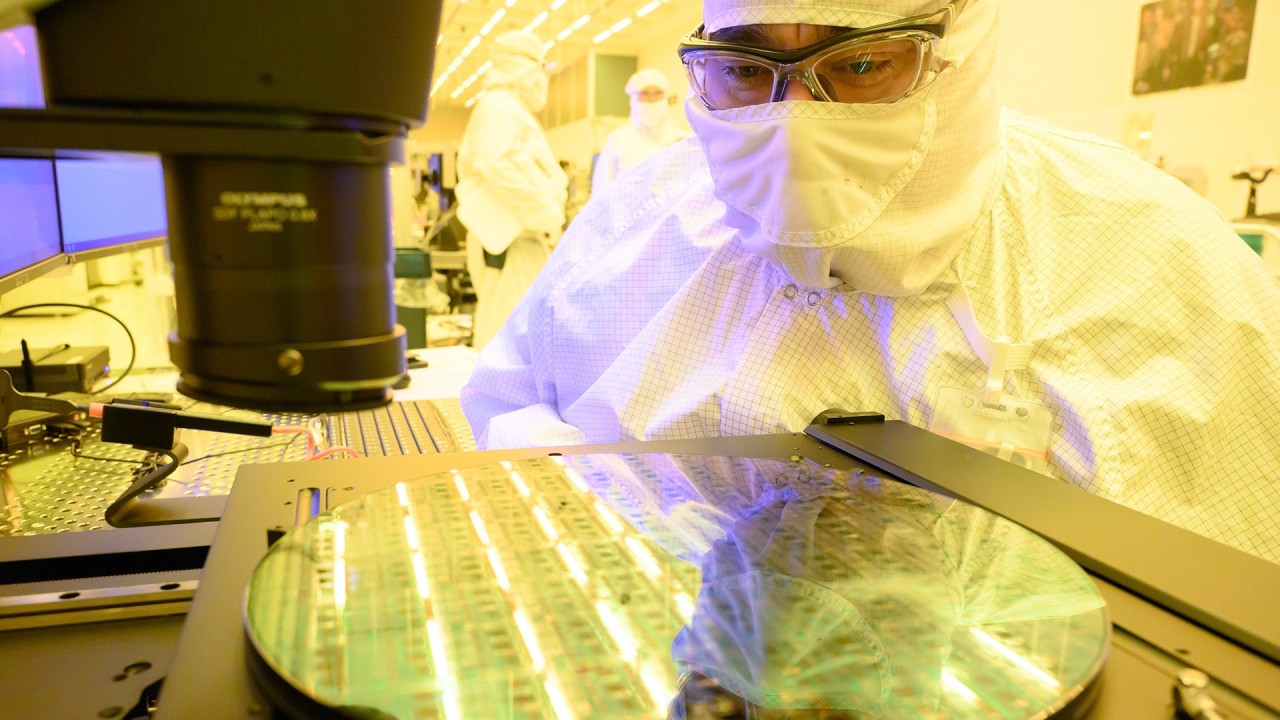
Intel Foundry’s factories collect nearly a billion images each week, generating petabytes of manufacturing data. Machine learning analyzes these images to detect defects, classify failure patterns, identify yield risks, and improve design rules. For your Intel 18A designs, these insights help surface potential layout issues earlier.
Neural networks and ensemble decision trees help isolate root causes and accelerate defect resolution. You benefit from faster learning cycles and more predictable yield progression as technologies enter production.
Digital twins and predictive maintenance monitor manufacturing equipment, identifying potential tool issues before they disrupt production and supporting continuous factory operations.
Bringing your next system to market
Your success depends on optimizing the entire platform. With advanced process technologies, packaging innovation, and AI-enabled manufacturing, you can build increasingly capable AI systems and bring them to market faster, more efficiently.
Explore your options at intel.com/foundry or contact foundry.contact@intel.com.
Also Read:
Intel’s Open Software Blueprint: Why Production AI Needs More Than GPUs
Data Center Energy Trends Force a Rethink of Chip Power Delivery
Intel Foundry: AI performance now depends on the whole system
Share this post via:


Comments
There are no comments yet.
You must register or log in to view/post comments.