





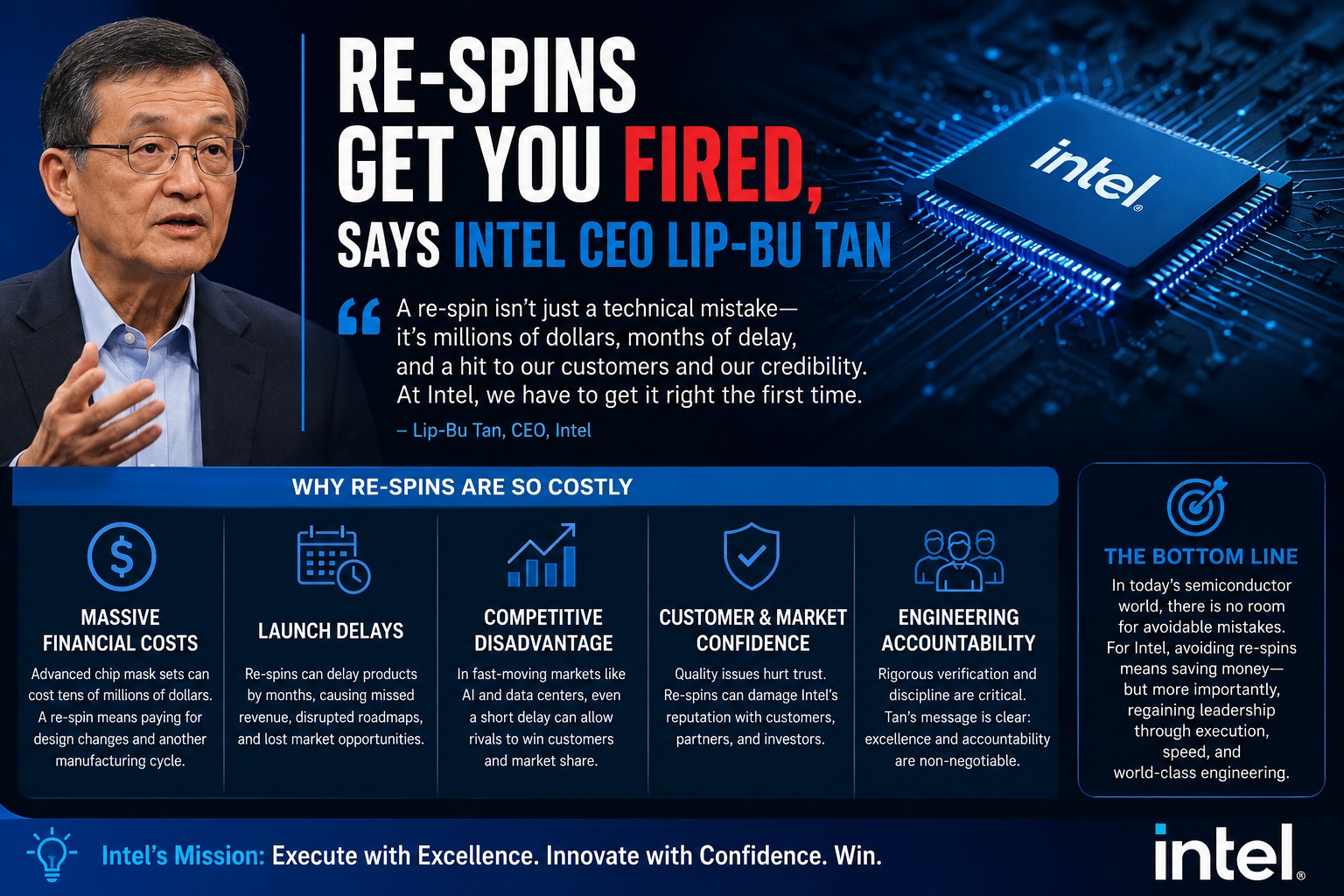
Intel CEO Lip-Bu Tan’s statement that “re-spins get you fired” reflects the enormous pressure facing semiconductor companies as chip complexity, manufacturing costs, and competitive demands continue to rise. In the semiconductor industry, a “re-spin” occurs when a chip design must be revised and manufactured again because of errors discovered after tape-out or during silicon validation. These mistakes can cost millions of dollars, delay product launches by months, and damage customer confidence. Tan’s warning highlights how critical execution has become for Intel as it attempts to regain leadership in the global semiconductor industry.
“I have a culture right now I have just implemented. It has to be A0 to production,” Tan told the JP Morgan Global Technology, Media and Communications Conference, “A0 is when you tape out, first time pass. Intel does not have that culture, so I tell that, first time pass A0. B0, you keep your job. Anything above that, you are fired.”
“People initially thought that I’m just joking,” he told the J P Morgan conference, “now I started to implement, they started to say that, ‘Okay, Lip-Bu, you are very serious, you really look into all the design, all the bugs that we’ve tried to fix, and then all the IP that we use. You make sure that we certify and make sure we do that before we go to tape-out.”
“Those are kind of the culture we need to have,” said Tan.
Intel built its dominance on engineering excellence and manufacturing discipline. For decades, the company led the industry through advanced process technology and strong x86 processor designs. However, in recent years Intel struggled with manufacturing delays, roadmap changes, and execution problems that allowed competitors such as AMD, NVIDIA, and TSMC to gain significant ground. Under Tan’s leadership, Intel is trying to restore confidence among customers, investors, and partners. His comments about re-spins send a clear internal message that costly design mistakes are unacceptable.
The financial consequences of a chip re-spin are severe. Modern semiconductors contain billions of transistors and are produced using extremely advanced manufacturing nodes. Mask sets for leading-edge chips can cost tens of millions of dollars, especially at technologies such as 3nm and 2nm. If a flaw is discovered after production begins, engineers may need to redesign parts of the chip and restart portions of the manufacturing cycle. This creates additional expenses while delaying product launches and reducing competitiveness.
Timing is especially important in high-growth markets such as artificial intelligence, cloud computing, and advanced data centers. Missing a product launch window by even a few months can shift market share to rivals. Intel has already experienced this challenge while competitors accelerated their positions in AI accelerators and high-performance computing. Tan’s statement reflects the reality that execution speed and product reliability are now strategic weapons in the semiconductor business.
The complexity of chip design also means that verification and validation have become more important than ever. Modern processors require coordination among thousands of engineers working across architecture, software, packaging, manufacturing, and testing. Detecting errors before tape-out is critical because correcting them later becomes dramatically more expensive. By emphasizing accountability, Tan is reinforcing the need for rigorous engineering discipline throughout Intel’s development process.
However, some critics might argue that such a strong message risks creating a culture driven by fear rather than innovation. Semiconductor design is one of the most difficult engineering disciplines in the world, and even the best companies encounter technical setbacks. Excessive pressure can discourage engineers from taking necessary risks or experimenting with bold new ideas. Successful leadership requires balancing accountability with an environment that still encourages innovation and collaboration.
Nevertheless, Intel’s current situation explains why management is emphasizing flawless execution. The company is investing heavily in manufacturing expansion, advanced packaging, and foundry services while attempting to compete aggressively in AI and high-performance computing. Customers and investors are closely monitoring whether Intel can execute its roadmap successfully. In this environment, re-spins are more than technical errors; they represent delays, lost revenue, and reduced confidence.
Bottom line: Lip-Bu Tan’s statement symbolizes the harsh realities of today’s semiconductor industry. As chip development becomes more expensive and competition intensifies, companies cannot afford repeated mistakes. For Intel, avoiding re-spins is not only about reducing costs but also about restoring credibility, accelerating innovation, and proving that the company can once again lead the semiconductor industry through disciplined execution and engineering excellence.
Also Read:
ASML High-NA EUV is Not Ready for High-Volume Production
Elon Musk Needs to Put His Fab Money Where his Mouth is!
Is Intel About to Take Flight?
Share this post via:



Comments
There are no comments yet.
You must register or log in to view/post comments.