





The semiconductor industry creates increasingly complex SoC and chiplets using lots of IP and all of that IP needs to be characterized at the cell level. As we design with 3nm and 2nm nodes, the sheer volume of data required for accurate static timing analysis (STA) is greatly increasing. Modern design flows rely on characterized .lib models for everything from standard cells to complex memories, however using the traditional brute-force SPICE approach is taking too much time. Engineers are facing characterization cycles that stretch into weeks, consumed by the massive simulation demands of Liberty Variation Format (LVF) and the need to characterize over hundreds of PVT corners.
Siemens EDA recently addressed this challenge with the expansion of its Solido Characterization Suite, introducing AI-powered tools designed to accelerate the library lifecycle from generation to validation. The era of manual, schedule-volatile characterization is ending, replaced by generative and agentic AI workflows.
At the heart of the suite is the new Solido Characterizer. For foundries and design teams, the goal is to provide faster throughput without sacrificing SPICE-level accuracy. Siemens has achieved a 7x greater throughput by combining two critical innovations: an AI-driven characterization engine and the industry’s first purpose-built library simulator, Solido LibSPICE.
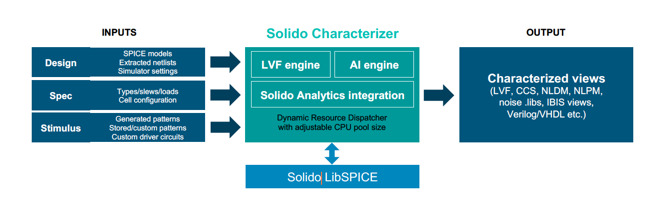
Solido LibSPICE provides a 2x+ performance boost by optimizing simulations specifically for library IP. When paired with the suite’s advanced LVF techniques that achieve a 5x speedup on their own, the result is a reduction in the simulation phase of characterization. Early adopters like GlobalFoundries have already noted that the tool maintains production accuracy while enabling speedups within internal flows.
While Characterizer handles the initial SPICE-backed circuit simulations, Solido Generator is where the scale happens. Generator uses machine learning to build an analytical model of a library based on “anchor” PVT corners. Once the model is trained, it can produce new PVT .libs in just minutes, performing at speeds 100x+ faster than SPICE.
This is a new methodology for multi-corner libraries. Instead of running SPICE for every single voltage and temperature variation, Generator uses reinforcement learning to adaptively model the space, boosting accuracy where it’s most critical while saving simulation time elsewhere. It supports all standard data structures, including NLDM, CCS, and LVF, ensuring that the AI-generated models are signoff-ready.
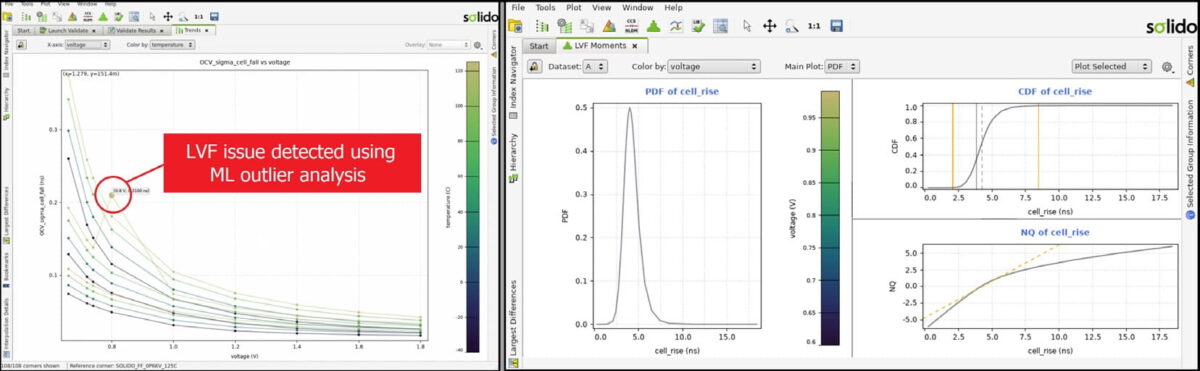
Speed is not helpful if the data is flawed, and at advanced nodes, errors can be increasingly subtle. Solido Analytics replaces the multi-week manual verification process with an AI outlier detection engine that can validate a library in just a few hours.
Traditional rule-based checks often miss spikes or noise results in LVF data, which can impact timing by 100% or more at 3nm. Solido Analytics uses advanced information visualization and automated analysis to find issues undetectable by traditional methods. It even allows engineers to visualize LVF moments, like standard deviation and skewness through probability density functions and normal quantile plots, making complex statistical data much more intuitive.
The suite isn’t just for the characterization teams, it’s also for the IP users. The Solido Library Profiler allows physical design teams to perform PPA (Power, Performance, Area) comparisons across different libraries early in the flow, so your team can choose the best library.
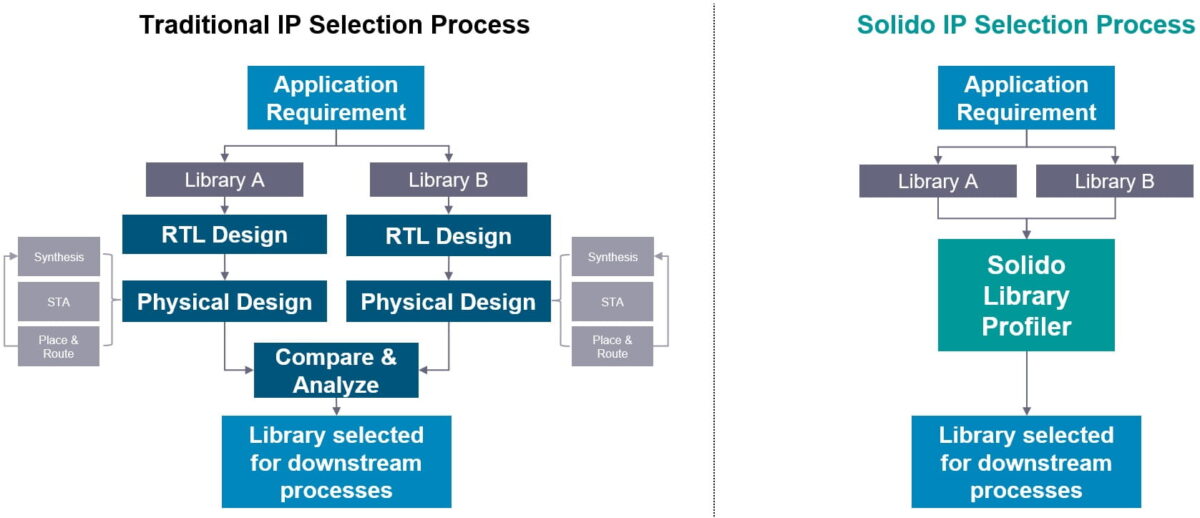
Selecting the right IP can require running multiple iterative cycles of synthesis and Place & Route (P&R), which is incredibly resource-intensive. Library Profiler uses smart auto-alignment to map differences down to the pin and arc level, allowing teams to choose the optimal library before they ever kick off an STA run. This effectively eliminates a major bottleneck in the early design phase.
The most powerful development is the integration of the Fuse EDA AI system, which brings generative and agentic AI capabilities to the suite. This allows for a more live debugging experience, where the software can pinpoint issues, monitor in-progress runs, and even suggest informed re-runs to maximize productivity.
Moving toward even more complex modeling standards, the Solido Characterization Suite provides a scalable, cloud-ready framework that is capable of running on tens of thousands of CPUs in order to meet the project schedule. This shift to AI-driven characterization isn’t just a luxury, it’s a necessary methodology to keep the semiconductor roadmap on track.
Summary
There’s a better way to perform library characterization using AI techniques from Siemens called the Solido Characterizer, promising faster characterization times while preserving accuracy. Your teams can build and deliver LVF libraries in record time using statistical characterization that reduces the number of required simulations. Generator techniques create portions of the library with AI, instead of using full SPICE characterization, while keeping SPICE in the loop.
The new Solido LibSPICE simulator is optimized for characterization, providing a 2x speed up. Debugging of Liberty files becomes more productive using Solido Analytics. Running characterization in the cloud with AWS and Azure provide the scale to meet your schedules.
Related Blogs
- Custom IC Design using Additive Learning
- Accelerating SRAM Design Cycles: MediaTek’s Adoption of Siemens EDA’s Additive AI Technology at TSMC OIP 2025
- Why chip design needs industrial-grade EDA AI




Comments
There are no comments yet.
You must register or log in to view/post comments.