





Review the specifications of any state-of-the-art microcontroller and you will discover the high dynamic current the device can consume. Examining the high clock rates and low tolerable voltage drop will lead you to the all-important power delivery network, or PDN. Components here include power planes, layer stack-up, decoupling capacitors, and a voltage regulator module. The quality of the PDN can have a big impact on overall product performance. The goal is to deliver a stable supply voltage with low voltage drop across the entire specified temperature range throughout the product’s lifetime.
Getting all this right can be quite daunting. Siemens recently released a white paper on this topic. Predominant failure mechanisms for PDN designs are discussed, along with how to avoid them. There is a lot of great information here. A link is coming so you can get the whole story but first let’s see what exploring the hidden complexity of modern power electronics design reveals in this Siemens white paper.
What’s at Stake
An improperly designed PDN can create many issues, some immediate and others are like a ticking time bomb. An example is high voltage drop due to narrow traces. In this case, the result is reduced timing margin that can cause products to fail. This effect may not manifest at room temperature but rather at higher temperatures or after years of field operation. The impact of such field failures is unforeseeable but can be avoided by applying the capabilities of integrated simulation tools.
It’s important to note that the interaction between electrical, thermal, and reliability constraints is far more complex than most traditional workflows can typically capture. In addition, it’s crucial to understand PDN modelling to ensure efficiency during the design process and to guarantee deterministic behavior across all load states and switching events.
The white paper goes on to point out that the journey from a perfect schematic to field failures is not intuitive, but the significant amount of design constraints increases the complexity for modern power electronics. For example, even a simple current-mode pulse-width-modulated controller, such as the LM5020 has about 40 explicit design constraints for using the part. Not handling those constraints across the electrical, thermal, mechanical, and manufacturing domains, along with the associated complexity, can lead to field failures.
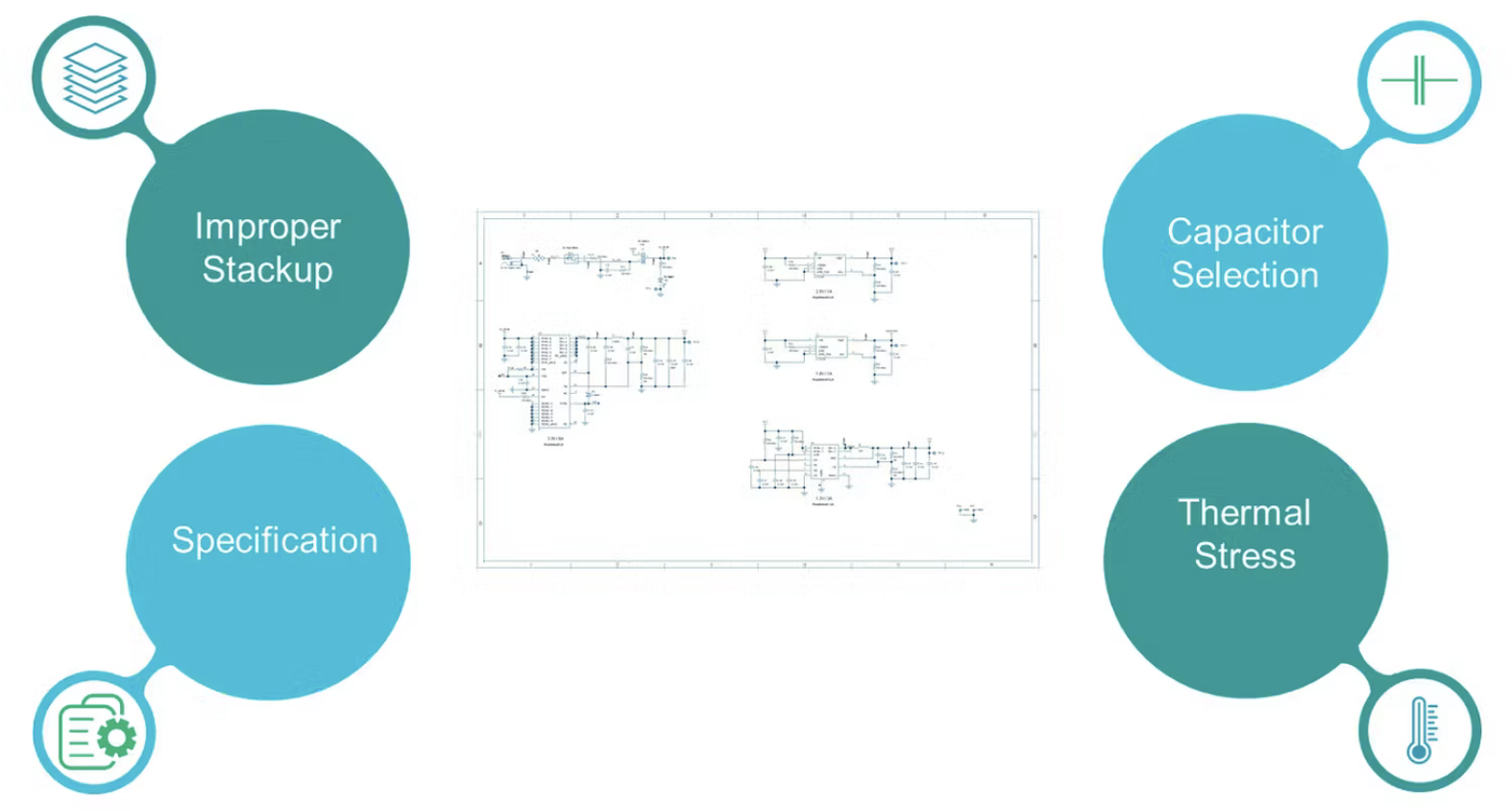
With this backdrop, the white paper discusses the four predominant PDN failure mechanisms to illustrate the necessity of a highly integrated design and verification flow. The graphic at the top of this post summarizes those four failure mechanisms.
What to Focus On
Here is a short summary of the PDN failure mechanisms discussed in the white paper.
1) Improper stackup: Printed circuit board (PCB) failures often originate from insufficient control of the PDN, whose impedance must remain low across a wide frequency range to ensure stable IC supply conditions. The white paper explains that PDN behavior is strongly influenced by layer stackup configuration, dielectric spacing, power-plane geometry, and decoupling-capacitor placement.
Improper choices in these areas leads to increased impedance, resonant peaks, and voltage ripple, all of which reduce design margin and increase susceptibility to field failures.
2) Capacitor selection: While layer stack-up and power-plane spacing define the baseline impedance profile of the PDN, the white paper points out that impedance is not static over the system lifetime. In addition to geometry-induced resonances, time- and temperature-dependent degradation of decoupling capacitors progressively alters the PDN characteristics and dominates long-term reliability and failure behavior.
3) Thermal and environmental stress: Beyond purely electrical phenomena such as PDN resonances and decoupling degradation, the white paper also points out that long-term system reliability is governed by a broader set of interacting effects. Here, mechanical, thermal, and environmental stressors couple with electrical loading and material properties, giving rise to cumulative damage mechanisms that cannot be captured by electrical analysis alone.
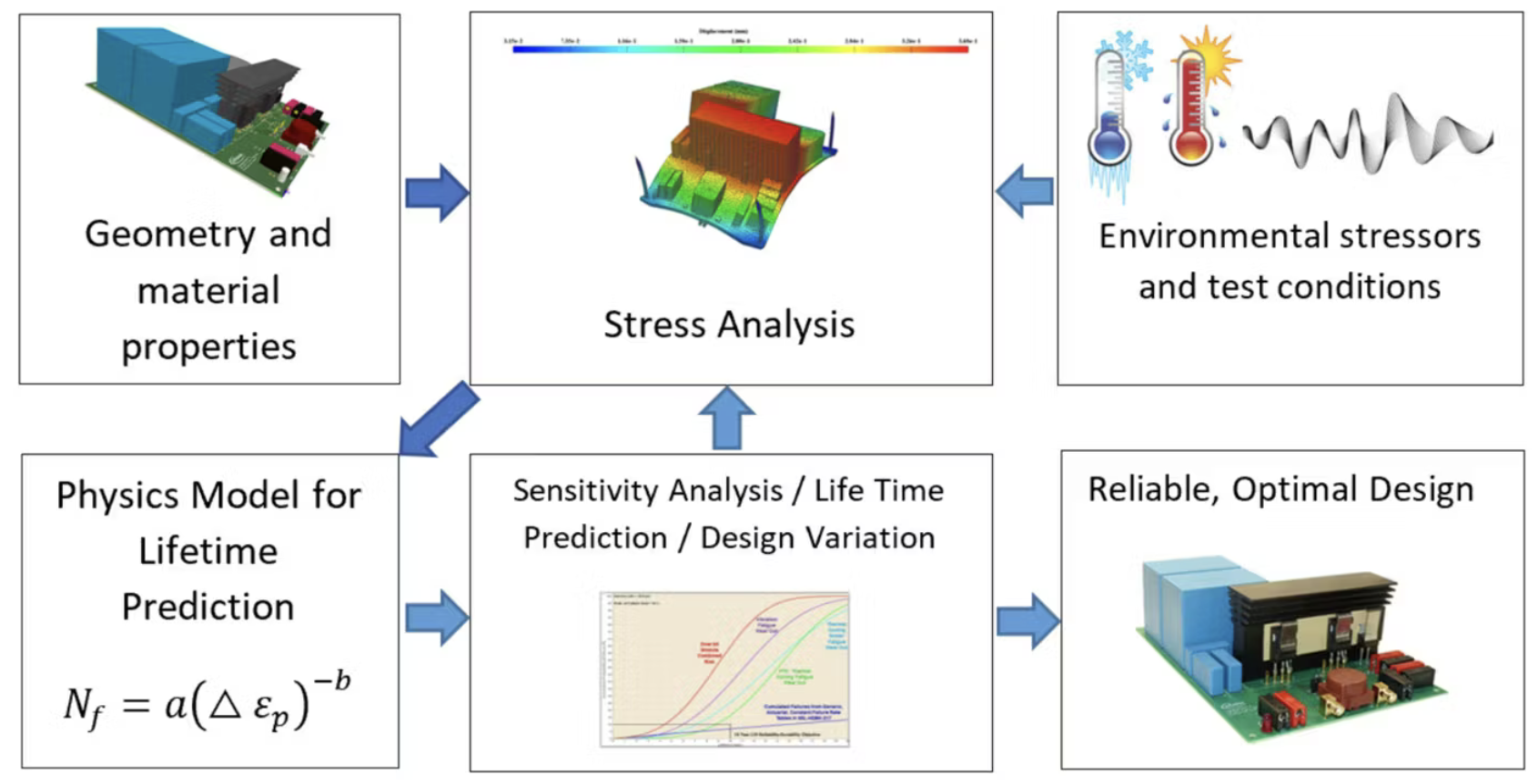
The white paper presents a physics of failure (PoF)-based methodology for predicting the lifetime of power electronics at the PCB level during early design stages. There are a lot of details covered in this approach. A summary of the methodology is shown below to give you an idea of what’s involved.
4) Using components out of the specification: After addressing electrical, mechanical, and aging-related failure mechanisms at the system level, the white paper revisits failures that originate directly from component operating conditions. It is pointed out that operation beyond specified electrical and thermal limits remains a dominant root cause of semiconductor failures and directly constrains PDN design and verification. The dominant failure mechanisms for this class of issues are discussed, along with approaches to address them.
To Learn More
A concluding comment from the white paper is that power electronics has moved beyond simple schematic-driven design. The complexity of modern systems demands automated, multi-domain, simulation-driven workflows that drastically reduce manual effort and improve reliability.
This white paper provides an excellent overview of the key issues designers will face and practical guidance on approaches to address these issues. If you are faced with PDN design challenges this is a must-read white paper. You can get your copy here. And that is what’s involved in exploring the hidden complexity of modern power electronics design.
Also Read:
Siemens Wins Best in Show Award at Chiplet Summit and Targets Broad 3D IC Design Enablement
Siemens Fuse EDA AI Agent Releases to Orchestrate Agentic Semiconductor and PCB Design
Accelerating Computational Lithography Using Massively Parallel GPU Rasterizer
Share this post via:



Comments
There are no comments yet.
You must register or log in to view/post comments.