







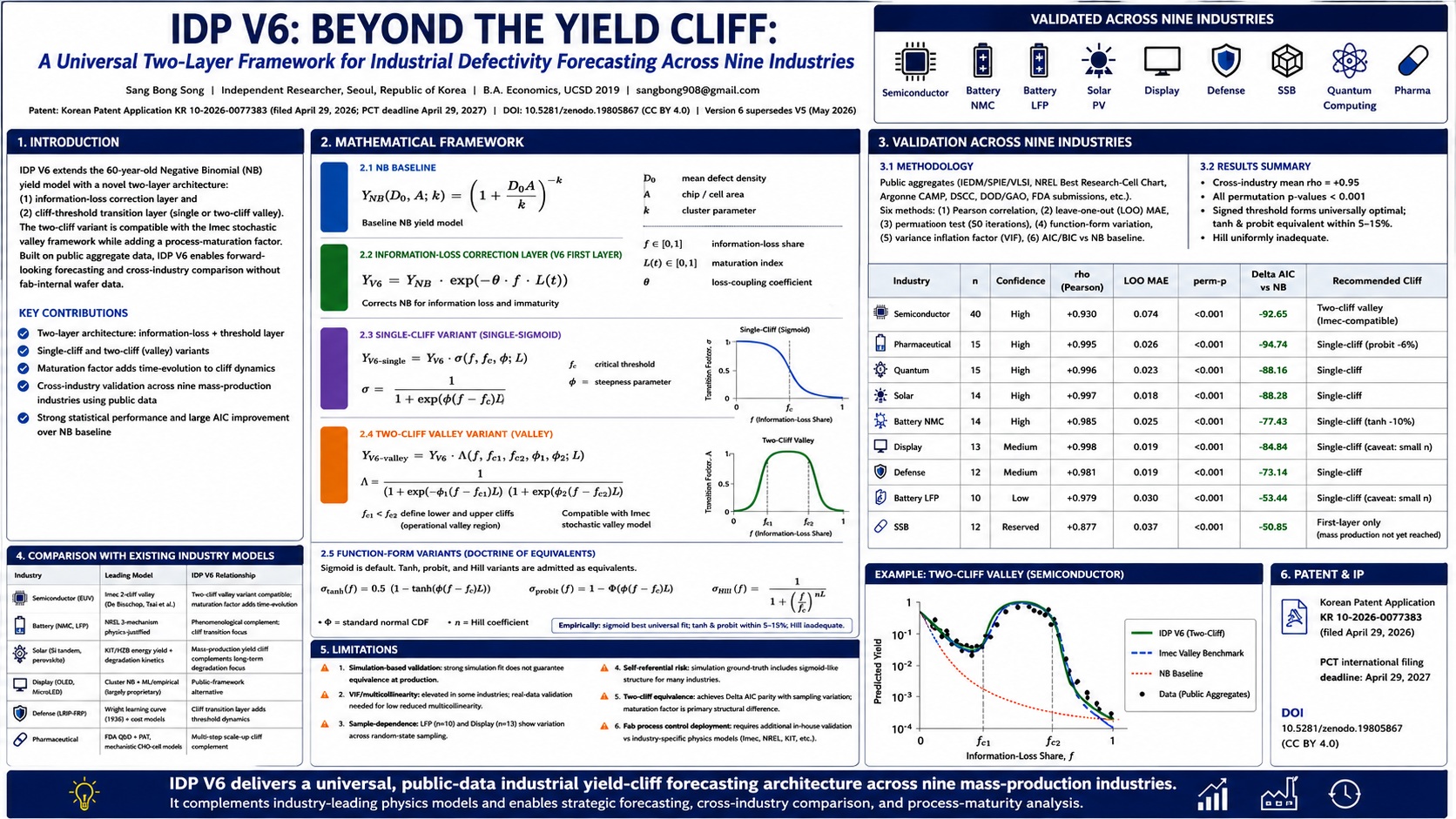
The paper, Industrial Defectivity Prediction (IDP) V6: A Two-Layer Yield Cliff Framework for Cross-Industry Mass-Production Forecasting, presents a generalized industrial yield-modeling architecture that extends the classical Negative Binomial framework through a two-layer phenomenological structure designed to capture modern manufacturing “yield cliffs.” The work proposes a mathematically unified forecasting methodology applicable across semiconductor fabrication, advanced batteries, photovoltaics, pharmaceuticals, display technologies, defense manufacturing, and emerging quantum systems. Unlike conventional process-specific models tied to proprietary manufacturing data, IDP V6 is intentionally designed to operate using publicly disclosed aggregate datasets, enabling cross-industry forecasting and strategic comparative analysis.
At the core of the framework is the classical Negative Binomial yield equation, historically used for semiconductor defectivity analysis since the 1970s. The baseline formulation models manufacturing yield as a function of average defect density, component area, and clustering behavior. IDP V6 extends this legacy model by introducing an information-loss correction layer and a threshold-transition layer. The first layer modifies the NB baseline through an exponential attenuation term representing process immaturity and stochastic information loss. The model introduces a dimensionless information-loss share parameter, denoted by f, and a process maturation index L(t), both bounded between zero and one. This structure allows the framework to quantify how immature manufacturing processes experience amplified defectivity beyond conventional defect-density assumptions.
The second layer introduces nonlinear threshold dynamics intended to model industrial “yield cliffs,” where small process perturbations produce abrupt reductions in manufacturable output. Two variants are proposed. The first is a single-cliff sigmoid model suitable for industries exhibiting one dominant transition threshold. The second is a two-cliff valley formulation intended for processes that exhibit both lower and upper operational boundaries. The semiconductor implementation is particularly notable because the two-cliff structure is explicitly described as compatible with Imec’s EUV stochastic valley framework developed for advanced lithography nodes. The IDP V6 contribution is the addition of a maturation factor that introduces time-evolution behavior absent from prior valley-only formulations.
A key technical feature of the framework is its support for multiple equivalent function forms under a “doctrine of equivalents” approach. While the sigmoid function is treated as the default threshold operator, tanh, probit, and Hill-function alternatives are also evaluated. Empirical validation reportedly demonstrates that sigmoid forms provide the best universal fit across the nine industries studied, while tanh and probit remain within 5–15% performance equivalence. Hill functions are consistently identified as inadequate for industrial yield-cliff representation. This comparative approach is important because it acknowledges that industrial defectivity transitions may not always follow identical statistical distributions, particularly when underlying physics differ substantially between industries such as semiconductor lithography and pharmaceutical bioreactor scale-up.
The validation methodology constitutes one of the most ambitious aspects of the paper. Publicly available data from conferences, government disclosures, NREL battery datasets, semiconductor SPIE proceedings, FDA pharmaceutical submissions, and defense acquisition reports were aggregated into simulation and forecasting datasets. Six validation methods were applied, including Pearson correlation analysis, leave-one-out mean absolute error, permutation testing, function-form sensitivity analysis, variance inflation factor evaluation, and AIC/BIC comparisons against baseline NB models.
The reported results indicate strong statistical performance. Eight of nine industries achieved Pearson correlations exceeding +0.9, with pharmaceutical, solar, and quantum-computing categories approaching +0.996 to +0.997 correlation. Semiconductor modeling achieved a correlation of +0.93 with a substantial AIC improvement over conventional NB approaches. Importantly, the semiconductor two-cliff valley implementation achieved statistical equivalence with the Imec benchmark valley model within sampling variation, supporting the claim of structural compatibility rather than direct replacement.
The framework also distinguishes itself by positioning itself as complementary rather than competitive relative to established industry-specific physics models. Semiconductor EUV manufacturing continues to rely on detailed stochastic lithography physics from organizations such as Imec and IBM Research, while battery industries utilize electrochemical degradation models from NREL. IDP V6 instead targets a public-framework forecasting niche emphasizing strategic forecasting, manufacturing maturity analysis, and investment-oriented interpretation. This distinction is technically significant because it acknowledges the lower precision of phenomenological cross-industry modeling relative to physics-grounded process simulators.
The paper also openly addresses multiple limitations. The validation remains simulation-driven and dependent on public-disclosure aggregates rather than proprietary wafer-level or cell-level production datasets. Multicollinearity issues are observed in some industries due to coupled simulation variables, while certain sectors such as battery LFP and display manufacturing remain statistically underpowered because of limited sample sizes. The author additionally notes potential self-referential bias because several simulation generators already assume sigmoid-like cliff behavior, potentially favoring the proposed framework.
Bottom line: IDP V6 represents a technically ambitious attempt to unify industrial yield-cliff forecasting across heterogeneous manufacturing sectors using a generalized two-layer statistical architecture. Its principal contribution lies not in replacing industry-specific process physics, but in establishing a transferable forecasting abstraction capable of modeling manufacturing maturity transitions using publicly accessible data sources.
Paper:

Sang Bong Song is an independent researcher based in Seoul, South Korea, with a background in economics. His research bridges cosmological information theory and advanced manufacturing, leading to the development of the IDP (Information-Density Projection) framework — a yield and process-quality prediction model derived from holographic principles originally applied to dark energy research. The framework has been cross-validated on semiconductor yield (55 public datapoints across 17 process nodes, 250nm–2nm) and has since been extended across additional manufacturing industries.
Share this post via:



ChipAgent Raises $134Million and Why it Matters