






Many of us think of DAC as an important trade show for the Semiconductors and EDA industries. That is certainly part of the history of DAC, but the event is also a highly prestigious technical conference dating back to 1964. In fact, the exhibits at DAC began 20 years after the conference started. That long history as a premier technical conference attracts some world-class speakers.
This year, there is a robust agenda of topics and presentations. Some of those details were covered in a recent post by Dan Nenni on SemiWiki. I’ll focus here on the high-level presenters that will be at the event. I’ll finish with details of how to register for DAC, including some background on how a unique, free access pass came to be. Let’s take a look at the high-profile speakers presenting at #DAC2026.
Keynotes
Keynotes typically define the major focus areas for an event.
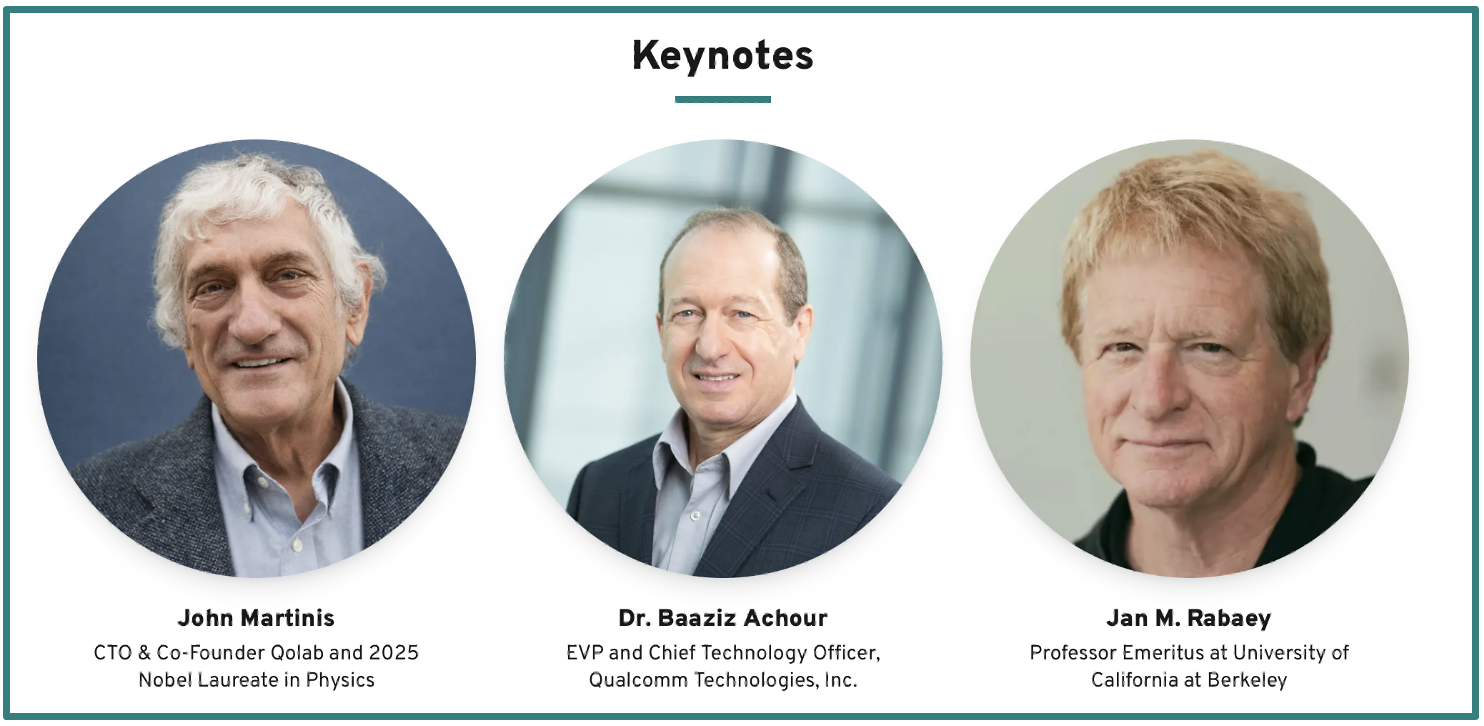
John Martinis is a distinguished physicist and 2025 Nobel Laureate in Physics, renowned for his pioneering contributions to superconducting quantum computing. His research has been central to developing high-fidelity qubits and engineering the architectures needed for scalable quantum processors. He previously led Google’s quantum hardware team, where his group achieved the landmark 2019 quantum supremacy experiment — the first demonstration of a quantum computer outperforming the world’s most powerful classical supercomputer on a computational task. In 2022, he co-founded Qolab, where he now serves as CTO and continues to advance next-generation superconducting qubit technology and quantum system design.
Baaziz Achour serves as Executive Vice President and Chief Technology Officer of Qualcomm Technologies, Inc. In this role he is responsible for global research and development activities associated with all technologies in QCT, Qualcomm’s semiconductor business, as well as overseeing the execution of enterprise-wide technical and product roadmaps across all business areas. He holds master’s and doctorate degrees in Electrical Engineering from Tufts University and has 24 granted U.S. patents in communications.
Jan Rabaey is Professor Emeritus of the EECS Department at the University of California at Berkeley, after being the holder of the Donald O. Pederson Distinguished Professorship at the same institute for over 30 years. He is a founding director of the Berkeley Wireless Research Center (BWRC), the Berkeley Ubiquitous SwarmLab, and the SIA-DARPA GSRC Center. He served as the Electrical Engineering Division Chair at Berkeley twice. From 2019 until 2025, he also served as the CTO of the System-Technology Co-Optimization (STCO) Division of IMEC, Belgium. I have been involved in EDA for a very long time, and I can tell you that Professor Rabaey’s research has impacted my work over the years many times.
SKYTalks
These presentations feature insights from industry leaders on topics related to EDA and advancements in technology, particularly focusing on AI and semiconductor innovation.
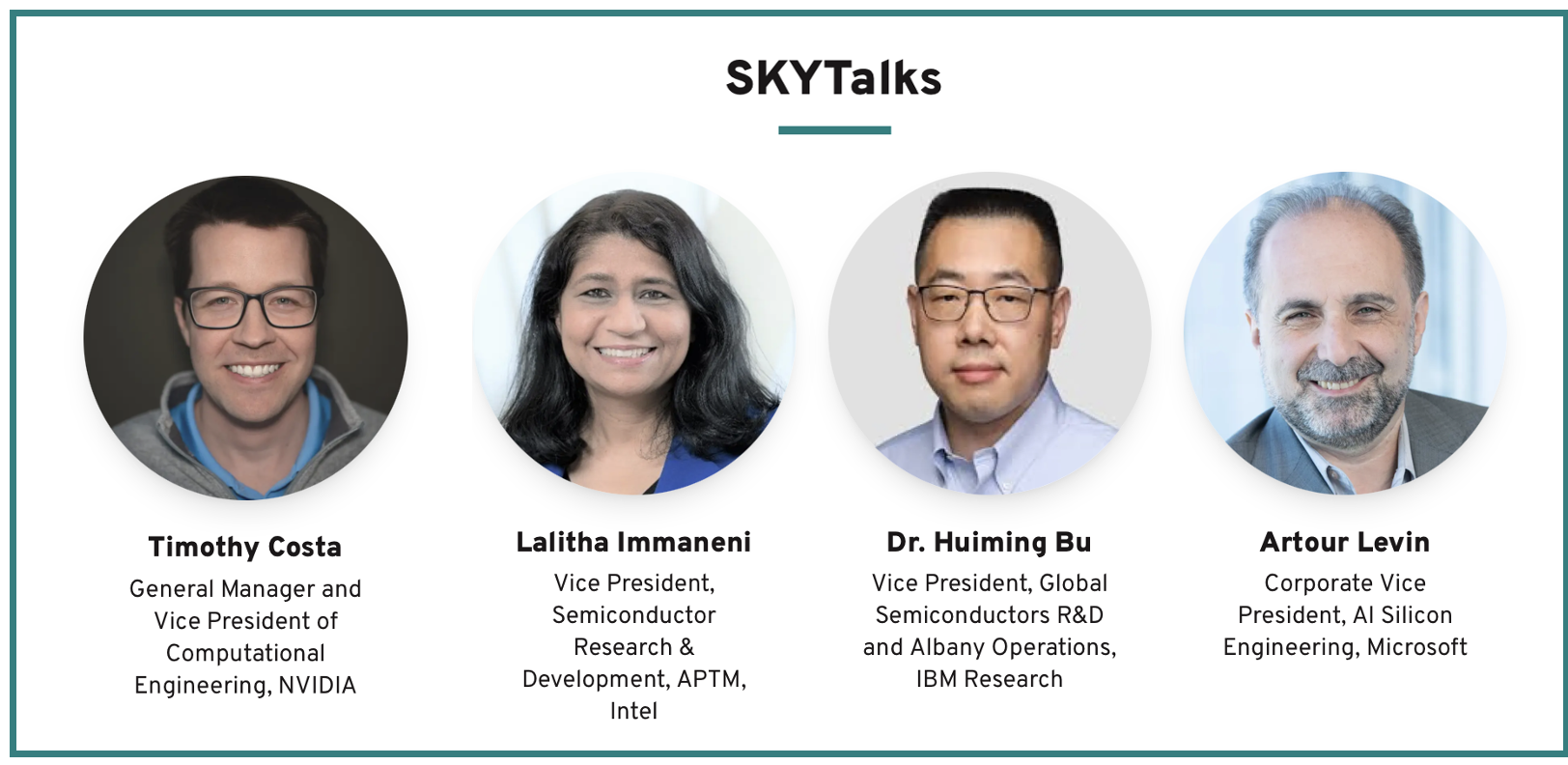
Timothy Costa will kick things off on Sunday. He is the General Manager for Industrial and Computational Engineering at NVIDIA, where he spearheads the strategic development and implementation of solutions for these critical industries. He has played a key role in shaping NVIDIA’s scientific computing offerings and driving innovation in the Quantum Computing industry. He holds a Ph.D. in Mathematics, focusing on numerical methods for modeling fluids and semiconductors.
Lalitha Immaneni is Vice President of Semiconductor Research & Development in the Assembly Test Technology Development organization for Intel Corporation. She manages a world class and diverse team of packaging architects, designers, and specialized engineers in the Advanced Design & Customer Enabling group, spanning multiple geographies. She leads the back end technical interface to Intel’s foundry customers. She is a renowned mentor and coach to countless engineers within and outside Intel.
Huiming Bu is vice president of IBM Global Semiconductors R&D and Albany Operation. He has 20+ years of professional experience in semiconductor technology R&D at IBM after he received his Ph.D. in Electrical Engineering from Yale University. He oversees R&D activities in advanced logic, chiplet and advanced packaging, emerging memory and analog AI hardware. He is also responsible for the IBM Research Albany site and fab operations. Huiming has authored/co-authored 100+ technical publications and holds 100+ patents in the semiconductor area.
Artour Levin serves as Corporate Vice President of AI Silicon Engineering at Microsoft Corporation, where he leads the company’s in-house team focused on defining and building advanced silicon AI acceleration technologies — custom hardware designed to power next-generation artificial intelligence workloads. His background combines deep technical knowledge in semiconductor design, system-level architecture, and AI hardware acceleration.
TechTalks
TechTalks aim to provide insights and practical knowledge to attendees about current trends and technologies in the field.
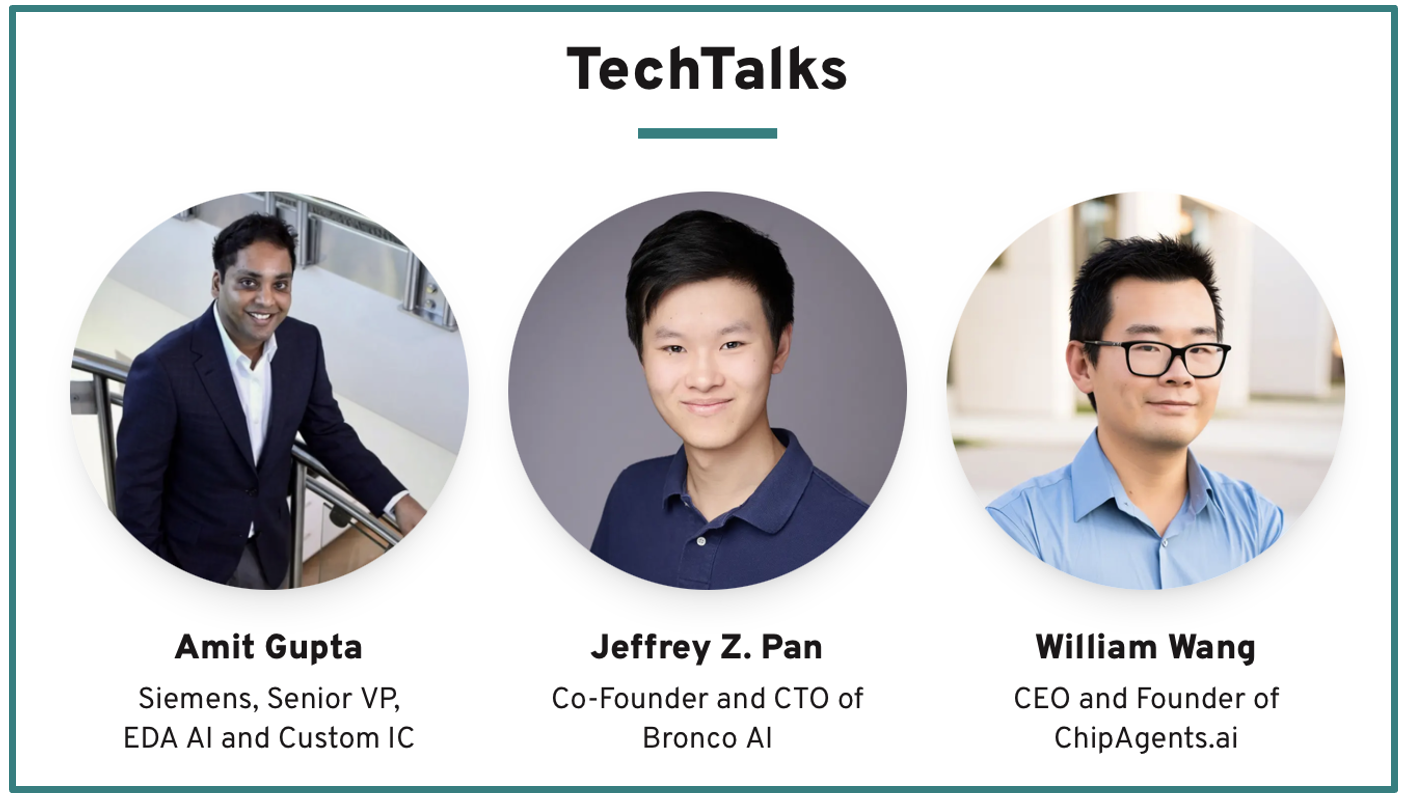
Amit Gupta is Senior Vice President and General Manager of the Solido Custom IC and Central AI divisions at Siemens EDA. He leads the strategic growth and development of Solido’s AI-powered solutions for variation-aware custom IC design, simulation, library characterization, and IP validation, as well as the Fuse EDA AI system. I personally know Amit. He is very smart, articulate and entrepreneurial. He has a presentation style that delivers substantial, ground-breaking information in an approachable and easy-to-understand way.
Jeffrey Pan is the cofounder and CTO of Bronco AI. At age 15, he was the youngest-ever author at CVPR (the highest-impact ML conference). He then won the MIT-IBM Best Paper Award at KDD’s AdvML (Adversarial ML) Workshop, and his real-time edge model won First Place in an international competition focusing on efficient ML and hardware-software co-design. He was then a founding member of an AI research team that deployed generative AI models to hundreds of millions of monthly active users before co-founding Bronco to bring AI to semiconductors and other fundamental industries.
William Wang is the CEO and Founder of ChipAgents.ai, the category leading agentic AI platform for advancing agent-based AI approaches for semiconductor workflows. He is also the Mellichamp Endowed Chair Professor of AI and Designs at UC Santa Barbara, and a global leader in fundamental AI research. He founded the UCSB Center for Responsible Machine Learning, the Mind and Machine Intelligence Initiative, and the UCSB NLP Group. His honors include the IEEE SPS Pierre-Simon Laplace Award, NSF CAREER Award, BCS Karen Sparck Jones Award, DARPA Young Faculty Award, and IEEE AI’s 10 to Watch.
Analyst Reviews
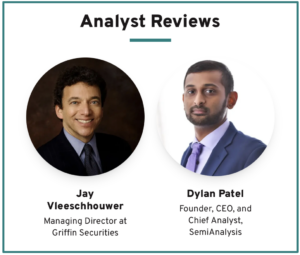 Analyst reviews are a critical part of any industry conference. These presentations bring into focus all the information presented and aim to highlight the macro trends.
Jay Vleeschhouwer has over 40 years of research analyst experience in the technology sector, including software, computer hardware, and imaging technology; Jay was formerly a senior analyst at Merrill Lynch, Josephthal Lyon & Ross, Bear Stearns, and Cantor Fitzgerald. His work has been recognized on numerous occasions in the annual Institutional Investor and Greenwich Associates rankings of analysts.
Dylan Patel is the Founder, CEO, and Chief Analyst at SemiAnalysis – the preeminent authority on all things AI and semiconductors. Through Dylan’s unwavering commitment to excellence, he has built the firm from the ground up as the recognized authority on the semiconductor supply chain to the cloud ecosystem, machine learning models, and all things in between.
Going To DAC
DAC will be held July 26–29, 2026, at the Long Beach Convention Center in California. There are many reasons to attend the conference. The speakers highlighted in this post are just another aspect of why this show is so important.
You can register for the conference here. It’s important to note that the I Love DAC program provides free access to Keynotes, SKYTalks, TechTalks and Panels in the DAC Pavilion, and the Exhibitor Forum. You also have access to the Exhibit Hall and daily networking receptions.
Take note: I Love DAC passes are free until July 12, 2026. When I was at Atrenta back around 2010 I got a call from the marketing team at Denali. In those days, large exhibitors got a lot of free DAC passes to give to customers and prospects. The Denali folks proposed that we join forces and offer our combined free ticket inventory to folks who couldn’t afford to attend DAC. That was the birth of the I Love DAC program. It’s become quite popular over the years and is now administered directly by the conference organizers.
And that’s a look at the high-profile speakers presenting at #DAC2026.
Also Read:
Caspia’s AI Makes You a Security Verification Expert
What Winemakers and Chip Designers Have in Common
Siemens EDA Expands AI and Advanced Packaging Collaboration with TSMC
Share this post via:



Rethinking Phase Jitter: An Algorithmic Approach to Signal Integrity