




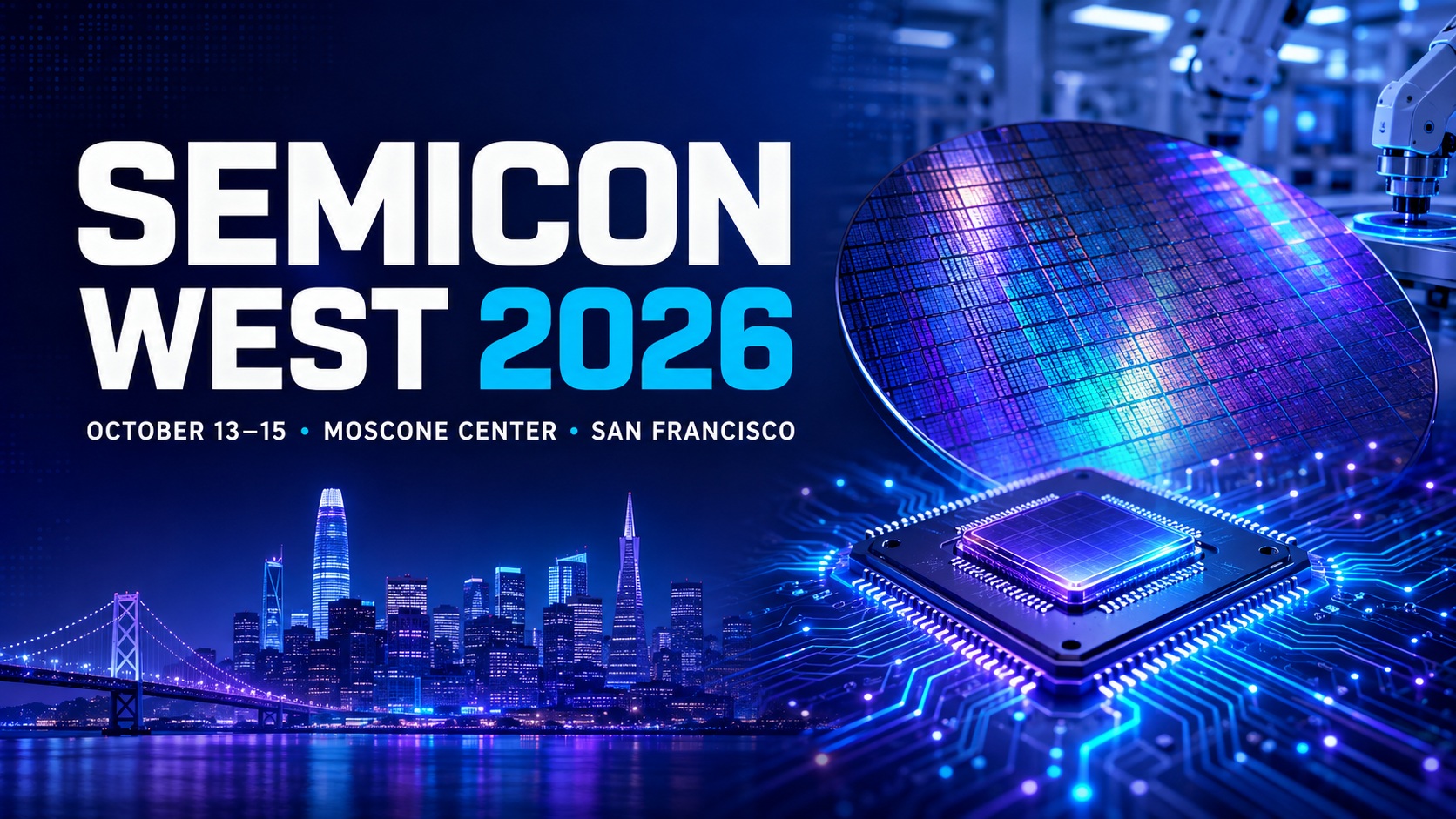



SEMICON West 2026 arrives at a pivotal moment for the global chip industry. Scheduled for October 13–15 at San Francisco’s Moscone Center, the event returns to the Bay Area after its 2025 edition in Phoenix. Organized by SEMI under the theme “Transform Tomorrow,” it will bring together semiconductor manufacturers, equipment and materials suppliers, designers, researchers, policymakers, investors, and customers from across the electronics value chain.
The timing gives this year’s gathering unusual weight. Artificial intelligence is driving extraordinary demand for computing power, memory bandwidth, networking, and energy-efficient infrastructure. At the same time, manufacturers face geopolitical tension, trade restrictions, rising construction costs, shortages of specialized talent, and pressure to make fabrication less resource intensive. SEMI expects industry revenue to move beyond the trillion-dollar threshold, making the event not simply a technology showcase but a forum on how sustainable growth can be achieved.
Advanced packaging should command particular attention. As conventional transistor scaling becomes more difficult and expensive, chiplets, heterogeneous integration, three-dimensional stacking, and high-bandwidth memory are becoming essential to system performance. These approaches connect different computing, memory, and interconnect components in one package, allowing designers to optimize cost and capability. Discussion at SEMICON West will likely extend beyond packaging techniques to the inspection, bonding, thermal management, testing, and standards required for high-volume production.
Smart manufacturing is another major theme. Semiconductor fabs generate enormous quantities of operational data, creating opportunities for artificial intelligence, digital twins, advanced process control, predictive maintenance, and automation. Yet deploying these tools in tightly controlled production environments requires reliable data, cybersecurity, interoperability, and measurable returns. The show floor and technical sessions offer suppliers a chance to demonstrate how their systems can improve yield, reduce downtime, and accelerate the transition from pilot projects to dependable factory infrastructure.
The program also reaches beyond leading-edge computing. Mobility, medical technology, power electronics, and future computing are among the areas highlighted by organizers. Electric vehicles, renewable-energy systems, industrial automation, and connected healthcare all require different combinations of sensors, processors, analog devices, and power semiconductors. Bringing these markets into one event underscores an important reality: the semiconductor industry is no longer shaped by a single product cycle, but by many overlapping transformations across the economy.
Resilience and sustainability will run through the conversation. Governments and companies are investing heavily in regional manufacturing capacity, but new fabs need equipment, chemicals, water, electricity, logistics, and skilled workers. Building a fab does not automatically create a complete supply chain. Attendees will therefore be watching for practical strategies on supplier localization, international coordination, workforce development, emissions reduction, water reuse, and energy efficiency. The tension between geographic diversification and global interdependence will remain difficult to resolve.
SEMICON West is structured to mix strategic debate with commercial activity. Keynotes, executive panels, expert sessions, technology talks, standards meetings, training courses, and networking events accompany an exhibition covering much of the semiconductor supply chain. Pre-show programming begins October 12, while the expo runs for three days. For engineers, the value lies in comparing tools and learning about process advances; for executives, it lies in partnerships, market intelligence, and visibility into customer investment priorities.
Ultimately, the significance of SEMICON West 2026 will be measured less by headline predictions than by evidence of execution. The industry already knows that AI, advanced packaging, resilient supply networks, and cleaner manufacturing matter. The harder questions concern cost, scale, standards, and speed. In San Francisco, participants will seek credible answers: which technologies are production ready, which partnerships can remove bottlenecks, and which policies can support expansion without fragmenting the global ecosystem.
Bottom Line: SEMICON West 2026 will connect ambition with implementation, turning enthusiasm about semiconductor innovation into concrete decisions about factories, equipment, talent, investment, and collaboration. As semiconductors become increasingly central to economic strategy and technological progress, the event will provide an important platform for advancing the partnerships and practical solutions needed to support the industry’s next phase of growth.
Also Read:
Agentrys Shows You How to Build a Multi-Agent System in 30 Minutes
Hot Chips 2026: Architectures for the Agentic Computing Era
Beyond Moore: Co-Optimizing AI from Systems to Materials
Share this post via:



Terafab’s Single Roof: Why Packaging, Not Lithography, Decides High Volume