You are currently viewing SemiWiki as a guest which gives you limited access to the site. To view blog comments and experience other SemiWiki features you must be a registered member. Registration is fast, simple, and absolutely free so please,
join our community today!
Every silicon executive worries about schedule. A slipped tape-out is painful. A chip that works but loses to the previous generation is worse. The question that matters most is simple. Will this architecture win on the workloads customers will actually run?
The best teams answer that question long before RTL. The leading CPU,… Read More
The recent AI Infra Summit was exceptionally jam-packed, filled to the brim with compelling talks, overlapping tracks, and emerging technologies. Amid the noise of the event, there were many excellent presentations detailing the physical realities of scaling hardware. But one presentation in particular caught my attention… Read More
imec announced that IC-Link by imec has joined the TSMC 3DFabric Alliance, a strategically important move that reflects the semiconductor industry’s transition from traditional monolithic scaling toward heterogeneous integration, chiplet architectures, and advanced packaging-driven system optimization. The partnership… Read More
Artificial Intelligence (AI) has witnessed explosive growth in applications across various industries, ranging from autonomous vehicles and natural language processing to computer vision and robotics. The AI embedded semiconductor market is projected to reach $800 billion by year 2030. Compare this with just $48 billion… Read More
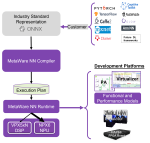
DSP and AI are generally considered separate disciplines with different application solutions. In their early stages (before programmable processors), DSP implementations were discrete, built around a digital multiplier-accumulator (MAC). AI inference implementations also build on a MAC as their primitive. If the interconnect… Read More
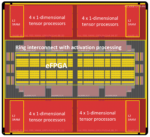
As more AI applications turn to edge computing to reduce latencies, the need for more computational performance at the edge continues to increase. However, commodity compute engines don’t have enough compute power or are too power-hungry to meet the needs of edge systems. Thus, when designing AI accelerators for the edge, Joe… Read More
Whenever a new partnership is announced, the natural question is, “why?” What will this partnership make possible that wasn’t already possible with those two companies working independently? I talked yesterday with Frank Schirrmeister of Arteris on the partnership. (Yes, Frank is now at Arteris). And I just got off an Arm press… Read More
From a business viewpoint we often read in the technical press about the virtues of applying AI, and in the early days most of the AI model building was done in the cloud, because of the high computation requirements, yet there’s a developing trend now to use AI accelerators at the Edge. The other mega-trend in the past decade… Read More
Let’s face it, AI is everywhere. From the cloud to the edge to your pocket, there is more and more embedded intelligence fueling efficiency and features. It’s sometimes hard to discern where human interaction ends, and machine interaction begins. The technology that underlies all this is quite complex and daunting to understand.… Read More
As the Linley Fall Processor Conference winds down, there are certain presenting companies that left a lasting impression. SiFive is one of those companies. On October 21, SiFive introduced the newest member of the SiFive Intelligence family of processor coresSiFive Intelligence family of processor cores, based on… Read More