







The semiconductor industry is generating more engineering data than ever before.
This article follows the previously published GFL and TCG foundation pieces. GFL introduced the lifecycle-governance problem. TCG clarified why observable or interoperable data is not automatically trustworthy convergence evidence. CEMH now defines the maturity path by which information becomes eligible for authority.
Advanced design and realization flows now produce massive volumes of simulation results, telemetry streams, firmware traces, validation outputs, DFT evidence, manufacturing data, qualification results, and field observations. Interoperability improvements have made it easier for this data to move across tools, domains, teams, and organizations.
But a critical distinction is becoming increasingly important:
Data movement does not create decision authority.
A signal may be observable. A file may be interoperable. A telemetry stream may be accessible. A simulation result may be available to downstream tools. Yet none of this guarantees that the information is trustworthy enough to influence convergence governance, closure decisions, runtime intervention, or Fleet Learning.
This is why SEGA-AI™ requires a Convergence Evidence Maturity Hierarchy, or CEMH.
The hierarchy defines how information matures from raw observation into convergence-authoritative evidence capable of supporting governed system decisions.
The canonical sequence is:
Raw Data → Interoperable Data → Normalized Evidence → Admissible Evidence → Convergence-Authoritative Evidence
The purpose of this hierarchy is not theoretical classification alone. It provides the implementation basis for SEGA-AI™ evidence handling. Without defined maturity levels, tools may collect data, platforms may exchange data, and AI systems may analyze data, but the governance system still cannot determine whether that information is eligible to close a gate, reopen a decision, trigger intervention, or refine future lifecycle assumptions.
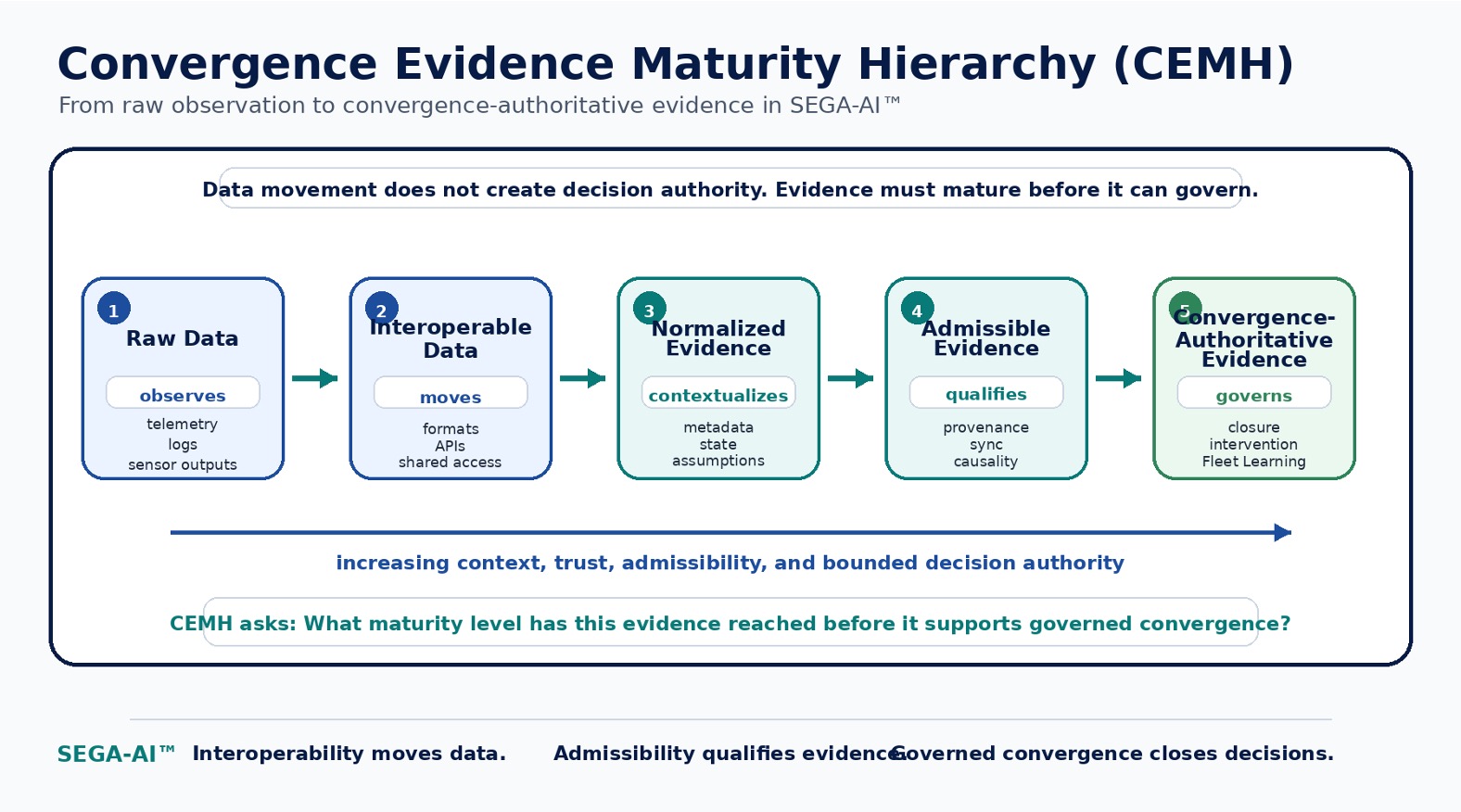
This sequence may appear simple, but it addresses one of the most important challenges in advanced heterogeneous systems: determining when information becomes authoritative enough to govern convergence.
The purpose of CEMH is not simply to organize data. Its purpose is to define the path by which information becomes eligible for authority. In SEGA-AI™, convergence-authoritative evidence is the maturity state at which information can support bounded gate closure, runtime intervention, Fleet Learning refinement, or lifecycle governance without breaking causality, synchronization, or realization-state validity.
Why Raw Data Is Not Enough
Raw data is the starting point.
It may include sensor outputs, telemetry streams, simulation logs, manufacturing measurements, validation results, firmware traces, workload behavior, thermal readings, voltage behavior, SI/PI observations, EM indicators, or field-return signals.
Raw data is valuable because it provides observability.
But observability alone is not governance.
Raw data may be incomplete, stale, desynchronized, incorrectly contextualized, weakly correlated, or disconnected from the relevant physical state.
A telemetry stream may show a thermal event without preserving the workload condition that produced it. A firmware trace may record an intervention without preserving the package, board, voltage, or thermal state in which the intervention occurred. A field observation may reflect a real failure pattern but lack enough causal context to refine future closure assumptions.
Raw data tells us that something was observed.
It does not automatically tell us whether that observation can govern a decision.
Raw data observes. It does not govern.
Level 1: Raw Data
The first maturity level is raw data.
This includes:
- telemetry
- logs
- sensor outputs
- tool outputs
- simulation results
- lab measurements
- manufacturing records
- validation outputs
- field observations
At this level, the system has visibility but not authority.
Raw data may identify that something occurred, but it does not necessarily explain why it occurred, whether it is synchronized to the correct state, whether it represents the current realization configuration, or whether it is valid enough to influence a convergence decision.
Raw data is therefore necessary but insufficient.
It is the beginning of the evidence path, not the endpoint.
Level 2: Interoperable Data
The second maturity level is interoperable data.
Interoperable data can move across tools, databases, workflows, teams, or organizational boundaries. It may follow a standard format, connect to downstream environments, or be accessible through shared infrastructure.
Interoperability is essential because modern semiconductor systems require coordination across silicon, package, interposer, PCB, PDN, thermal, mechanical, firmware, validation, manufacturing, and runtime domains.
However, interoperability solves transport.
It does not solve authority.
A piece of data can be interoperable while still being misleading for convergence decisions. It may preserve syntax but lose context. It may move correctly while carrying stale assumptions. It may be readable by another tool while lacking boundary-condition consistency, correlation status, timestamp validity, or realization-state alignment.
This is the core limitation of interoperability:
Interoperability makes data movable. It does not make evidence authoritative.
This distinction is central to advanced semiconductor governance. As systems become more heterogeneous and lifecycle-dependent, the industry cannot assume that connected data is qualified data.
Data can move perfectly and still fail as convergence evidence.
Level 3: Normalized Evidence
The third maturity level is normalized evidence.
To become useful for governed convergence, data must gain context. Normalized evidence preserves not only the result itself, but the conditions required to interpret it.
This may include:
- source domain
- model version
- geometry revision
- timestamp
- boundary conditions
- temperature assumptions
- reference-plane definitions
- model fidelity
- confidence level
- correlation status
- package or board configuration
- workload state
- relationship to other evidence
This stage is essential because advanced heterogeneous systems do not fail only because data is unavailable. They often fail because different domains interpret data through different assumptions.
A package model may use one thermal boundary condition. A PCB PDN model may use a different return-path assumption. An EM calculation may depend on a temperature map that no longer matches the current thermal solution. A firmware trace may correspond to an operating state that does not match the validation scenario being reviewed.
Normalized evidence creates a shared decision context.
It allows domain outputs to be compared, correlated, and evaluated as part of a larger convergence structure.
But normalized evidence is still not enough.
It must become admissible.
Level 4: Admissible Evidence
The fourth maturity level is admissible evidence.
Admissible evidence is evidence that satisfies bounded governance criteria before it participates in a closure decision, runtime intervention, or lifecycle refinement process.
Admissibility may require:
- provenance continuity
- synchronization integrity
- realization-state validity
- model fidelity
- causal relevance
- boundary-condition completeness
- confidence qualification
- timestamp freshness
- chain-of-custody preservation
- correlation maturity
This is where Trusted Convergence Governance becomes important.
Operational evidence, telemetry, firmware traces, DFT infrastructure, qualification outputs, and Fleet Learning inputs should not be trusted simply because they are observable or interoperable. They must pass through admissibility governance before they influence convergence decisions.
This protects the system from a dangerous condition:
operationally connected but convergence-non-authoritative data.
A system may continue exchanging data while losing the trust continuity required for deterministic convergence. Telemetry may remain active while becoming desynchronized. Firmware traces may exist while losing causal context. Field data may show a pattern while lacking realization-state validity. Fleet Learning may identify a statistical correlation while the underlying evidence is not physically admissible.
Admissible evidence is therefore the threshold where information becomes qualified to participate in governance.
It is not yet the final destination.
But it has crossed the boundary from visibility into governed participation.
Level 5: Convergence-Authoritative Evidence
The fifth maturity level is convergence-authoritative evidence.
This is evidence strong enough to influence governed closure, bounded intervention, Fleet Learning, lifecycle refinement, or future realization assumptions.
This does not mean the evidence is perfect.
It means the evidence has preserved enough trust, context, causality, synchronization, fidelity, and admissibility to support bounded decision authority.
Examples may include:
- a thermal model correlated to measured package behavior and synchronized with the current geometry revision
- an EM margin calculation using the correct temperature state and current-density distribution
- a PDN analysis aligned with package and board return-path assumptions
- a telemetry stream with provenance, timestamp validity, and realization-state consistency
- field evidence that has passed correlation checks and can refine future package constraints
- Fleet Learning outputs that recommend threshold adjustment without independently closing gates
This is the point at which evidence may influence governance decisions.
The distinction is critical:
Observable data can inform.
Admissible evidence can participate.
Convergence-authoritative evidence can govern.
Why This Matters for Fleet Learning
Fleet Learning makes the hierarchy even more important.
Within SEGA-AI™, Fleet Learning is not generic analytics. It is a governed realization-feedback mechanism through which operational evidence can refine convergence assumptions, admissibility boundaries, firmware policies, package constraints, validation priorities, and future closure criteria.
That creates a recursive governance problem.
If Fleet Learning refines future convergence decisions, then the evidence feeding Fleet Learning must itself be governed. Otherwise, future closure criteria may be refined using non-admissible or causally incomplete evidence.
This is the question Trusted Convergence Governance raises:
Who validates the evidence that validates the system?
CEMH answers by requiring operational information to mature through visible stages before it can influence governance.
Raw data is not enough.
Interoperability is not enough.
Normalization is not enough.
Admissibility is the gate.
Convergence authority is the outcome.
Fleet Learning should therefore not learn equally from all available data. It should refine future convergence assumptions only from evidence that has matured sufficiently for bounded decision use.
Relationship to GFL and TCG
CEMH also clarifies the relationship between three SEGA-AI™ concepts: Governance for Lifecycle, Trusted Convergence Governance, and the Convergence Evidence Maturity Hierarchy.
GFL asks whether the realized system can remain converged throughout operational life.
TCG asks whether the evidence entering governance is trustworthy enough to influence convergence decisions.
CEMH defines the maturity level that evidence must reach before it can carry decision authority.
These are separate but connected concepts.
GFL defines the lifecycle governance problem.
TCG defines the trust gate.
CEMH defines the evidence maturity path.
Together, they prevent a common failure mode in advanced heterogeneous systems: assuming that visibility, interoperability, or analytics automatically creates convergence authority.
It does not.
Evidence must mature before it can govern.
From Evidence Maturity to Implementation
The Convergence Evidence Maturity Hierarchy is not only a conceptual classification model. It also provides the implementation logic for how SEGA-AI™ handles evidence across tools, domains, gates, and lifecycle states.
At the architecture-theory level, SEGA-AI™ defines why evidence must become authoritative before it can govern system realization. This includes admissibility, causality continuity, synchronization, realization-state validity, bounded convergence, and decision authority.
At the implementation-specification level, those principles must become executable. This includes evidence schemas, admissibility checks, timestamp and synchronization rules, causal dependency maps, gate states, validation criteria, runtime policies, audit artifacts, and closure/reopen logic.
In simple terms:
D2 defines the authority model.
D3 verifies and executes the authority model.
This distinction is important because convergence-authoritative evidence is not created by one tool, one database, or one AI model. It emerges only when the architecture defines what authority means and the implementation layer proves that the evidence satisfies that authority model.
Without the architecture layer, evidence lacks governance meaning.
Without the implementation layer, evidence lacks operational proof.
Together, they allow SEGA-AI™ to distinguish between information that is merely visible and evidence that is mature enough to govern system convergence.
Relationship to Governed Convergence
Governed convergence depends on CEMH because deterministic closure requires more than domain completion.
It requires evidence that is admissible, causally consistent, synchronized, and authority-bearing.
A local SI result may pass. A PI model may pass. A thermal solution may pass. An EM calculation may pass. But unless those results mature into convergence-authoritative evidence within a shared decision context, the system may still remain globally inconsistent.
This is why the hierarchy is not only a data pipeline.
It is a governance pipeline.
It transforms fragmented observations into bounded decision authority.
That transformation is central to SEGA-AI™:
Interoperability moves data.
Admissibility qualifies evidence.
Governed convergence closes decisions.
Together, they allow SEGA-AI™ to distinguish between information that is merely visible and evidence that is strong enough to govern system convergence.
A Practical Example
Consider a high-current advanced package where a thermal sensor reports repeated local hotspot behavior during field operation.
At the raw-data stage, the system has a temperature observation.
At the interoperable-data stage, that observation can move into a diagnostic environment or fleet database.
At the normalized-evidence stage, the observation is associated with workload state, package lot, board revision, firmware version, sensor location, timestamp, operating voltage, and thermal boundary conditions.
At the admissible-evidence stage, the system validates provenance, synchronization, realization-state relevance, sensor confidence, and causal relationship to package behavior.
At the convergence-authoritative stage, the evidence may influence future package constraints, firmware policy refinement, thermal-interface validation criteria, or Fleet Learning recommendations.
The same temperature reading therefore changes meaning as it matures.
It begins as a signal.
It becomes data.
It becomes evidence.
It becomes admissible.
Only then can it become convergence-authoritative.
Why This Matters for AI, Chiplets, HBM, and Advanced Packaging
In AI and HPC systems, evidence crosses many boundaries.
It moves from die to package, package to board, board to rack, simulation to silicon, lab to field, firmware to workload, and telemetry to Fleet Learning.
Advanced packaging increases the importance of this evidence path because the system is no longer governed by one isolated domain. Chiplets, HBM, interposers, substrates, power delivery, thermal spreading, mechanical stress, firmware behavior, and workload dynamics interact across the realization environment.
A result that appears valid inside one domain may become misleading when used outside its original context.
A thermal map may not match the electrical state. A PDN result may not reflect the current package deformation condition. A firmware trace may not preserve the physical state that caused it. A field pattern may be statistically visible but physically incomplete.
CEMH gives the organization a way to ask:
What maturity level has this evidence reached?
Without that question, organizations risk treating all visible data as equally useful.
That creates convergence risk.
Conclusion
The semiconductor industry has made major progress in interoperability, observability, simulation, and data infrastructure.
These advances remain necessary.
But they do not automatically create trustworthy convergence decisions.
As heterogeneous systems become more physically coupled, operationally adaptive, and lifecycle-dependent, the industry must distinguish between data that is available and evidence that is authoritative.
The Convergence Evidence Maturity Hierarchy provides that distinction.
It defines the path from raw data to convergence-authoritative evidence and clarifies why each stage matters.
Without this hierarchy, systems risk making closure, intervention, or learning decisions from information that is visible but not admissible, interoperable but not synchronized, correlated but not causal, or useful but not authoritative.
The future of advanced packaging and heterogeneous integration may depend not only on collecting more data, but on governing the maturity of evidence itself.
The critical question is no longer only what the system observed.
The deeper question is whether that evidence has matured enough to become convergence-authoritative.
Raw data observes.
Interoperable data moves.
Normalized evidence contextualizes.
Admissible evidence qualifies.
Convergence-authoritative evidence governs.
This evidence-maturity model also prepares the ground for the next SEGA-AI™ layer: Fleet Learning as a governed convergence system. Fleet Learning should not learn equally from all available data. It should refine future convergence assumptions only from evidence that has matured sufficiently to become admissible or convergence-authoritative.
Fleet Learning may recommend refinement, but bounded gate authority must approve lifecycle decisions.
And across the full SEGA-AI™ framework:
Interoperability moves data.
Admissibility qualifies evidence.
Governed convergence closes decisions.
Also Read:
Closing the Silicon Realization Gap: From Static DFM to Governance for Lifecycle (GFL)
Beyond Tool Interoperability: The Emerging Governed Convergence Problem in Semiconductor Design




Why America’s Semiconductor Manufacturing Capacity Matters