







As semiconductor systems evolve toward heterogeneous integration, chiplets, 2.5D and 3D packaging, distributed observability, runtime adaptation, Fleet Learning, and lifecycle convergence governance, the industry is entering a fundamentally new operational reality.
Convergence decisions are no longer driven only by pre-silicon simulation, static signoff, or isolated qualification criteria. Increasingly, they are influenced by operational evidence generated throughout the lifecycle of the system itself.
Telemetry, firmware traces, validation results, DFT infrastructure, workload behavior, qualification outputs, manufacturing data, and field operational evidence are no longer peripheral engineering artifacts. They are becoming active participants inside convergence governance.
This transition creates a major architectural challenge for advanced heterogeneous systems:
Convergence governance is only as trustworthy as the evidence allowed to participate in the convergence process.
Historically, the semiconductor industry has focused heavily on interoperability, observability, runtime telemetry, and operational adaptation. These efforts remain essential. However, increasingly coupled heterogeneous systems now require something more fundamental: trust continuity inside the convergence loop itself.
This is the role of Trusted Convergence Governance (TCG).
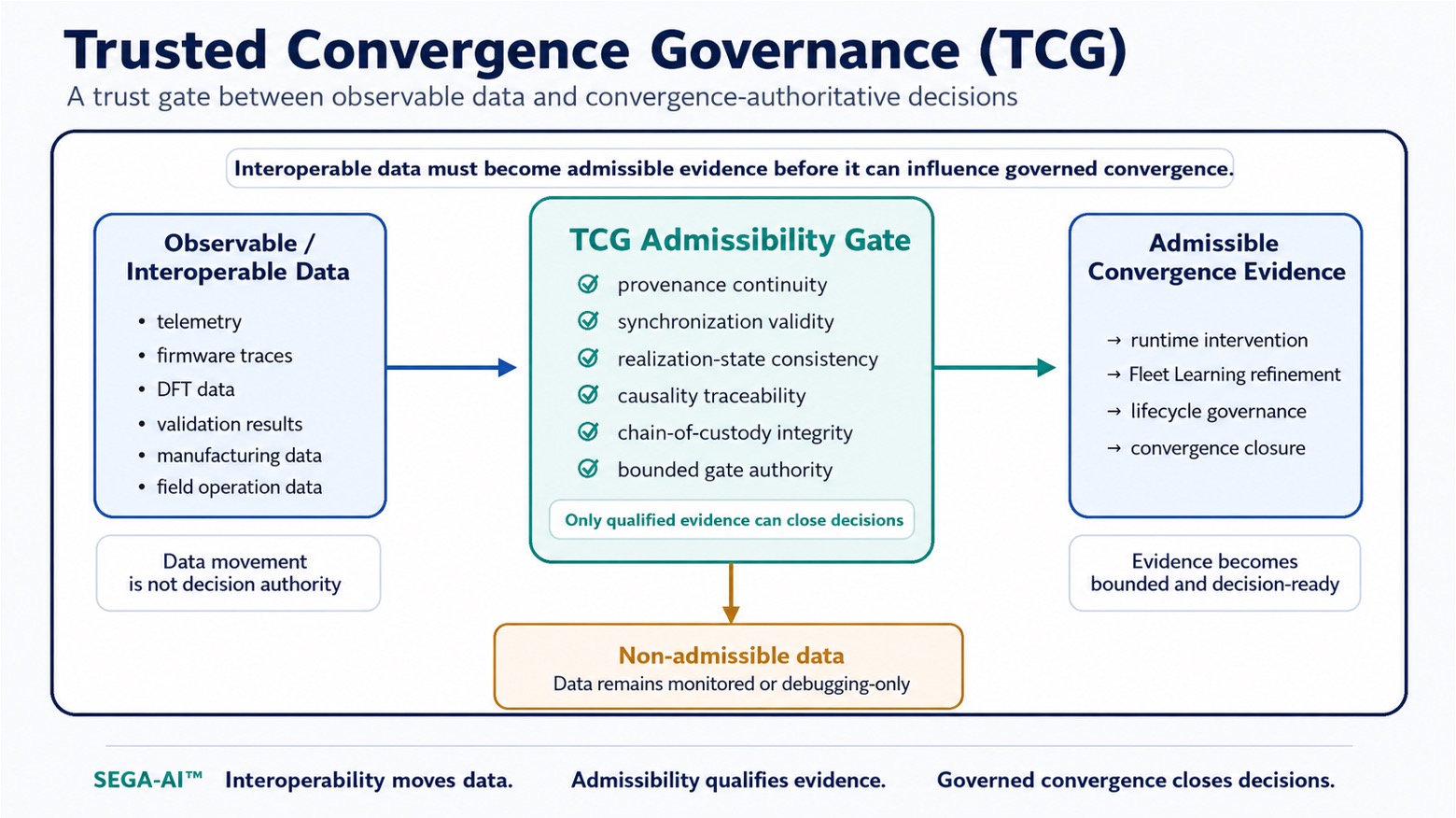
TCG preserves admissibility integrity, synchronization validity, provenance continuity, realization-state consistency, and causality traceability before operational evidence is allowed to influence convergence decisions.
Figure 1 illustrates TCG as a bounded admissibility gate between observable/interoperable data and convergence-authoritative evidence.
SEGA-AI™ is not positioned as another analytical layer. It is a deterministic realization-governance architecture for preserving convergence across the full lifecycle of high-performance heterogeneous computing systems.
Figure 1. Trusted Convergence Governance as a bounded admissibility gate between observable/interoperable data and admissible convergence evidence.
Interoperability Is Not Trust
One of the most dangerous assumptions in modern distributed engineering systems is the belief that interoperable data automatically becomes trustworthy convergence evidence.
It does not.
Interoperability guarantees that engineering data can move across tools, domains, systems, organizations, and lifecycle stages. But it does not guarantee that the resulting convergence decisions remain trustworthy.
A heterogeneous semiconductor system may successfully exchange telemetry, firmware traces, qualification outputs, runtime observability data, manufacturing evidence, and operational feedback while still lacking provenance continuity, synchronization integrity, realization-state validity, or causal traceability.
Under these conditions, the system may remain operationally connected while no longer remaining convergence-authoritative.
This distinction becomes increasingly important because operational evidence now directly influences runtime intervention, firmware adaptation, Fleet Learning, convergence refinement, realization assumptions, and future closure criteria.
The challenge is therefore no longer simply data movement.
The challenge is trust-preserved convergence governance.
The Need for Bounded Admissibility
Traditional telemetry architectures often assume that all operational data is useful. Within the SEGA-AI™ framework, however, operational evidence must pass through bounded admissibility governance before participating in convergence decisions.
The purpose is not to block data. The purpose is to qualify whether the data has the authority to influence convergence.
A separate evidence-maturity model can classify how data progresses toward decision authority. However, the focus of Trusted Convergence Governance is the trust mechanism itself: preserving provenance, synchronization, realization-state validity, causality, fidelity, and chain of custody before evidence is allowed to affect convergence closure.
In this model, admissible evidence is not simply observable telemetry.
It is operational or engineering evidence that satisfies bounded governance criteria, including:
- provenance continuity
- synchronization integrity
- realization-state validity
- measurement fidelity
- causal relevance
- chain-of-custody preservation
- bounded authority for decision use
Evidence that fails these checks may still be useful for monitoring, debugging, or exploratory analysis. But it should not automatically become convergence-authoritative.
This distinction matters because operational perturbations may propagate recursively across firmware behavior, thermal behavior, runtime scheduling, SI/PI stability, System EM Corridor behavior, package mechanics, and distributed synchronization environments.
A corrupted, stale, desynchronized, or non-admissible evidence stream may influence convergence decisions incorrectly while remaining fully interoperable.
The result is a dangerous condition in which systems remain connected while no longer preserving trustworthy convergence states.
TCG Is Not Generic Cybersecurity
Trusted Convergence Governance should not be confused with generic cybersecurity enforcement.
Cybersecurity protects systems against unauthorized access, tampering, intrusion, and attack. Those protections are essential, but they are not sufficient for convergence governance.
TCG addresses a different question:
Is this evidence trustworthy enough, synchronized enough, realization-consistent enough, and causally valid enough to influence convergence decisions?
A data stream may be secure but still non-admissible.
It may come from an authorized source but be temporally stale.
It may be complete but synchronized to the wrong runtime epoch.
It may be statistically correlated but physically non-causal.
It may be valid in one realization state but invalid after firmware intervention, package drift, workload migration, thermal excursion, or manufacturing variation.
TCG therefore extends governance beyond access control and data transport. It protects the decision integrity of the convergence loop.
Cryptographic signatures or hardware roots of trust may support evidence chain of custody, but the core TCG function is broader: determining whether evidence is synchronized, realization-consistent, causally valid, and admissible for a specific convergence decision.
Realization-State Consistency
One of the most important elements of TCG is realization-state consistency.
In advanced heterogeneous systems, evidence does not exist in isolation. It belongs to a specific realization state: a particular configuration of die, package, interposer, substrate, board, firmware, workload, thermal condition, voltage condition, manufacturing history, aging profile, and system operating mode.
If evidence loses this context, its decision authority becomes compromised.
For example, telemetry collected during one workload regime may not remain valid after workload migration. Thermal behavior measured under one cooling condition may not remain valid under a different rack environment. SI/PI behavior observed before firmware adaptation may not remain valid after runtime policy changes. Package stress data from one assembly configuration may not remain valid after material, substrate, or underfill variation.
This is why convergence governance cannot rely only on data availability.
It must preserve the realization context in which the evidence was generated.
TCG ensures that operational evidence remains tied to the correct system state before it influences convergence decisions.
Causality Before Pattern Recognition
As AI-assisted operational systems continue scaling, another critical distinction emerges.
Pattern recognition alone does not guarantee convergence validity.
A system may identify statistical correlations, anomaly signatures, behavioral clusters, or workload patterns while still lacking physics-grounded causality continuity, realization-state admissibility, or convergence-authoritative evidence.
SEGA-AI™ therefore prioritizes physics-grounded causality preservation over isolated statistical pattern matching.
This distinction becomes increasingly important because heterogeneous convergence behavior now emerges from tightly coupled physical interactions involving thermal-current propagation, package deformation, System EM Corridor behavior, runtime scheduling, firmware intervention, PDN behavior, synchronization continuity, and manufacturing variation.
A causality matrix generated from non-admissible evidence may remain mathematically coherent while becoming physically invalid.
For example, a statistical correlation may attribute a localized voltage drop to a firmware workload pattern. A physics-grounded causality review may instead show that the event was driven by transient thermal deformation, localized package-stress shift, and a resulting change in the effective power-delivery path. In that case, the statistical pattern is not wrong as an observation, but it is incomplete as convergence evidence.
This is why TCG does not ask only whether a pattern is detectable.
It asks whether the evidence behind that pattern is admissible, synchronized, realization-consistent, and physically causal enough to influence convergence decisions.
The objective is not only to detect what happened.
The objective is to determine whether the evidence is trustworthy enough to explain why it happened, whether that explanation is valid in the current realization state, and whether it can safely influence future convergence decisions.
Fleet Learning Requires Trust-Preserved Feedback
Fleet Learning introduces another major governance challenge.
In the SEGA-AI™ framework, Fleet Learning is not merely analytics. It is a governed realization-feedback mechanism through which operational evidence refines convergence assumptions, realization constraints, firmware policies, admissibility boundaries, runtime governance logic, and future closure criteria.
This creates a recursive governance problem:
Who validates the validator?
If convergence refinement depends on operational evidence, then the evidence used for refinement must itself remain governed.
Runtime telemetry may become desynchronized. Firmware policies may diverge. Workload traces may lose causal context. Distributed observability environments may become incomplete. Manufacturing records may become disconnected from field behavior. Qualification assumptions may drift away from real operating conditions.
Under these conditions, Fleet Learning may begin refining convergence assumptions using non-admissible evidence.
The result is not simply inaccurate telemetry.
The result becomes convergence drift driven by non-authoritative operational evidence.
Trusted Convergence Governance prevents this by ensuring that Fleet Learning remains bounded, traceable, admissibility-preserving, causality-grounded, synchronization-valid, and operationally trustworthy.
The Operational Role of TCG
The semiconductor industry has spent years solving interoperability and data-continuity challenges across fragmented engineering ecosystems. Those efforts remain necessary and valuable.
However, interoperability alone cannot guarantee trustworthy convergence, convergence-authoritative operational states, admissibility-preserved refinement, or deterministic lifecycle governance.
The next operational layer above interoperability is Trusted Convergence Governance.
TCG ensures that operational evidence, runtime observability, firmware traces, DFT infrastructure, qualification data, manufacturing records, and Fleet Learning inputs remain provenance-preserved, synchronization-valid, realization-consistent, causality-grounded, and admissibility-qualified before they influence convergence decisions.
Within SEGA-AI™, TCG can be implemented through bounded validation gates that combine provenance records, realization-state identifiers, synchronization epochs, chain-of-custody checks, physics-consistency tests, admissibility thresholds, and gate-authority rules before evidence is allowed to influence convergence decisions.
In practical terms, TCG introduces a trust gate between observable data and convergence authority.
That gate asks:
- Where did this evidence come from?
- Is its provenance preserved?
- Is it synchronized to the correct system state?
- Is it tied to the correct realization configuration?
- Is the evidence physically causal or only statistically correlated?
- Is the chain of custody intact?
- Is the evidence fresh enough to influence this decision?
- Does the evidence have bounded authority for this type of intervention or refinement?
Only after satisfying these conditions should operational evidence be allowed to participate in convergence closure, runtime intervention, Fleet Learning refinement, or lifecycle governance.
Conclusion
Trusted Convergence Governance addresses a fundamental gap in advanced semiconductor systems.
The industry can no longer assume that observable data is trustworthy, that interoperable data is admissible, or that connected telemetry is convergence-authoritative.
As AI infrastructure, chiplets, 2.5D and 3D integration, advanced packaging, firmware adaptation, and fleet-scale operation continue to converge, the integrity of the evidence loop becomes as important as the integrity of the physical system itself.
TCG preserves that evidence loop.
It ensures that operational evidence remains provenance-preserved, synchronization-valid, realization-consistent, causality-grounded, and admissibility-qualified before it influences convergence decisions.
Ultimately, deterministic convergence depends not only on evidence continuity, but on admissibility integrity across the complete realization ecosystem.
Also Read:
Closing the Silicon Realization Gap: From Static DFM to Governance for Lifecycle (GFL)
Beyond Tool Interoperability: The Emerging Governed Convergence Problem in Semiconductor Design
Closing the Reality Gap: A New Architecture for 1.8-Tb/s Chiplet Governance
Share this post via:



The silent killer of analog reliability: Why SPICE misses floating net