





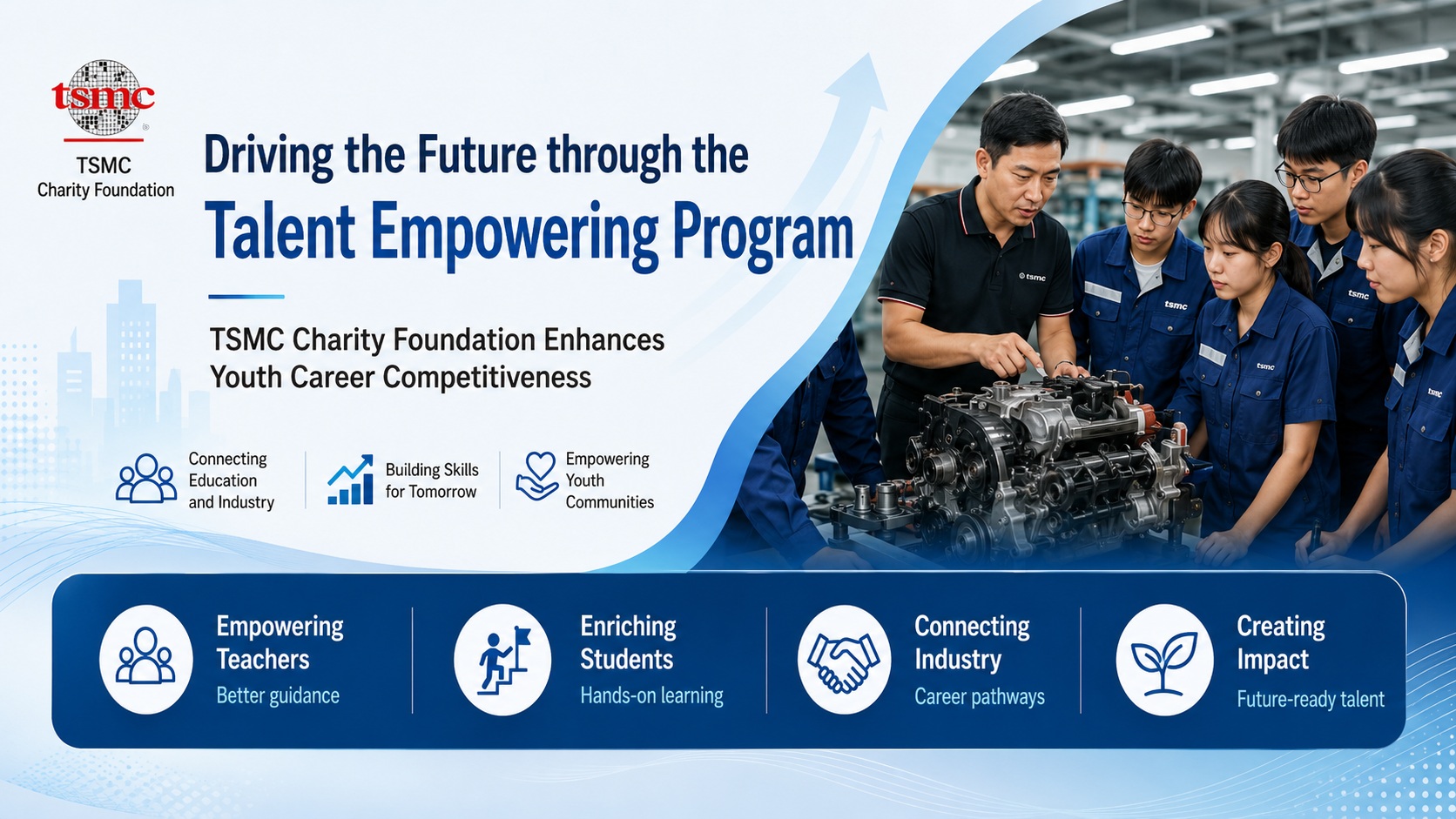
The future of work will not be shaped by technology alone. It will be shaped by whether young people are given the confidence, skills, and guidance to participate in that future. This is why the TSMC Charity Foundation’s “Technical and Vocational Talent Empowerment Program” matters. By connecting schools, industry partners, local governments, and universities, the program addresses one of the most urgent challenges facing education today: the gap between what students learn in school and what they need to succeed in real careers.
Launched through collaboration with the Hsinchu County and City Governments, Kuang-Fu High School, and Minth University of Science and Technology, the program focuses on both teachers and students. Its dual strategy is simple but powerful: help junior high school teachers provide better career guidance, while giving vocational high school students practical exposure to industry expectations. According to TSMC’s sustainability report on the initiative, the program invited 27 junior high school teachers from Hsinchu City to visit vocational education sites and learn directly from educators and automotive industry leaders.
This teacher-focused approach is especially important. Students often make early decisions about academic tracks and career pathways before they fully understand the opportunities available to them. When teachers are equipped with current industry knowledge, they can guide students more effectively and help them choose paths that match their interests, strengths, and long-term goals. This is not just career counseling; it is a form of social empowerment.
The program also gives students something that traditional classrooms often struggle to provide: hands-on experience. Through visits, demonstrations, mentorship, and exposure to departments such as automotive technology and intelligent vehicles, students gain a clearer picture of what modern technical careers look like. Industry partners including Lexus, Mazda, and Porsche-related representatives helped introduce students and teachers to hiring trends, industry-academia collaboration, and pathways from vocational education to employment.
Why does this matter? Because technical and vocational education can be a powerful engine of upward mobility. For many young people, especially those outside elite academic tracks, practical skills can become a direct route to stable employment, dignity, and long-term development. The TSMC Charity Foundation’s broader work has long included rural empowerment and employability initiatives, including career exploration videos, job fairs, and partnerships designed to help students understand real workplace possibilities.
The initiative also matters to industry. Taiwan’s economy depends heavily on advanced manufacturing, semiconductors, smart mobility, and precision technology. These sectors require not only engineers and researchers, but also skilled technicians, operators, maintenance professionals, and applied specialists. A sustainable talent pipeline cannot be built at the point of hiring alone. It must begin earlier, when students are forming their identities and imagining their futures.
At its core, the Talent Empowering Program is not simply about filling jobs. It is about helping young people see possibilities that may once have felt distant or invisible. Alumni mentorship, industry visits, and applied learning experiences allow students to connect classroom knowledge with real-world purpose. That connection can transform hesitation into confidence and uncertainty into direction.
The program’s significance also lies in its collaborative model. No single school, company, or government agency can solve the education-employment gap alone. By bringing together public institutions, vocational schools, universities, and global industry brands, the TSMC Charity Foundation demonstrates how social impact can be practical, targeted, and scalable.
Bottom line: As the Foundation continues expanding career exploration opportunities in 2026, the program offers an important lesson: investing in youth competitiveness is not charity in the narrow sense. It is an investment in social resilience, industrial sustainability, and shared prosperity. When young people are empowered to build skills, understand industries, and choose careers with confidence, they do more than prepare for the future. They help drive it.
Also Read:
TSMC Expands Use of NVIDIA AI Technologies Across Chip Production Operations
TSMC Pioneers a New Era in AI-Powered Trade Secret Management, Achieving Intelligent Innovation
TSMC Powers Up: 408,000 Batteries Get a Safety Intelligence Upgrade
Share this post via:



Comments
There are no comments yet.
You must register or log in to view/post comments.