







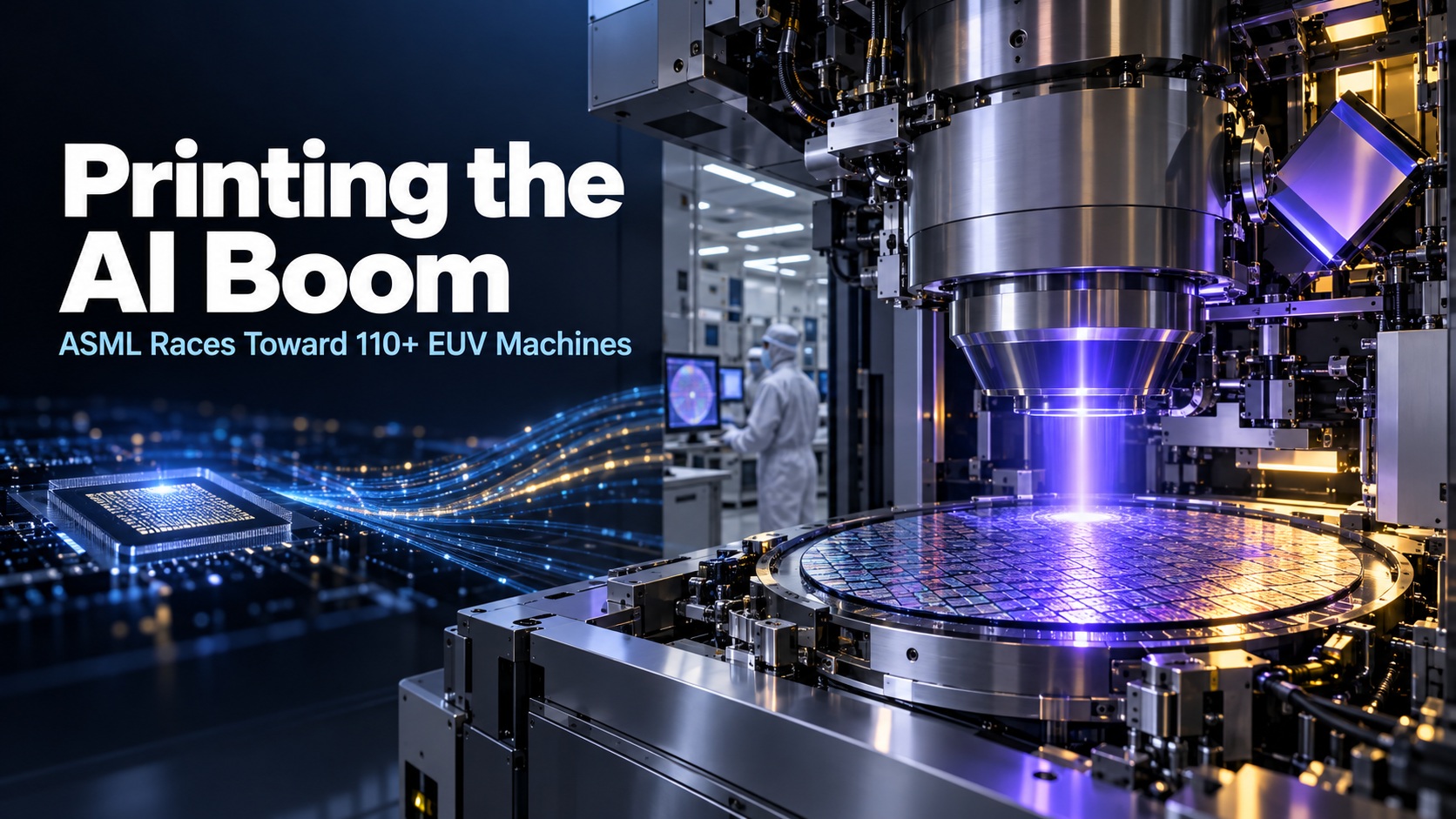
ASML is exploring how to produce more than 110 extreme ultraviolet lithography machines in 2028, reflecting the extraordinary investment flowing into artificial intelligence infrastructure. The Dutch semiconductor-equipment company expects to manufacture at least 80 EUV systems in 2027 and is considering another production increase of approximately 30 percent the following year. Although the 2028 figure remains a capacity scenario rather than a firm production commitment, the scale of the proposal shows how quickly demand for advanced chipmaking equipment is accelerating.
EUV lithography is essential for manufacturing the world’s most sophisticated semiconductors. The technology uses extremely short-wavelength light to print remarkably small circuit patterns onto silicon wafers. These patterns form the transistors and interconnections inside advanced processors, graphics chips, and memory products. ASML is the only company commercially supplying EUV lithography systems at scale, making its production capacity a critical constraint on how rapidly the semiconductor industry can expand leading-edge manufacturing.
The immediate driver is AI. Training and operating increasingly capable AI models requires enormous quantities of computing power. Companies building AI infrastructure need advanced accelerators, while those processors depend on leading-edge foundry capacity and high-bandwidth memory. Both advanced logic and modern memory production require increasingly intensive use of lithography. ASML has said its logic business is benefiting from foundries adding capacity for new process nodes, while demand for high-bandwidth memory and DDR5 is supporting growth in its memory business.
According to a Reuters report, ASML was already nearly fully booked for 2027, with many newer orders intended for delivery in 2028. JPMorgan analysts said the principal limitation was the speed at which ASML could assemble EUV systems rather than shortages throughout its supplier network. That distinction matters: improving assembly throughput may be more manageable than rebuilding an entire supply chain, although producing these extraordinarily complex machines still requires careful coordination with specialist suppliers.
For chipmakers such as TSMC, Samsung, Intel, SK Hynix, and Micron, additional EUV availability could support faster construction and ramp-up of advanced fabrication capacity. More machines do not instantly translate into more chips—factories also need buildings, utilities, process equipment, trained personnel, and sufficient yields—but lithography is among the most important pieces of the capacity equation. An expansion by ASML could therefore reduce the risk that EUV availability becomes the decisive bottleneck limiting AI-chip output.
The plan also matters because demand is becoming more lithography-intensive. As semiconductor manufacturers move toward smaller process geometries, they generally use EUV on more layers of each chip. Consequently, demand for ASML systems can rise faster than the number of wafers being produced. At the same time, ASML is introducing High-NA EUV, a next-generation technology capable of printing smaller features. Wider High-NA adoption is expected to begin around 2028 and develop more significantly during the following decade, adding another dimension to the company’s expansion.
There are risks. AI infrastructure spending could slow if customers struggle to earn adequate returns from their enormous capital investments. Semiconductor markets are historically cyclical, so capacity planned during a boom can become excessive if demand weakens. Export restrictions, particularly those affecting sales to China, create further uncertainty. ASML must also avoid compromising quality as it raises output, because an EUV machine contains an immense number of precision components and must perform reliably inside high-volume factories.
Bottom line: The proposed target is a powerful signal. ASML is preparing before it holds purchase orders for every potential 2028 system because customer forecasts are strong enough to justify early action. If demand persists, producing more than 110 EUV machines would strengthen the foundations of global AI expansion. It would enable more leading-edge manufacturing, reinforce ASML’s strategic importance, and demonstrate that the AI boom is reshaping not only software and data centers but the industrial infrastructure required to manufacture the computing hardware beneath them.
Sources:
- Reuters: ASML examining production of more than 110 EUV tools in 2028
- ASML 2025 Annual Report: AI-driven growth and EUV performance
- ASML Investor Day 2024: long-term AI and EUV outlook
- Reuters: ASML capacity expansion and AI-chip demand
- Euronext/Reuters: Summary of the 110-plus EUV production scenario
Also Read:
ASML Has High-NA and Chipmakers Can’t Say No
A Study of Photoresist Bake Influence on Stochastics for DUV Immersion Lithography
High-NA EUV Moves From Experiment to Manufacturing
Share this post via:



ASML and TSMC’s 12-Inch Photomask Initiative: Technical Significance