You are currently viewing SemiWiki as a guest which gives you limited access to the site. To view blog comments and experience other SemiWiki features you must be a registered member. Registration is fast, simple, and absolutely free so please,
join our community today!
Content of this book has focused upon predictability of trends in the semiconductor industry based upon past trends, experience and ratios. What about newly emerging applications of semiconductors? After all, the entire history of the semiconductor industry is driven by emergence of new applications.
Artificial Intelligence… Read More
I recently had the pleasure of attending the AI Hardware Summit at the Computer History Museum in Mountain View, CA. This two-day conference brought together many companies involved in building artificial intelligence solutions. Though the focus was on building the hardware for this area, there was naturally much discussion… Read More
Solid State Drives (SSDs) are rapidly gaining popularity for storage in many applications, in gigabytes of storage in lightweight laptops to tens to hundreds of terabyte drives in datacenters. SSDs are intrinsically faster, quieter and lower-power than their hard disk-drive (HDD) equivalents, with roughly similar lifetimes,… Read More
High-Speed PHY IP for Hyperscale Data Centersby Tom Dillinger on 09-25-2019 at 10:00 amCategories: EDA, Synopsys
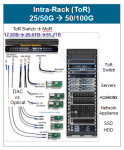
A new designation has recently entered the vernacular of the computing industry – a hyperscale data center. The adjective hyperscale implies the ability of a computing resource to scale corresponding to increased workload, to maintain an appropriate quality of service.
The traditional enterprise data center is often characterized… Read More
Caching intent largely hasn’t changed since we started using the concept – to reduce average latency in memory accesses and to reduce average power consumption in off-chip reads and writes. The architecture started out simple enough, a small memory close to a processor, holding most-recently accessed instructions and data … Read More
The global semiconductor market is headed for the largest decline in 18 years. The market dropped 32% in 2001 when the Internet bubble burst. The 2019 decline should be around 15%, the third largest annual drop after 2001 and a 17% drop in 1985. The current weakness is largely due to excess memory capacity (DRAM and NAND flash) relative… Read More
With many design teams still searching for an effective means of identifying Charged Device Model (CDM) issues early in the design process, it comes as no surprise that events on this topic generate a lot of interest and are well attended. In July Magwel’s CEO Dr. Dundar Dumlugol had the honor of being invited by Professor Ming-Dou… Read More
A few years back people were saying that the “EDA” problem was solved and that design tools had become commodity. At the same time people hailed ADAS, smart homes, mobile communication and AI as the frontiers of electronics. Perhaps it could be said that layout tools, routers, placers, and circuit simulators had largely matured… Read More
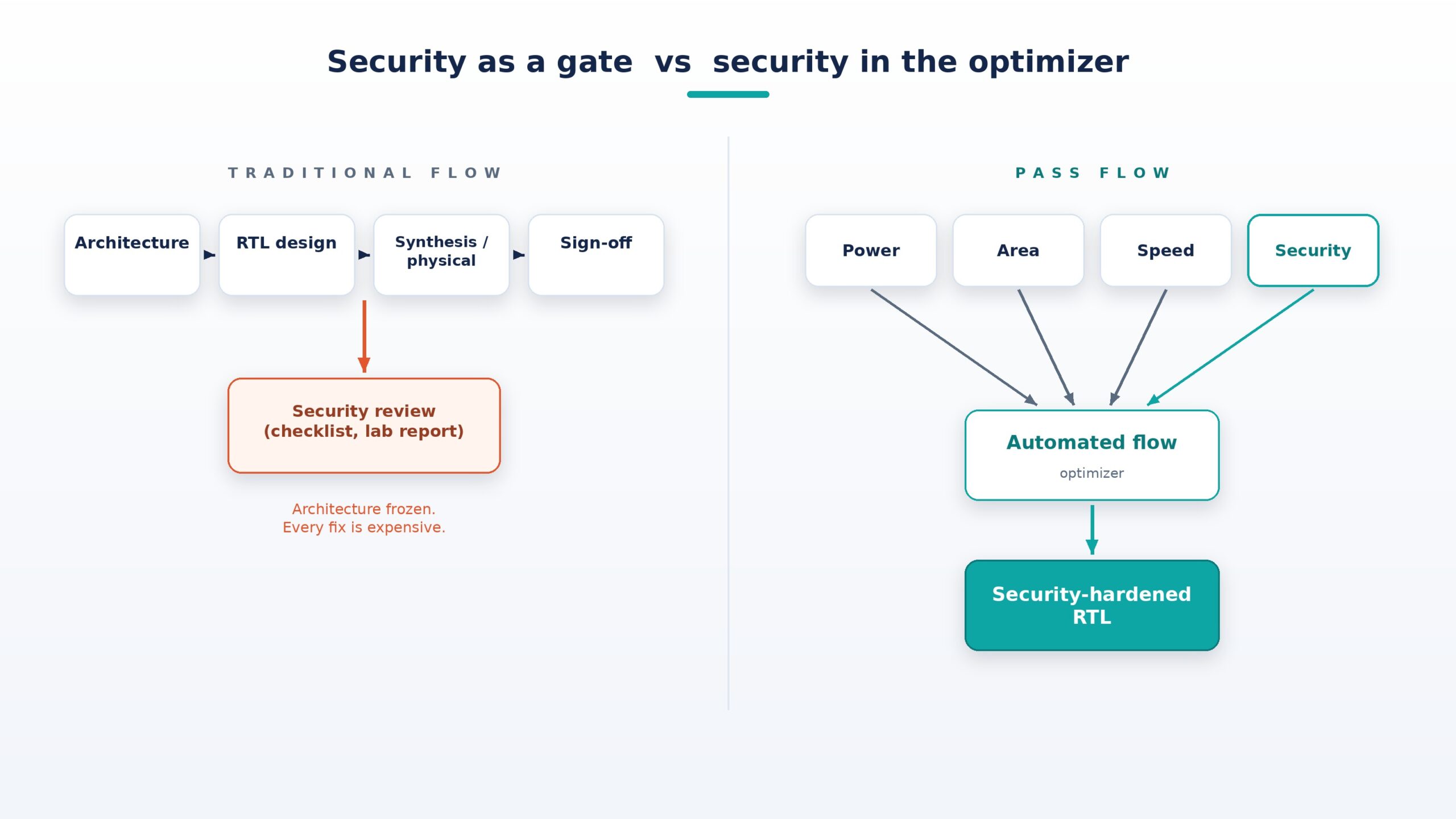
In the old days, product architects would throw a functional block diagram “over the wall” to the design team, who would plan the physical implementation, analyze the timing of estimated critical paths, and forecast the signal switching activity on representative benchmarks. A common reply back to the architects was, “We’ve… Read More
In 1990 Xilinx notified us that they believed Actel was infringing a patent that had just been issued to them. My immediate thoughts – the patent system is all screwed up! Actel had been developing our product for five years. We had been shipping it for a year and a half. During all that time, we were totally unaware that there was … Read More














Rethinking Phase Jitter: An Algorithmic Approach to Signal Integrity