







The next gains from AI in semiconductors will come less from models and more from making fab and test data reliable, connected and tied to engineering decisions.
By Sriram Nithin Gopal Lanka
Every few months there is a new AI model that can do more and semiconductor manufacturers are under pressure to put them to work. But ask the engineers who have deployed machine learning in fab or on test floor where they have spent their time and few will say choosing the algorithm. Most of it goes into finding, cleaning and joining data, and convincing colleagues that the result could be trusted. That experience leads to an uncomfortable conclusion. The next big gains for the industry from AI aren’t going to come from running more sophisticated models but they will come from making manufacturing data reliable, contextualized and connected to the decisions engineers make every day.
Plenty of data, very little of it connected.
Semiconductor fabs are not short of data. Equipment saves the sensor data for every chamber and step. Recipes, maintenance events, consumable changes are logged. Metrology and inspection tools measure film thickness, critical dimensions and defects. Wafer acceptance test, wafer sort and final test add millions of parametric data and test content pass/fail, and customer returns close the loop months later.
The problem is that those sources were built by different teams, for different reasons on different systems. They use different identifiers, time bases and levels of detail. A process engineer focuses on the lots and wafers, a test engineer on sites, yield, test time and bins, a reliability engineer on the packaged units. Somewhere between them links a failing part back to the wafer, chamber and recipe that produced it breaks. When it does, each team can analyze their own data and the problem spans over several stages.
Context turns a number into evidence
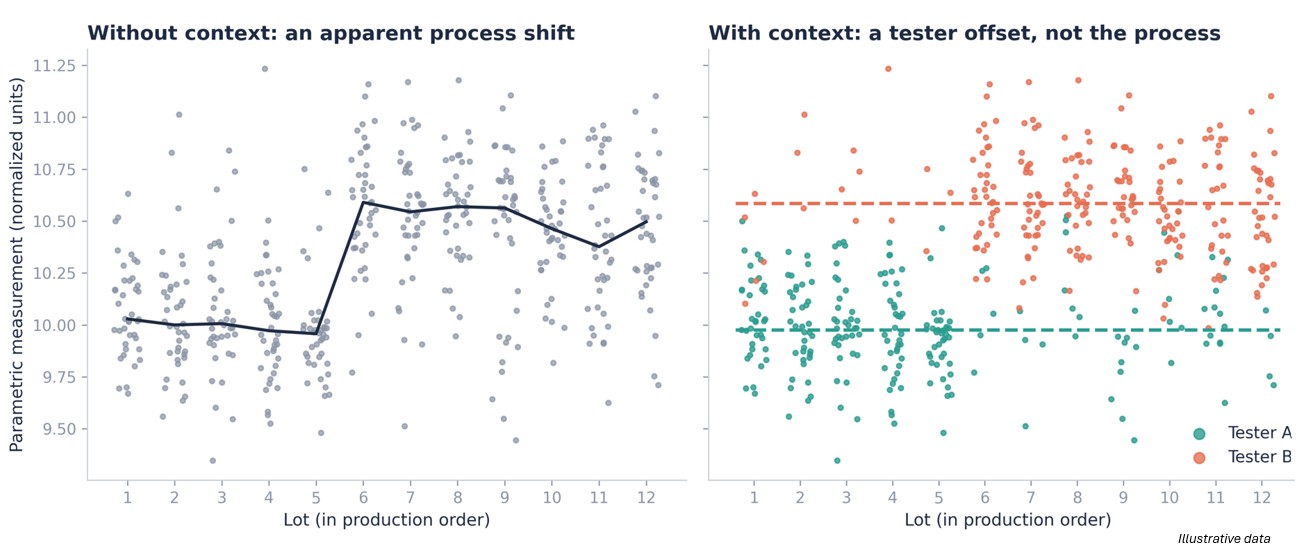
Even within one source a measurement is only as useful as the context associated with it. A leakage measurement means little without the voltage and temperature at which it was taken, revision of test program, and probe card. The thickness value means little without tool step, chamber step and recipe step. Without the context the models will find patterns. In uncontextualized manufacturing data the strongest pattern is often artifact rather than physics: an offset between two testers, a probe card changed mid-lot or units retested twice. A model that learns these patterns can look accurate in validation but still sends engineers chasing the wrong cause (Figure 1).
Data also changes reasoning over time. When a test is retired, a recipe is tuned or a limit is moved, the data before and after the change no longer describes the same thing. Unless those changes are explicitly mentioned with the data, any model trained is mixing two different processes.
Where AI genuinely helps
AI can find correlations across process steps. A slow drift from one etch chamber may show up weeks later as a shifted parametric distribution at wafer sort, later as a spike in failures on final test. Connecting those dots requires linking data that may reside in tools across many departments.
AI can also help clean data. Machine learning excels at linking inconsistent identifiers, identifying physically impossible measurements, classifying wafer map patterns and extracting knowledge from unstructured maintenance and FA notes. In many groups the most impactful first AI effort won’t be a yield model. Rather it will be the effort required to make the data credible enough for a yield model to be valuable (Figure 2).
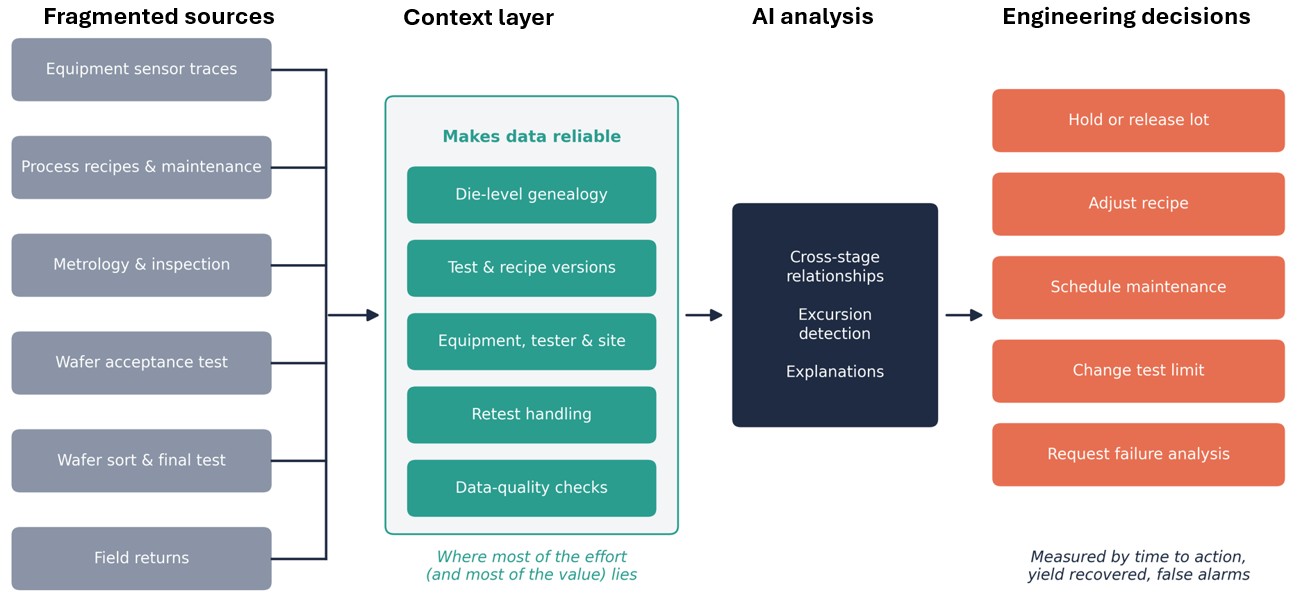
The last gap can be found between insight and action. The dashboard can indicate correlations, but correlation does not achieve yield. Someone needs to do something like change a recipe, make sure maintenance is done, check test limits or call for failure analysis. People also need to be ready to act based on the evidence. This leads to two points.
First a model must explain why it flagged something. In engineering terms that means saying what instrument was used, what step was involved and what parameter was out of range. It must be clear and precise.
Second, we should measure success by engineering performance not just how accurate the model is. The real questions are: How fast does the model detect an anomaly? How much yield can be recovered after action? How often is an alert incorrect? These are the indicators of success.
What to do first
For teams that are starting or restarting an AI effort a few things are more important than picking an algorithm.
- Connect data at every stage from wafer sort to test and if possible, include field returns so that data can be traced back to its source.
- Give context to every measurement, including test conditions, equipment, program and recipe versions and retest status.
- Treat data quality as an engineer, with an owner rather than as a cleanup task performed before each project.
- Keep engineers in the loop by providing explanations that engineers can verify against their experience.
The real advantage
Algorithms are now open for everyone with models and commercial tools. What competitors cannot copy is a tightly linked well understood body of manufacturing data and an organization that knows exactly what to do with it. The semiconductor companies that win with AI will not necessarily be the ones with the sophisticated models but rather the semiconductor companies whose engineers trust their data.
Sriram Nithin Gopal Lanka is a Senior Product Development Engineer at Advanced Micro Devices, Inc. (AMD) in Austin Texas where he has worked on DFT scan testing, memory BIST, Diagnostics, leakage testing, array repair, bitmapping, new product characterization, yield improvement and test program ownership at wafer sort and final test, and test time reduction. Before joining AMD, he was a research and development failure analysis intern at NXP Semiconductors in Austin, where he performed electrical fault isolation for new product introduction, qualification, yield enhancement and customer quality complaints. He also worked as design and validation co-op at Skyworks Solutions in Irvine CA on RF power amplifier design and measurement.
Also Read:
What DARPA Taught Me About Building Trust into Silicon
Delivering Silicon Systems Through AI Disruption, Part 1: Writing the Score
Teradyne Unveils Magnum E2 for the Next Wave of AI Memory
Share this post via:



The silent killer of analog reliability: Why SPICE misses floating net