


Blogging is not an easy thing to do. It takes time, patience, commitment, and creativity. SemiWiki brought blogging to the semiconductor industry and many companies have followed. Very few have been successful with personal or corporate blogs but as a premier semiconductor blogger I have developed a proven recipe over the last… Read More
Agentic AI Can Reach GDS. What Must It Prove Before Engineers Trust It for Tapeout?Agentic AI is beginning to move semiconductor engineering…Read More
TSMC OIP Ecosystem Forum 2026: Opening RemarksThe 2026 TSMC Open Innovation Platform (OIP) Ecosystem…Read More
LLM-assisted schematic test-report analysis and root-cause investigationBy Piyush Bag Intro: In this AI era,…Read More
From Frontend to the Frontiers of Silicon with Moores Lab AIAlex Navarro is a Principal Software Engineer at…Read More
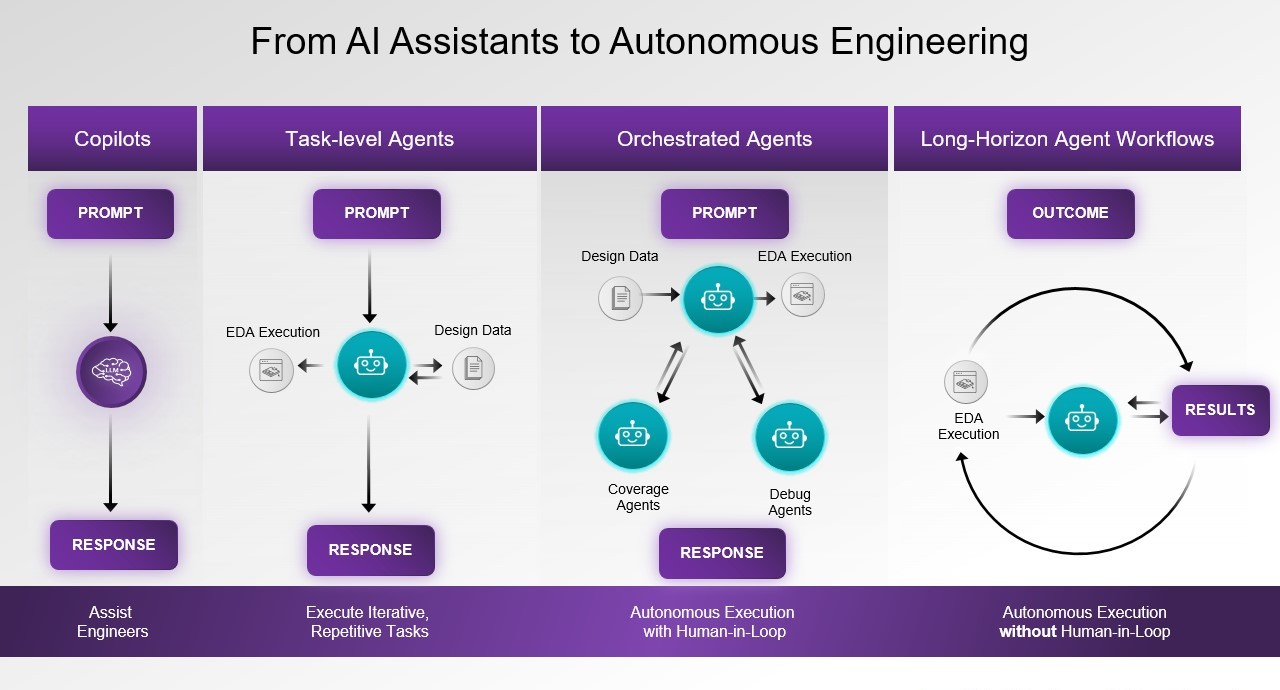
Synopsys Announces AgentEngineer Solutions and Autopilot Platform for Autonomous EngineeringSynopsys today announced its AgentEngineerTM solutions portfolio and…Read MoreInterface IP Category to Overtake CPU IP by 2025?
The Interface Design IP market explodes, growing by 18% in 2019, with $870 million, when CPU IP category grew by 5% at $1,460 million. In fact, Interface IP market is forecasted to sustain high growth rate for the next five years, as calculated by IPnest in the “Interface IP Survey 2015-2019 & Forecast 2020-2024”, to reach $1,800… Read More
Arm Rings the Bell in Supercomputing
Late last year I wrote about Arm’s efforts to play a role in servers, in AWS, and particularly Arm-based supercomputing, in the Sandia Astra roadmap and in partnering with NVIDIA who are in the Oak Ridge Summit supercomputer. These steps came, at least for me, with an implicit “Good for them, playing a role on the edges of these challenging… Read More
Siemens Acquires UltraSoC to Drive Design for Silicon Lifecycle Management
As reported recently by Dan Nenni, Siemens has signed an agreement to acquire Cambridge, UK-based UltraSoC Technologies Ltd. We’ve all seen plenty of mergers and acquisitions in EDA. Some transactions perform better than others. The best ones enhance an existing product or service by blending non-overlapping technologies.… Read More
Waking Up to the Requirements of Voice Activity Detection
There is a famous scene in the 1976 movie Taxi Driver when Robert De Niro’s character Travis is pretending to have a conversation looking in the mirror and repeatedly saying “Are you talking to me?”. I think about this scene every time I use a voice active device – Hey, are you talking to me? Yes, I am, but are you listening?
Voice command,… Read More
The Future of Chip Design with the Cadence iSpatial Flow
A few months ago, I wrote about the announcement of a new digital full flow from Cadence. In that piece, I focused on the machine learning (ML) aspects of the new tool. I had covered a discussion with Cadence’s Paul Cunningham a week before that explored ML in Cadence products, so it was timely to dive into a real-world example of the … Read More
A Compelling Application for AI in Semiconductor Manufacturing
There have been a multitude of announcements recently relative to the incorporation of machine learning (ML) methods into EDA tool algorithms, mostly in the physical implementation flows. For example, deterministic ML-based decision algorithms applied to cell placement and signal interconnect routing promise to expedite… Read More
Teaching AI to be Evil with Unethical Data
An Artificial Intelligence (AI) system is only as good as its training. For AI Machine Learning (ML) and Deep Learning (DL) frameworks, the training data sets are a crucial element that defines how the system will operate. Feed it skewed or biased information and it will create a flawed inference engine.
Application-Specific Lithography: The 5nm 6-Track Cell
An update is now available here: Application-Specific Lithography: Patterning 5nm 5.5-Track Metal by DUV
The 5nm foundry (e.g., TSMC) node may see the introduction of 6-track cells (two double-width rails plus four minimum-width dense lines) with a minimum metal pitch in the neighborhood of 30 nm. IMEC had studied a representative… Read More
What is Zero Trust Model (ZTM)
The Zero Trust Model of information #security simplifies how #information security is conceptualized by assuming there are no longer “trusted” interfaces, applications, traffic, networks, or users. It takes the old model— “trust but verify”—and inverts it, because recent breaches have proven that when an organization trusts,… Read More


The Invisible Bottleneck Is Costing You Time You Can’t Get Back