




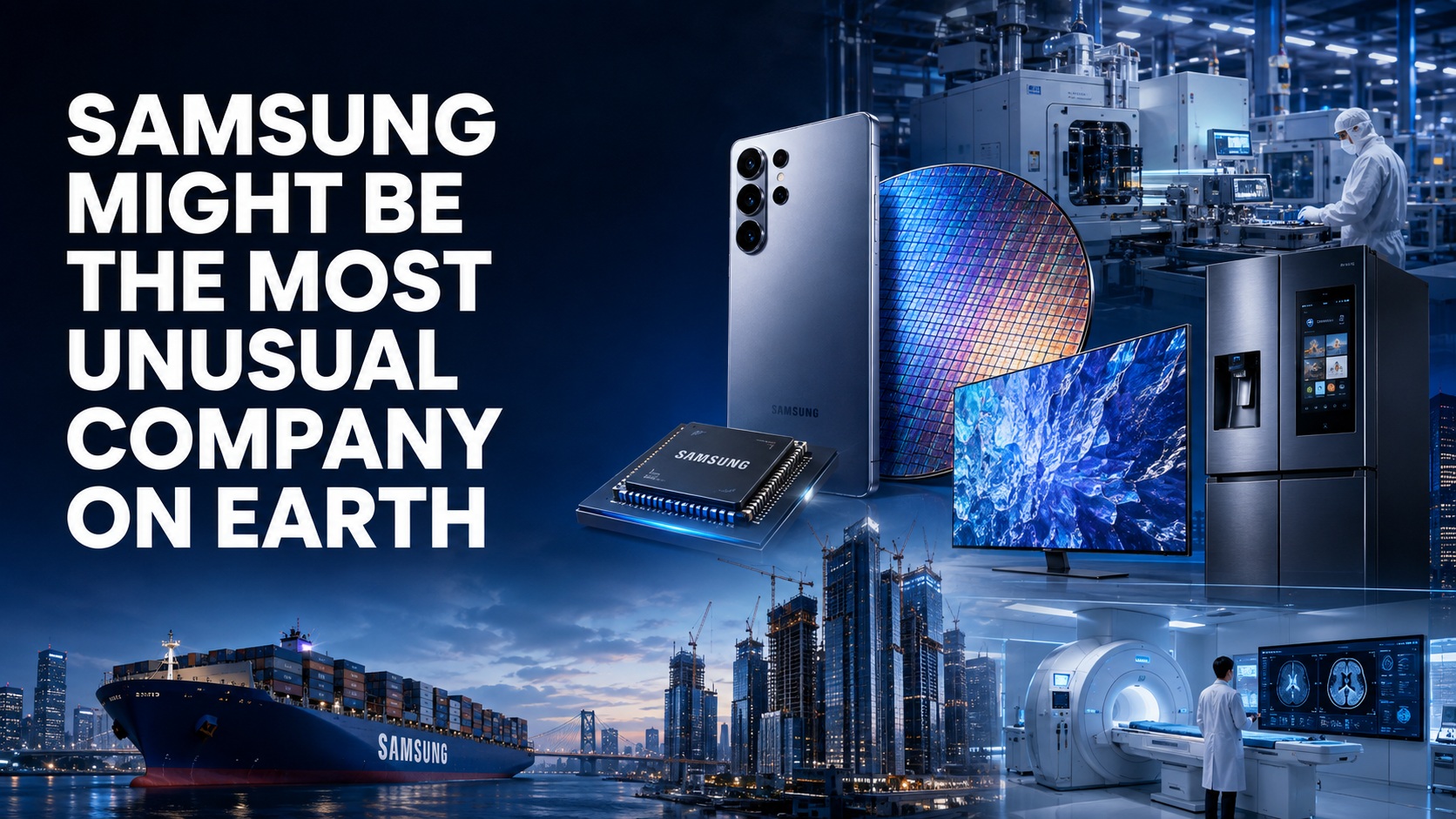


Samsung might be the most unusual company on earth because it is difficult to decide what kind of company it actually is. To most consumers, Samsung means smartphones, televisions, refrigerators. Yet the name also appears on apartment towers, cargo ships, hospital equipment, insurance policies, construction projects, and machinery. It is less like a conventional corporation than a commercial ecosystem: a network of businesses broad enough to touch every stage of modern life, from the materials inside a device to the building where its owner lives.
Its strangeness begins with scale. Many companies dominate one field. Apple is identified with consumer technology; Toyota with cars; Shell with energy. Samsung, by contrast, has spent decades spreading across fields. Its affiliates make electronics and medicines, build ships and skyscrapers, and sell financial services. This variety allows Samsung to operate on several levels of the economy at once. It can develop raw technologies, manufacture components, assemble finished products, finance expansion, and construct the infrastructure that industries require.
Semiconductors are at the center of this system. Samsung is not simply a company that puts chips into its own Galaxy phones, televisions, and appliances. It is a major producer of memory chips, processors, image sensors, and other components used throughout the technology industry. Its semiconductor factories are among the most complex manufacturing facilities ever built. They require precision, huge investments, machinery, and years of research. A tiny flaw can ruin a chip, while a successful design can power millions of devices.
This chip business reveals what makes Samsung so distinctive. Most people encounter the company through products, but much of its power lies deeper in the supply chain. Samsung can design a phone while also producing its memory, storage, display, memory and processor components. It also sells parts to rival manufacturers. A company competing against Samsung in the smartphone market may simultaneously depend on Samsung for hardware. Samsung is therefore both a consumer brand and part of the hidden industrial machinery behind other brands. Few corporations manage this double identity so.
Samsung’s structure reflects South Korea’s chaebol system: family-influenced business groups whose legally separate affiliates are connected through history, ownership, and strategy. Samsung is not one simple corporate entity but a constellation. Its rise was closely tied to South Korea’s transformation from a war-damaged country into an export powerhouse. As the nation industrialized, Samsung moved from trading groceries into textiles, electronics, heavy industry, finance, and advanced technology. Semiconductors became strategically important because they combined expertise, manufacturing scale, and global demand.
The company is unusual culturally as well. Its image combines futuristic engineering with the traditions of a family dynasty. It competes at the frontier while facing questions about succession, family control, political influence, and corporate governance. That tension makes Samsung appear simultaneously modern and old-fashioned. Its semiconductor campuses may represent the future of computing, yet the organization carries the institutional weight of an older industrial empire.
Samsung’s breadth creates both strength and risk. Semiconductor manufacturing is cyclical: demand, supply, and chip prices can change. Building fabs costs billions, and yesterday’s production process can quickly become outdated. Samsung can absorb some of these pressures because it operates across many industries, but its size also gives it economic influence. Complex relationships among affiliates may reduce transparency, while family leadership can conflict with the interests of shareholders. Its story includes scandals and controversies alongside engineering triumphs.
Bottom line: Perhaps that is why Samsung inspires fascination. It can be encountered in a pocket, a kitchen, a hospital, a portfolio, a shipyard, or a city skyline. Even when its logo is absent, its chips or displays may be inside the device someone is using. Calling Samsung an electronics company is accurate in the same way that calling a city a collection of buildings is accurate: true, but radically incomplete. Samsung might be the most unusual company on earth because it does not sell products. It helps manufacture the foundations on which industries depend.
Also Read:
The Twelve-Month Rule Does Not Describe a New Fab
How TSMC Is Wiring the AI Era With Light
Share this post via:



SEMICON West’s Autonomous Fab Vision Needs a Decision-Escalation Design