




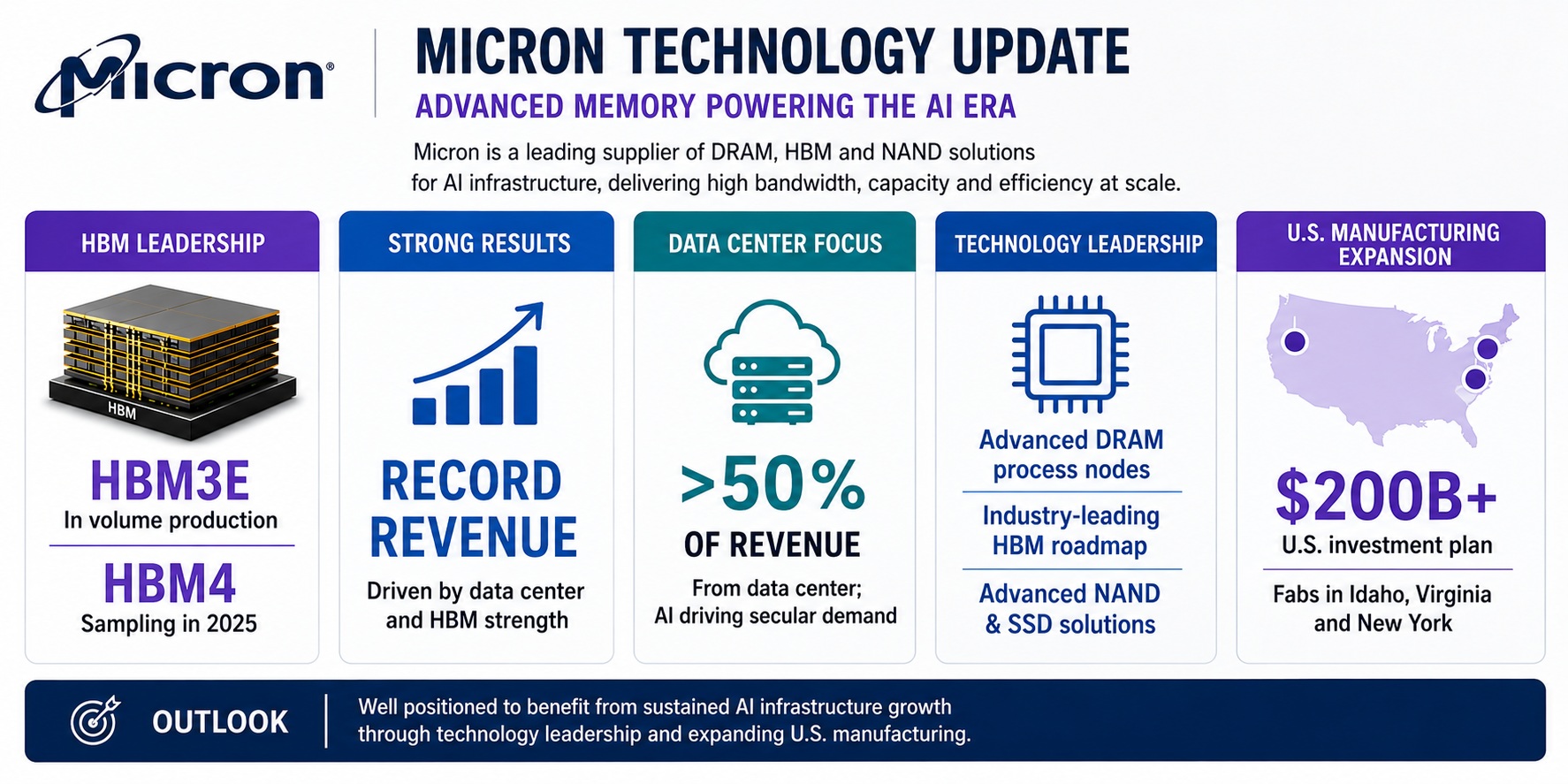



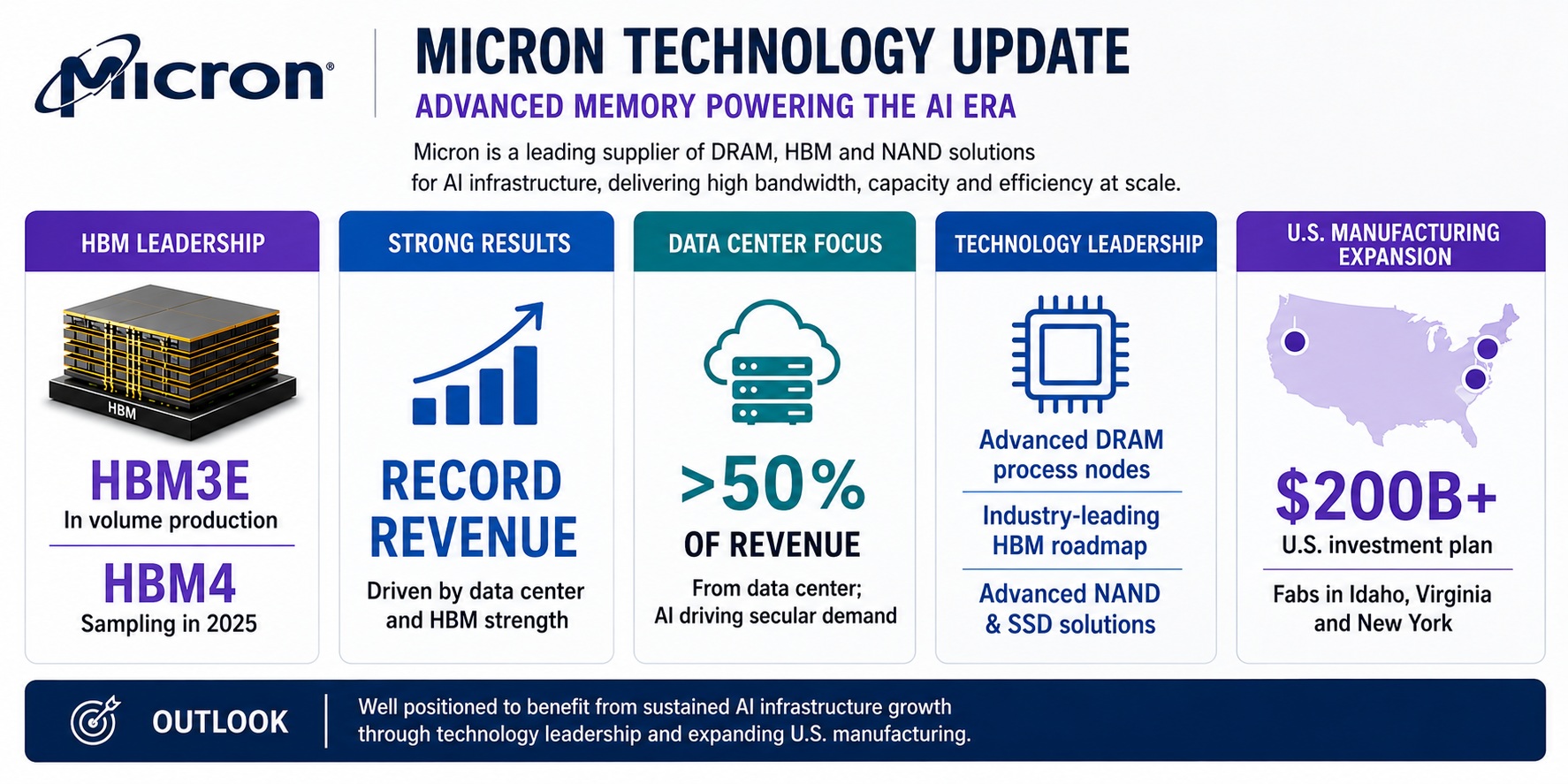
Micron Technology has emerged as a critical supplier in the AI compute ecosystem, leveraging its leadership in advanced DRAM, High Bandwidth Memory (HBM), and NAND flash technologies to address rapidly growing demand from hyperscale data centers and AI accelerator platforms. The company’s strategic focus on leading-edge memory architectures has significantly improved its competitive position as AI training and inference workloads drive unprecedented memory bandwidth and capacity requirements.
A central component of Micron’s growth strategy is its HBM portfolio. HBM integrates multiple DRAM dies through Through-Silicon Via (TSV) technology and advanced packaging techniques to deliver substantially higher bandwidth and lower power consumption than conventional DDR-based memory systems. Micron’s HBM3E products are now shipping into leading AI accelerator platforms, providing memory bandwidth exceeding 1.2 TB/s per stack while supporting the massive parameter counts associated with large language models and generative AI workloads.
The transition from HBM3E to HBM4 represents a major technology inflection point. HBM4 will incorporate wider interfaces, higher stack densities, and enhanced signaling architectures to support next-generation AI accelerators. Industry forecasts suggest that HBM content per accelerator could increase significantly over the next several years as model complexity, context windows, and inference requirements continue to scale. Micron’s roadmap positions the company to participate in this content growth while maintaining competitive power efficiency and performance metrics.
Beyond HBM, Micron continues to advance its DRAM technology portfolio through successive node transitions. The company’s 1-beta and 1-gamma DRAM process technologies deliver improved bit density, lower operating voltages, and enhanced performance characteristics. These advances are increasingly important because AI servers require significantly greater DRAM capacity than traditional enterprise systems. Memory capacity per server platform continues to rise as organizations deploy larger foundation models and retrieval-augmented architectures.
Data center revenue has become the dominant contributor to Micron’s business, reflecting the structural shift occurring within the memory market. Historically, PCs and mobile devices represented the largest DRAM demand drivers. Today, hyperscale AI clusters are consuming a growing percentage of industry output, particularly at advanced process nodes. AI servers typically contain multiple terabytes of DRAM in addition to substantial HBM capacity attached directly to accelerators, creating a favorable demand environment for memory suppliers.
Micron is also strengthening its position in data center storage through advanced NAND and SSD solutions. The company continues deployment of its 232-layer and next-generation NAND technologies, targeting improved cost per bit, endurance, and performance. AI infrastructure places increasing demands on storage systems due to the need to manage training datasets, vector databases, model checkpoints, and inference workloads. Enterprise SSDs capable of sustaining high throughput and low latency are becoming essential components of AI data pipelines.
From a manufacturing perspective, Micron is expanding both domestic and international production capacity. The company has initiated production of advanced DRAM technologies in Virginia while continuing development of new fabrication facilities in Idaho and New York. These investments support long-term supply requirements and align with broader efforts to establish a more resilient semiconductor manufacturing base within the United States. The expansion strategy is particularly important given the capital intensity associated with advanced memory production and the increasing complexity of leading-edge packaging technologies.
Supply-demand dynamics remain favorable for advanced memory products. HBM manufacturing requires substantially more wafer starts, packaging capacity, and testing resources than conventional DRAM. As a result, industry capacity additions remain constrained despite strong demand growth. This supply discipline has supported favorable pricing trends across premium memory segments, particularly for products targeting AI accelerators and hyperscale deployments.
Looking forward, Micron’s competitive position will be determined by execution across several key technology vectors: advanced DRAM node migration, HBM4 qualification and volume production, NAND scaling, and advanced packaging integration. Competition from Samsung Electronics and SK hynix remains intense, particularly in HBM, where product qualification cycles and packaging capabilities have become major differentiators. Nevertheless, Micron has successfully established itself as a strategic supplier within the AI infrastructure supply chain.
Bottom line: As AI compute architectures continue to evolve, memory bandwidth, capacity, power efficiency, and packaging integration are increasingly becoming system-level performance bottlenecks. This trend elevates the strategic importance of memory suppliers and positions Micron to benefit from sustained growth in AI infrastructure spending through the remainder of the decade.
Also Read:
Intel and TSMC Take Different Paths to High-NA EUV
Intel Foundry and the DAC2026 Ecosystem
Executive Interview with James Huang of AlChip
Share this post via:



The silent killer of analog reliability: Why SPICE misses floating net