







After speaking with dozens of semiconductor professionals at the Design Automation Conference in Long Beach about AI in the chip-design workflow, Claude emerged as the common denominator in every conversation. We’re still at the tip of the iceberg when it comes to using AI in the design flow. If management is pushing your team to adopt AI, it seems that Claude is an easy and practical entry point.
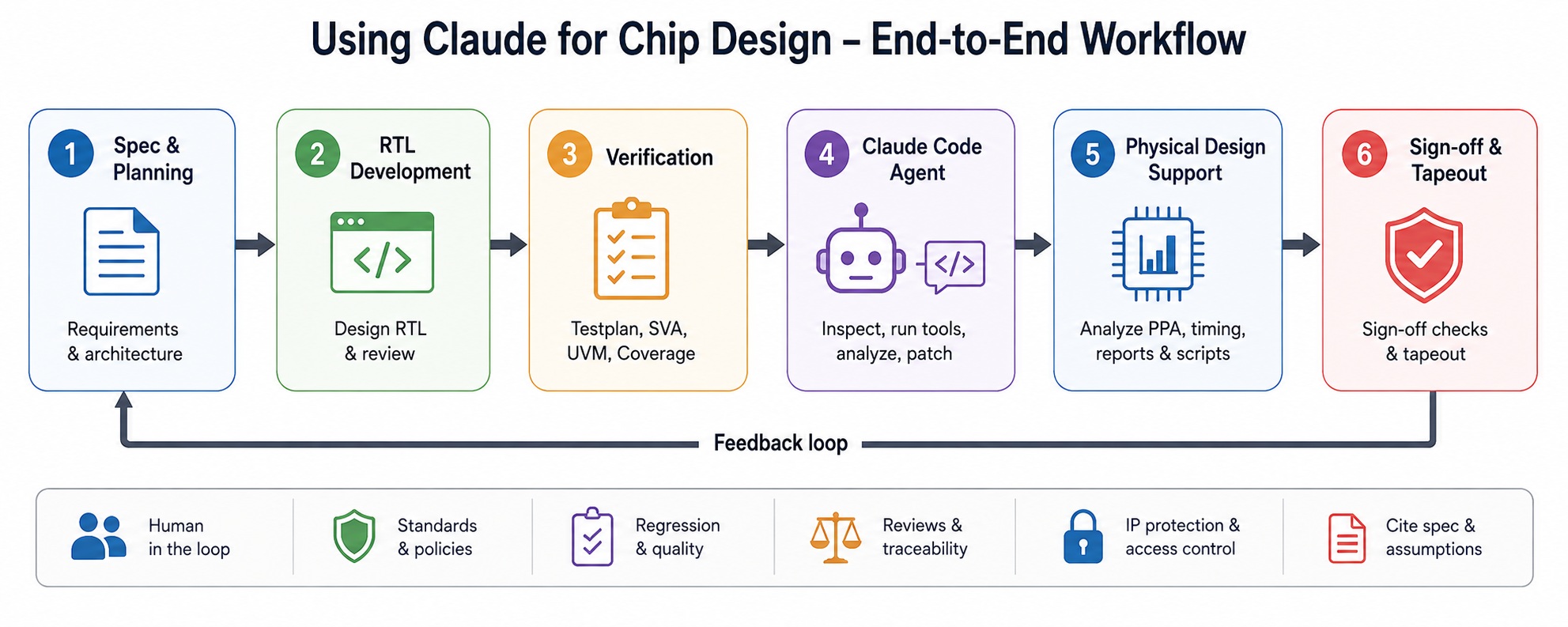
Today, Claude can support semiconductor design as an engineering copilot across specification analysis, RTL development, verification, automation, and debug. It should not be treated as an autonomous replacement for EDA tools or experienced engineers. Its value comes from translating design intent into structured artifacts, reasoning across large codebases, and orchestrating repeatable tool-driven workflows.
A productive starting point is specification decomposition. Engineers can provide a module specification, interface protocol, timing assumptions, reset behavior, performance targets, and corner cases. Claude can convert this material into a requirements table, microarchitecture proposal, register map, state-machine description, and implementation checklist. This step exposes ambiguity before coding begins. For example, Claude can identify undefined behavior during simultaneous read and write operations, inconsistent clock-domain assumptions, or missing rules for backpressure and error recovery.
Claude can then draft synthesizable SystemVerilog or VHDL. Suitable tasks include finite-state machines, arbiters, FIFOs, protocol adapters, control/status register blocks, and parameterized datapaths. Prompts should state the target language version, synthesis constraints, latency, throughput, reset polarity, clocking model, and prohibited constructs. The generated RTL must be reviewed for width errors, unintended latches, incomplete assignments, signedness problems, unsafe clock-domain crossings, and reset inconsistencies. Claude is most effective when asked to make small, reviewable changes rather than generate an entire complex subsystem at once.
Verification is often the strongest application. Claude can create test plans, SystemVerilog Assertions, constrained-random sequences, scoreboards, functional coverage models, and UVM component skeletons. It can derive properties directly from requirements, such as proving that a request is eventually acknowledged, FIFO pointers never overflow, mutually exclusive grants remain exclusive, or an output remains stable under backpressure. It can also analyze simulator logs, assertion failures, wave-dump summaries, and coverage reports to suggest likely root causes. Commercial EDA platforms increasingly combine generative or agentic AI with simulation, formal analysis, regression management, and debug, demonstrating that language-model assistance is most useful when connected to authoritative verification engines rather than used alone.
Claude Code can operate inside a repository, inspect multiple files, edit code, and run tests or command-line tools. In a chip-design environment, teams can wrap lint, elaboration, simulation, formal verification, synthesis, and static-timing commands in controlled scripts. Claude can execute a loop: modify RTL, run lint, interpret diagnostics, launch focused tests, and produce a patch with a concise rationale. Model Context Protocol connections or custom tool interfaces can expose internal documentation, issue trackers, regression dashboards, and approved EDA commands while preserving access controls.
For physical-design assistance, Claude can summarize synthesis and place-and-route reports, compare timing paths between runs, classify congestion or power issues, and generate Tcl or Python utilities for experiment management. It may recommend hypotheses—such as excessive fanout, poor pipelining, macro-placement constraints, or overaggressive clock targets—but the optimization decision must be validated through the actual flow. Power, performance, and area trade-offs depend on libraries, process corners, extraction, constraints, and tool settings that a language model cannot reliably infer from incomplete context with confidence.
A disciplined workflow is essential. Store project rules in a repository instruction file: coding conventions, clock and reset policies, directory structure, approved libraries, verification commands, and sign-off requirements. Require Claude to cite the specification paragraph behind every behavioral change. Use version control, mandatory human review, deterministic regressions, lint, CDC/RDC analysis, formal checks, synthesis, timing analysis, equivalence checking, and physical verification as gates. Never accept plausible-looking RTL merely because it compiles.
Security and intellectual-property protection are equally important. Teams must follow corporate policies regarding model deployment, data retention, source-code exposure, foundry information, third-party IP, and export-controlled material. Secrets, license credentials, and proprietary process data should not appear in prompts or logs. Enterprise gateways, restricted repositories, permission-limited tool calls, and audit trails reduce risk.
Bottom line: Claude works best as a reasoning and automation layer around established chip-design methods. When guided by experienced chip designers, Claude can accelerate documentation, implementation, verification, and debugging, but correctness still comes from executable specifications, trusted EDA tools, measured results, and accountable engineering review. Just the tip of the ice berg, absolutely.
Also Read:
Rethinking Formal Verification in the AI Era
Agentrys Designs a Real Chip with its Multi-Agent Workforce
IP Lifecycle Management in the AI Era
Share this post via:



The silent killer of analog reliability: Why SPICE misses floating net