





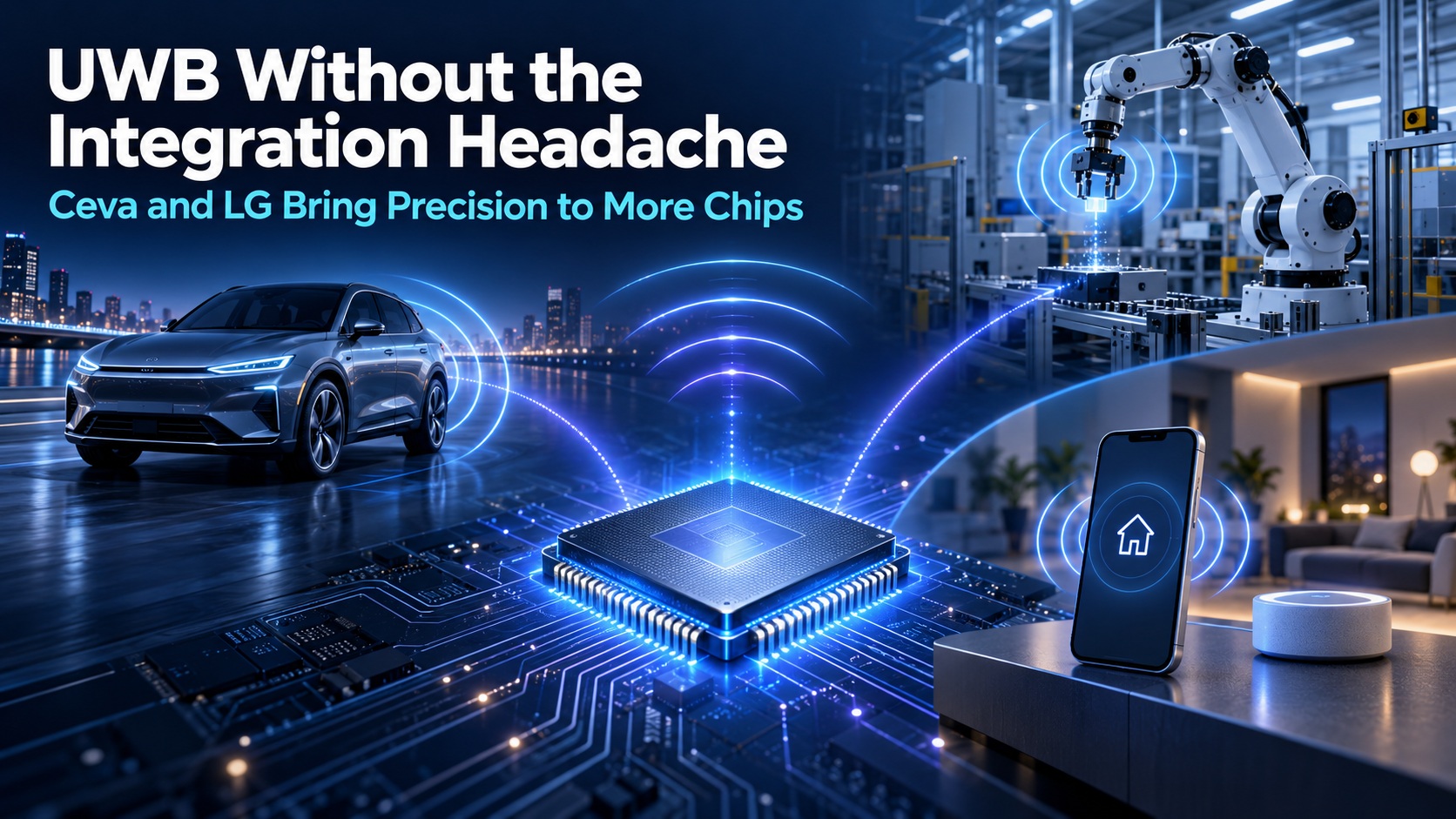
Ceva and LG Electronics have joined forces to remove one of the biggest obstacles to ultra-wideband adoption: integrating a complete radio, baseband and software stack into a production system-on-chip. Their joint platform combines Ceva-Waves UWB baseband intellectual property and software with an RF front end developed by LG Electronics’ SoC Center. The RF is designed for TSMC’s 22-nanometer process, giving semiconductor companies a silicon-ready route to add precise ranging, positioning and sensing to automotive, industrial and consumer devices.
Technically, the partnership closes the gap between two tightly coupled parts of any UWB implementation. LG supplies the analog and RF circuitry that generates, transmits and receives extremely short pulses across wide spectrum. Ceva supplies the digital baseband that turns those signals into timing and distance information, plus the software needed to configure the subsystem and expose its capabilities to applications. Packaging those elements as a coordinated solution should reduce interface validation, physical-design work and performance tuning compared with sourcing the radio and baseband separately.
That matters because UWB performance depends on more than checking protocol-compliance boxes. Accurate ranging requires precise timestamping, synchronization and channel estimation while coping with interference, multipath reflections and non-line-of-sight conditions. Power consumption and silicon area must also remain low enough for battery-powered tags, phones, wearables and embedded controllers. An RF and baseband designed and validated together can give SoC developers a more predictable path through these trade-offs, shortening development cycles and lowering the risk of expensive silicon respins.
Ceva’s next-generation architecture supports IEEE 802.15.4ab, the emerging evolution of the UWB standard. According to Ceva, it improves extended-range and non-line-of-sight ranging, adds resilience to interference, supports new channels and enables UWB radar sensing. Those additions push UWB beyond its familiar roles in phone-assisted item finding and vehicle digital keys. Instead of merely detecting whether a credential is nearby, systems can estimate position, direction and movement with high precision, while time-of-flight measurements help resist relay attacks that can fool technologies based mainly on received signal strength.
The market implications span three large semiconductor categories. In vehicles, UWB can support secure passive entry, occupant detection, child-presence monitoring, automated parking interactions and precise location of devices inside or around the cabin. In factories and warehouses, it can track tools, pallets, robots and personnel, improve geofencing and support safer human-machine collaboration where ordinary Bluetooth proximity is too ambiguous. In consumer products, it can enable spatially aware smart-home controls, indoor navigation, peer-to-peer discovery, access systems and gesture or presence sensing without relying on a camera.
The business model is equally important. Ceva licenses connectivity IP rather than selling a fixed chip, so customers can embed UWB inside a differentiated SoC alongside processors, security engines and other radios. LG contributes hard-to-develop RF expertise and a process-specific implementation. The companies say a major U.S. semiconductor supplier has already adopted the combined solution, providing early commercial validation. This approach could broaden the supplier base: more chipmakers can build UWB products without assembling every layer internally or depending on a standalone transceiver.
There are still practical constraints. Customers must complete system-level certification, antenna design, coexistence engineering, security architecture and interoperability testing. Support for 22nm is attractive for cost-sensitive mixed-signal devices, but customers using other process nodes may require additional porting. Adoption will also depend on consistent behavior across phones, vehicles, access points and infrastructure, not simply excellent radio specifications.
Bottom line: The Ceva-LG collaboration is significant because it turns UWB from a specialist integration project into a more accessible SoC building block. ABI Research, cited by Ceva, expects annual UWB device shipments to rise from 597 million in 2026 to nearly 1.18 billion by 2030. A validated, licensable RF-to-software platform can help supply meet that demand, increase competition and bring precise, secure spatial awareness to many more edge devices. That scale could improve interoperability by putting standards-based capabilities into more product categories.
Also Read:
2026 Ceva Edge Symposium: Building Intelligence Beyond the Cloud
New Audio SoCs Combine Bluetooth HDT with Dual-RF Technology
Intelligence at the Edge, Leverage at the Core
Share this post via:



Comments
There are no comments yet.
You must register or log in to view/post comments.