





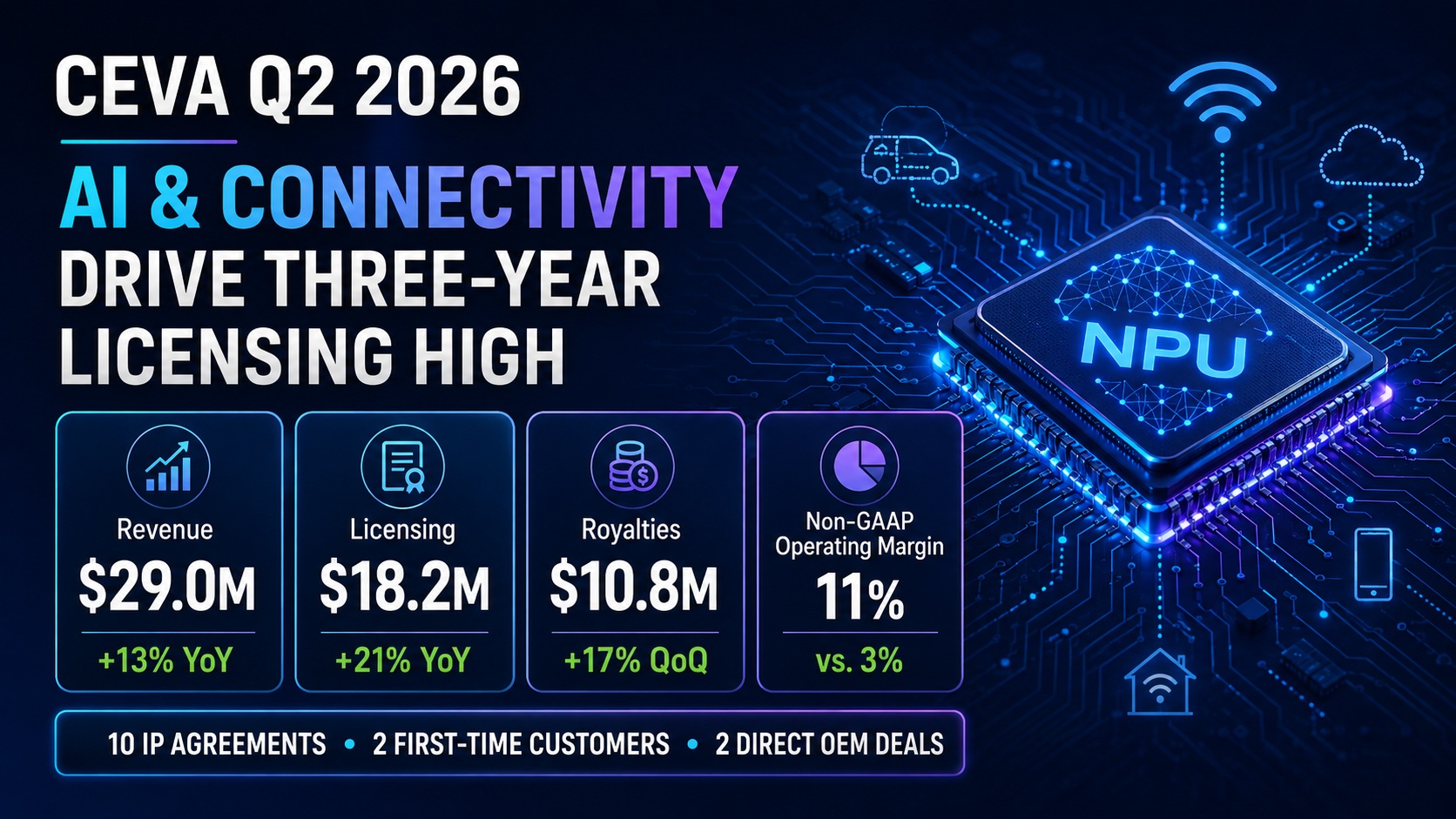
Ceva’s second-quarter 2026 performance demonstrates how an intellectual-property supplier converts design activity into high-margin revenue before customer products reach production. Total revenue increased 13% year over year to $29.0 million, led by licensing and related revenue of $18.2 million, up 21% and the highest quarterly level in three years. Licensing represented 63% of revenue, while royalties contributed $10.8 million, or 37%. Licensing payments monetize engineering access and contractual rights immediately, whereas royalties scale later with customer chip or device shipments.
The licensing result reflects demand across artificial intelligence and wireless connectivity. Ceva signed ten agreements, including two with first-time customers and two directly with original-equipment manufacturers. Direct OEM contracts can increase Ceva’s architectural influence because its hardware IP, embedded software, and system expertise are incorporated closer to product definition. They may expand content per design and create longer relationships than component-level engagements. Trailing-twelve-month licensing and related revenue reached $69.6 million, 13% higher, indicating sustained design-win activity rather than one isolated transaction.
The most significant agreement involved NeuPro-M neural-processing-unit IP for custom silicon developed by a global AI and computing platform company. This customer controls hardware and its operating-system environment, enabling optimization across neural-network execution, software tooling, memory behavior, and silicon implementation. Such vertical control may improve the probability that Ceva’s NPU becomes embedded in a repeatable platform rather than a single device. However, IP licensing has long qualification and production cycles, so a design win does not guarantee predictable royalty revenue.
Connectivity adoption also broadened. A U.S. semiconductor vendor added a third-party chip incorporating Ceva Wi-Fi 6 and Bluetooth Low Energy IP, illustrating that reusable IP can propagate across customers and portfolios. Another customer upgraded from an individual baseband component to Ceva’s complete baseband-processing subsystem. That transition increases silicon content, integration responsibility, and potential contract value while reducing the customer’s development burden. Agreements across the United States, Europe, China, and Asia-Pacific limit dependence on one geography, although export controls and trade restrictions remain material risks.
Royalty revenue grew only 1% year over year but improved 17% sequentially, signaling an emerging shipment recovery. Wireless-connectivity volumes were strong, automotive AI programs continued ramping, and smartphone royalties improved. Licensing strength supplies near-term revenue and creates a pipeline, while royalty growth validates prior designs through commercial volume. Automotive programs can be especially durable because vehicle platforms have long production lives, though certification and launch schedules are lengthy. Consumer wireless and smartphone royalties offer higher volumes but greater cyclicality, inventory sensitivity, and pricing exposure.
Ceva’s income statement shows meaningful operating leverage. GAAP gross margin increased to 87% from 86%, while non-GAAP gross margin reached 88% from 87%. Non-GAAP operating income rose to $3.1 million from $0.8 million, expanding operating margin to 11% from 3%. Revenue grew 13%, yet non-GAAP operating income nearly quadrupled because the incremental gross profit exceeded growth in operating expenses. This leverage is characteristic of scalable IP businesses: development costs are incurred centrally, while additional licenses and shipment royalties carry limited direct cost.
Nevertheless, GAAP results remained negative. GAAP operating loss improved to $2.1 million from $4.5 million, and net loss narrowed to $2.9 million from $3.7 million. Diluted loss per share improved to $0.10 from $0.15. The $5.2 million difference between non-GAAP operating income and GAAP operating loss likely reflects excluded items such as equity compensation, amortization, or acquisition-related charges; investors should assess their recurrence rather than treating every adjustment as economically irrelevant.
Bottom line: The quarter strengthens Ceva’s Smart Edge thesis. AI inference, connectivity, sensing, and embedded software increasingly converge inside power-constrained devices, favoring prevalidated, low-power IP. The central technical and financial question is conversion: Ceva must transform licensing momentum into diversified production royalties while controlling expenses and narrowing GAAP losses. If NeuPro-M platforms, automotive AI, Wi-Fi, Bluetooth, cellular, and OEM engagements reach volume, the company’s high gross margin should support further profit expansion. Failure or delay in commercialization would leave results dependent on episodic license timing, despite current demand strength.
Also Read:
New Audio SoCs Combine Bluetooth HDT with Dual-RF Technology
Ceva Targets PC Gaming Audio Market With RealSpace Elevate for Windows
CEVA Accelerates Wireless Edge Innovation with Bluetooth HDT and Integrated RF Design Win
Share this post via:



Comments
There are no comments yet.
You must register or log in to view/post comments.