





I believe DAC 2026 will be remembered as the turning point for AI assisted design. There has been discussion about AI infusion in EDA for a while now. Most of it was about how AI can be added to traditional tools to make existing methodologies better. This year, that changed. There were several new companies that highlighted a fundamentally new way to approach chip design. One where trained AI models take a more active role in design and optimization. A stronger focus on WHAT should be done instead of HOW to make an existing process better.
The presentations were exciting. Fundamentally new approaches were presented. You will be reading more about it here on SemiWiki. All this new technology does share something that isn’t new however – analog/mixed signal design is different. This is a story about one company that saw this problem and applied AI in a different way to address the unique challenges of analog design. Let’s see how Mach42 delivers a different take on AI in the design flow at DAC 2026.
How it Started
Mach42 was originally spun out of the Department of Physics at the University of Oxford in 2019. The original mission was to build software tools that could significantly accelerate expensive physics simulations while supporting complex computational workflows. The prototype tools were successfully applied in the emulation of extreme states of matter such as plasmas, and initial contracts in the fusion energy space followed.
After seed funding in 2021, Mach42 turned its attention to a fundamental simulation
bottleneck in semiconductor design, the verification of complex analog circuits. Traditional methods use non-linear equation solvers to model circuits. While this approach is highly accurate, it is also extremely slow. The main method of speedup is to apply more and faster hardware to the problem. Mach42 had a different idea. Develop a new generation of physics-driven AI models that can learn the underlying equations that govern complex systems.
The Overview Presented at DAC

On Tuesday at DAC, there was an engineering special session on AI and digital techniques powering the future of analog design. As part of that session, Dr. Bijan Kiani gave a presentation on Analog Intelligence. Bijan began by reviewing the increasing analog content in advanced chip designs. For example, the Apple M4 Max has about 200 instances of 20 different analog blocks.
Current methods of analog verification simply can’t keep up. According to Siemens/Wilson Research, in 2005 40% of respins were due to digital blocks and 10% were due to analog blocks. In 2025, digital contributes 15% to respins while analog contributes 40%. Something must be done.
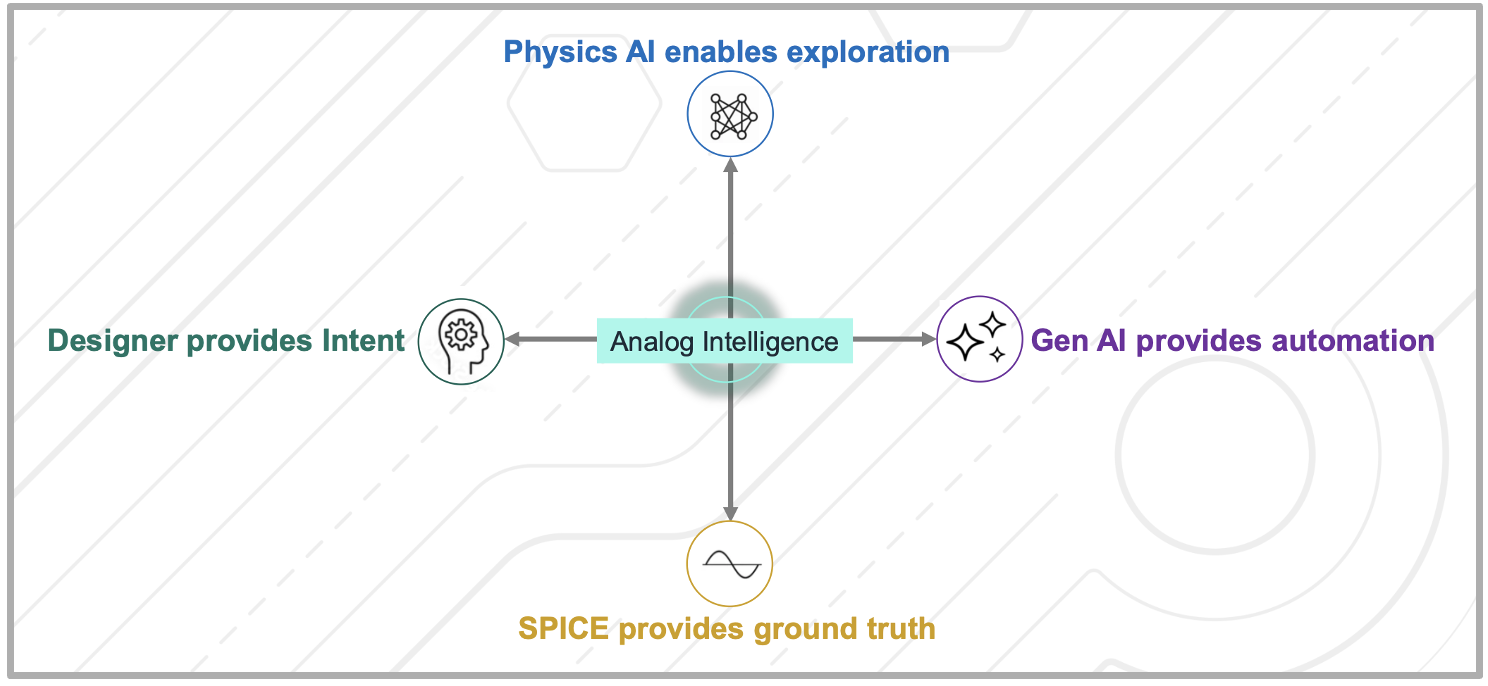
Bijan went on to point out that generative AI isn’t enough. This approach automates workflows by learning patterns and generating code and scripts. What is needed for analog design is something that enables exploration of the design space. He explained that Mach42’s Physics AI learns circuit dynamics which then allows prediction of circuit behavior. This approach takes the time-consuming analog simulation process out of the loop for design exploration, delivering highly accurate results in a fraction of the time.
Called Analog Intelligence, this new approach promises to radically improve the quality and speed of analog design, a process that is currently the limiting factor for many projects. Model training data is based on proven, accurate simulation results from popular tools. Once trained, these models can then deliver the required design exploration results much, much faster with high accuracy.
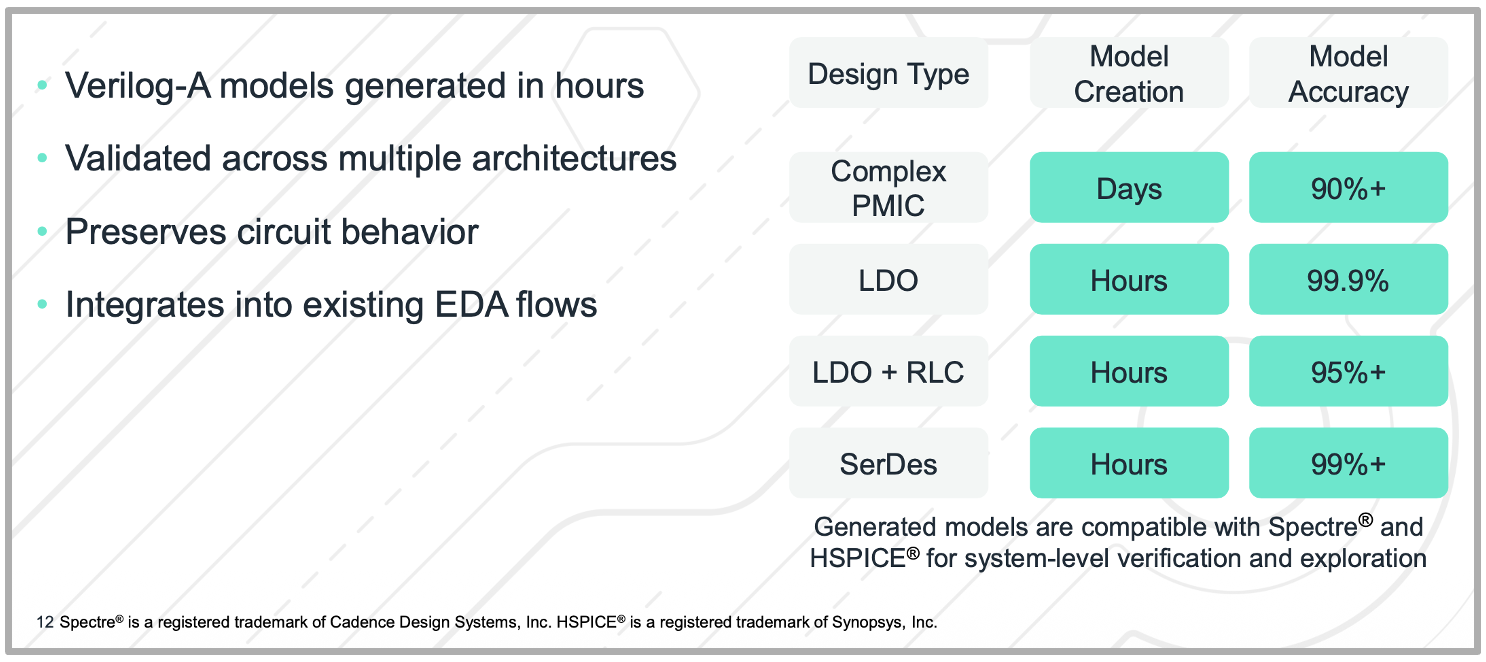
The figure below illustrates what Physics AI can deliver in practice.
How the pieces fit together to deliver Analog Intelligence is summarized in the figure below.
Seeing it in Action
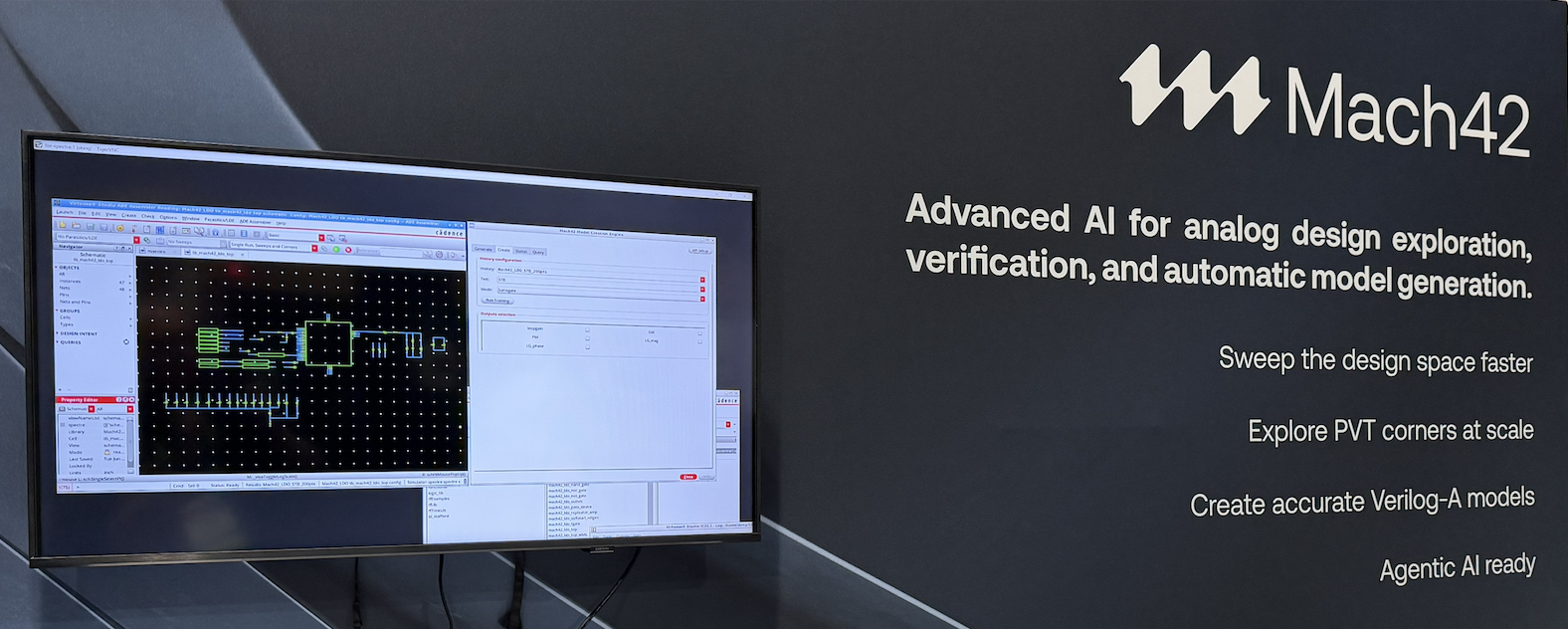
I had the opportunity to see a live demonstration of Analog Intelligence at DAC in the Mach42 booth. An LDO design was loaded into Virtuoso Studio ADE to generate the training data for an AI model of the LDO. An easy-to-use GUI is provided by Mach42 to define the various operating points to simulate over the operating range of the design. The tool provides multi-variable relationships to ensure the simulated points represent real operating conditions. The left side of the graphic at the top of this post shows what this interface looks like.
How the data should be assembled to drive model training is also specified in this interface. Once this is done, the training data is created, and the new analog model is trained on that data. The process is straightforward and not time-consuming.
When the model was created, we started some design exploration. A set of conditions that sweep various parameters for the design was easily created in the Mach42 interface. I watched as all these conditions were then run through the new AI model to generate a series of waveforms. In literally a few seconds there were 1,000 waveforms available. A partial view of the data generated is shown below.
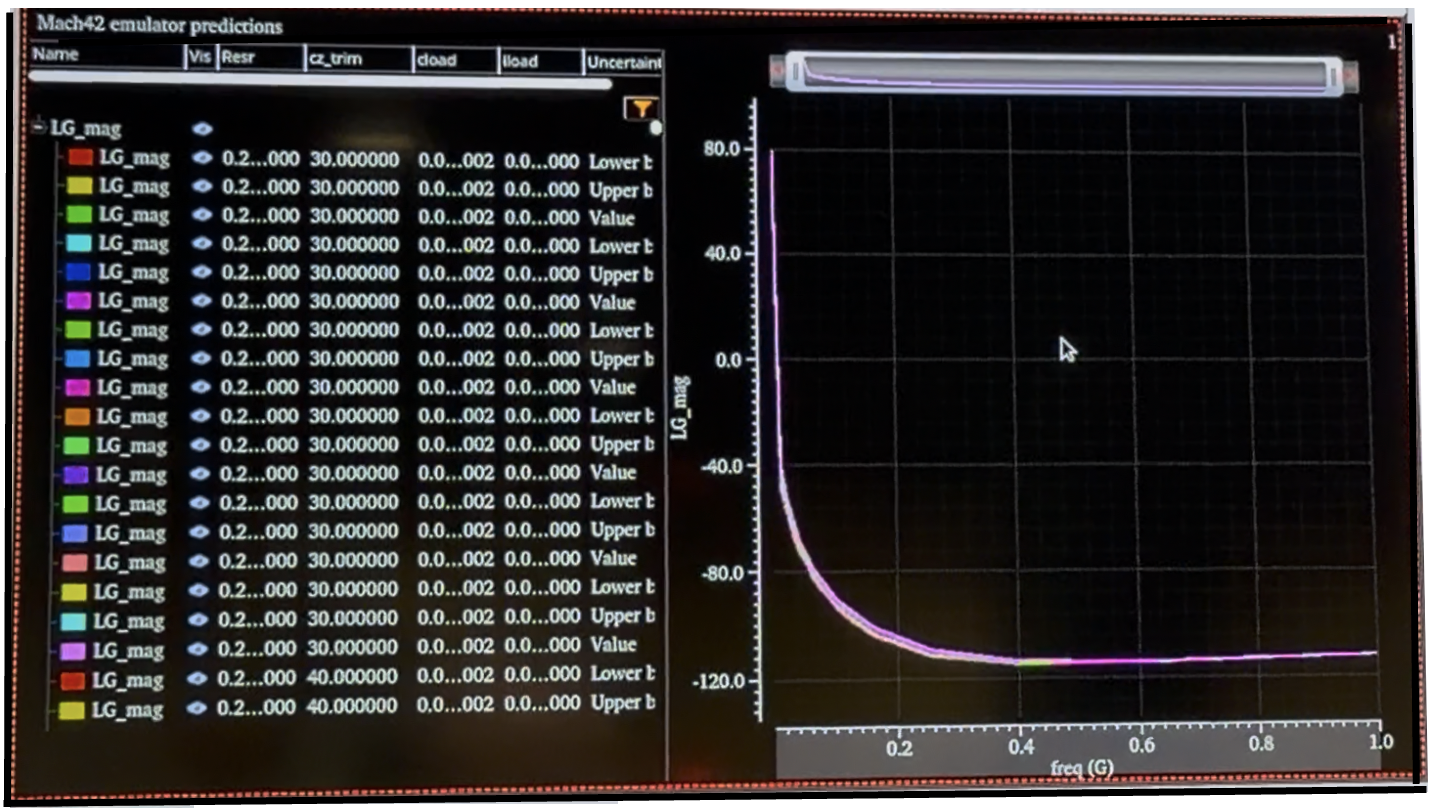
If you look closely at the figure above, you will see upper and lower bounds for the generated data. This analysis highlights the good accuracy delivered by the newly trained AI model that runs vastly faster than circuit simulation.
The performance of the trained model enables a verification team to deliver around 100x the design space coverage surface where the failure modes are likely to be, allowing the team to focus SPICE at those regions. SPICE remains the sign off authority; Analog Intelligence just makes sure it is deployed at the right corners.
After seeing this demo, I felt the power of Mach42’s Analog Intelligence. This is the right way to apply AI to the analog design problem.
To Learn More
If you struggle with analog design processes that are slowing down your system design, you need to learn more about Mach42’s unique and powerful approach. You can learn more about the company on SemiWiki here. And you can visit the Mach42’s website here. And that’s how Mach42 delivers a different take on AI in the design flow at #DAC2026.
Also Read:
DAC 2026 Mach42: A new generation of physics-driven AI models for analog circuit verification
Beyond Transformers. Physics-Centric Machine Learning for Analog
Video EP12: How Mach42 is Changing Analog Verification with Antun Domic
Share this post via:




Comments
There are no comments yet.
You must register or log in to view/post comments.