You are currently viewing SemiWiki as a guest which gives you limited access to the site. To view blog comments and experience other SemiWiki features you must be a registered member. Registration is fast, simple, and absolutely free so please,
join our community today!
WP_Term Object
(
[term_id] => 50
[name] => Events
[slug] => events
[term_group] => 0
[term_taxonomy_id] => 50
[taxonomy] => category
[description] =>
[parent] => 0
[count] => 1549
[filter] => raw
[cat_ID] => 50
[category_count] => 1549
[category_description] =>
[cat_name] => Events
[category_nicename] => events
[category_parent] => 0
[is_post] =>
)
Last year at Semicon I sat down with Soitec and got an update on the company. You can read my write up from last year here. A key point last year was Soitec was continuing to be profitable and grow after several years of financial struggles.
On Thursday, July 11th I got to sit down with Soitec’s CEO, Paul Boudre and get an update on… Read More
When it comes to security we’re all outraged at the manifest incompetence of whoever was most recently hacked, leaking personal account details for tens of millions of clients and everyone firmly believes that “they” ought to do better. Yet as a society there’s little evidence beyond our clickbait Pavlovian responses that we’re… Read More
In SoC design it’s all about managing complexity through modeling, and the models that make up IC designs come in a wide range of file formats like:
- Transistor-level , SPICE
- Interconnect parasitics, SPEF
- Gate and RTL, Verilog, VHDL
Even with standard file formats, designers still have to traverse the hierarchy to find out… Read More
As more than 343 people (and counting) know, we will be releasing the 2019 updated PDF version of our first book “Fabless: The Transformation of the Semiconductor Industry” via handout at a live webinar. The response has been overwhelming and I want to personally thank you. The webinar will be a brief overview of the book with a question… Read More
The need to design low power devices is not new. However, the criticality of lowering the power consumption of chip designs has never been as important as it is now. In 1989, I purchased one of the first consumer cell phones produced by Panasonic. The battery was the size of a brick, but only about a third of the thickness. If the battery… Read More
We all know (I hope) that security is important so we’re willing to invest time and money in this area but there are a couple of problems. First there’s no point in making your design secure if it’s not competitive and making it competitive is hard enough, so the great majority of resource and investment is going to go into that objective.… Read More
In RF designs Low Noise Amplifiers (LNA) play a critical role in system operation. They simultaneously need to be extremely sensitive and noise free, yet also must be able to withstand strong signal input without distortion. LNA designers often struggle to meet device performance specifications. Their task is further complicated… Read More
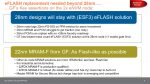
eFPGA stands for embedded Field Programmable Grid Arrays. An eFPGA is a programmable device like an FPGA but rather than being sold as a completed chip it is licensed as a semiconductor IP block. ASIC designers can license this IP and embed it into their own chips adding the flexibility of programmability at an incremental cost.… Read More
To deploy a GPU-based SPICE solution, you need to understand the costs involved. To get your hands on this new report analyzing this specific issue, all you need to do is attend Empyrean’s upcoming webinar, “GPU-Powered SPICE: The Way Forward for Analog Simulation,” which will be held on Thursday, August 8, 2019, at 10:00 am (PDT).… Read More
Every year at DAC, in addition to the hubbub of the exhibit floor and the relatively short technical sessions, there are a number of tutorials that dive in depth into interesting topics. At the 56th DAC in Las Vegas this year, MunEDA offered an interesting tutorial on Analog IP migration and optimization. This is a key issue for large… Read More
Available Is Not In Control: Balancing Output, Quality, and Risk in High-Volume Fabs