





By Mauli Shah, Product Engineer, Siemens
Analog and mixed-signal design teams face a persistent challenge that directly impacts tape-out schedules and project predictability: symmetry violations discovered at signoff trigger expensive respins, delay schedules and create unpredictable iteration cycles. Despite symmetry being critical for device matching, circuit performance and yield, most organizations still validate it using manual methods that catch problems too late to fix efficiently.
The semiconductor industry is experiencing a fundamental shift in verification methodology. Design teams are moving away from signoff-centric approaches that discover problems late in the design cycle toward shift-left strategies that embed validation directly into the design process. This transformation is particularly critical for symmetry checking, where early detection can mean the difference between a quick layout adjustment and a costly multi-week respin that consumes expensive compute resources and team time.
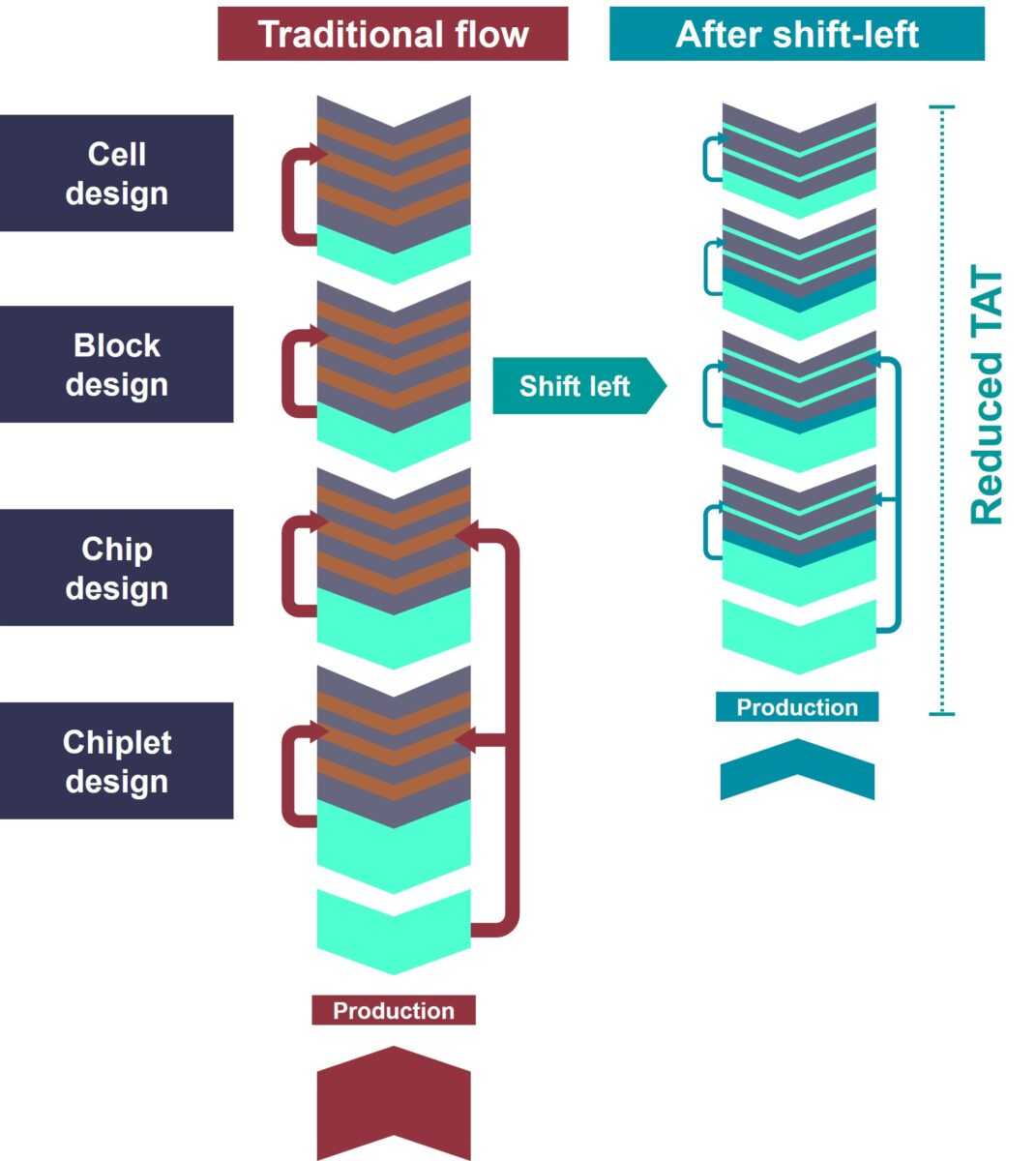
Organizations adopting interactive verification workflows are fundamentally changing when and how symmetry validation occurs. Instead of waiting for signoff-stage batch checking, design teams can now validate symmetry continuously as they work, catching and resolving issues immediately when they are easiest and least costly to address. This methodology shift enables teams to compress design iteration cycles, reduce schedule risk and accelerate time to tape-out (Figure 1).
The organizational cost of late-stage symmetry discovery
Symmetry checking is a fundamental requirement for high-performance integrated circuit (IC) design. It directly determines whether matched devices will behave as intended, whether circuit performance targets will be met and whether yield will be acceptable. A symmetry violation caught early can be fixed with minimal effort. The same violation discovered at signoff can trigger weeks of rework.
Traditional symmetry validation methods are poorly suited to the demands of modern IC design schedules. Manual ruler measurements are slow, error-prone and unscalable. As design complexity increases and teams work on larger layouts with more critical matching requirements, manual measurement approaches break down entirely. What might work for a single designer validating a small cell becomes impossible when multiple designers must coordinate across hierarchical blocks.
Custom rule writing demands extensive coding expertise and creates ongoing maintenance burdens as process technologies evolve. This approach also creates knowledge silos where only a few electronics design automation (EDA) experts can configure or modify symmetry checks, creating bottlenecks that slow the entire team. Organizations relying on cell mirroring assumptions discover too late that slight placement shifts or routing edits can silently break symmetry with no alert triggered. When multiple designers work on different portions of a hierarchical design, these silent failures accumulate undetected until signoff.
Parasitic extraction, while useful for electrical validation, relies on approximations that can mask real geometric asymmetries and is too slow for iterative use during active layout editing. Teams cannot afford to wait hours for extraction results when they need immediate feedback to maintain design momentum.
The most damaging consequence of all these methods is the same: symmetry problems are typically discovered late in the design cycle when fixing them requires time-consuming rework, additional tape-out iterations and significantly higher cost compared to early-stage detection. Organizations report symmetry-related respins adding two to four weeks to tape-out schedules. Late discovery also creates schedule unpredictability, making it difficult for design managers to forecast completion dates or allocate resources effectively across parallel projects.
As design teams grow and work becomes more distributed across blocks and hierarchy levels, the lack of systematic early symmetry validation creates compounding risk that only becomes visible when it is most expensive to address. This organizational coordination challenge represents one of the most significant hidden costs in analog and mixed-signal design flows.
How shift-left symmetry validation transforms workflows
Design teams are addressing these challenges by fundamentally changing when symmetry validation occurs in the IC design flow. The transformation centers on three key workflow changes that enable earlier detection, faster iteration and better team coordination.
Eliminating verification wait states
Traditional verification workflows create artificial separation between layout editing and checking. Designers complete a section of layout, export it, configure checking rules, submit batch jobs and wait for results. This context switching breaks design momentum and introduces delays that accumulate across multiple iterations. When designers must wait hours or days for symmetry validation results, they move on to other tasks, losing the mental context of what they were designing.
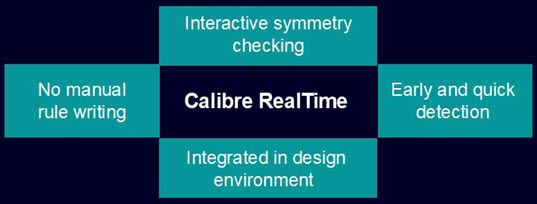
Organizations are eliminating these wait states by embedding symmetry validation directly into the design environment. When designers can validate symmetry on selected layout regions with immediate results, they maintain their design context and catch issues while the layout decisions are still fresh. This workflow change enables rapid fix-verify loops where designers can apply a correction and immediately confirm it resolves the violation. Teams adopting this approach report reducing symmetry validation cycles from days to minutes, enabling them to iterate faster and maintain design momentum (Figure 2).
The organizational benefit extends beyond individual designer productivity. When all team members can validate symmetry immediately without waiting for batch job queues or EDA expert support, parallel work streams remain unblocked and project schedules become more predictable.
Democratizing symmetry validation across design teams
Traditional symmetry checking has been limited to designers with deep EDA expertise or access to dedicated verification specialists. Custom rule writing requires knowledge of complex scripting languages and deep understanding of design rule check (DRC) syntax. This creates organizational bottlenecks where only a few team members can configure or run symmetry checks, slowing the entire design process.
Teams are solving this by adopting automated configuration approaches that eliminate manual rule writing entirely. When symmetry validation can be launched with simple toolbar selections and automated rule generation, all designers can validate their work regardless of EDA expertise level. This democratization enables better team coordination across hierarchical designs where multiple designers work on different blocks that must maintain symmetry relationships.
Organizations report significant improvements in design quality when every team member can validate symmetry continuously rather than relying on periodic checks by verification specialists. Issues are caught closer to their source, reducing the debug effort required to understand and fix violations. Design managers gain better visibility into project status when symmetry validation becomes a routine part of every designer’s workflow rather than a specialized activity performed only at specific milestones.
Compressing design iteration cycles through immediate feedback
The speed of feedback fundamentally determines how quickly design teams can iterate. Traditional batch-oriented verification creates multi-hour or multi-day feedback loops. Designers submit checks overnight, review results the next morning, make corrections and repeat. This cadence limits how many iterations teams can complete in a given timeframe.
Interactive verification workflows compress these feedback loops dramatically. When designers can select a layout region, launch symmetry validation and see results within seconds, they can complete multiple iteration cycles in the time previously required for a single batch run. This acceleration is particularly valuable during the critical convergence phase when teams are resolving the last remaining violations before tape-out.
Organizations adopting interactive symmetry workflows report being able to validate changes immediately after making them, enabling designers to confirm fixes work correctly before moving to the next issue. This eliminates the common problem of making multiple changes between verification runs, then struggling to determine which change introduced a new violation. When validation happens continuously, designers maintain clear cause-and-effect understanding of how layout changes impact symmetry.
The organizational impact extends to schedule predictability. When design managers can see symmetry issues being caught and resolved continuously throughout the design process rather than accumulating until signoff, they gain earlier visibility into potential schedule risks and can allocate resources more effectively.
Enabling technologies and adoption approaches
Interactive symmetry checking capabilities integrated within design environments enable these workflow transformations. Solutions such as Calibre RealTime software give designers working in environments like Calibre DESIGNrev immediate validation of X-axis, Y-axis, 90-degree and 180-degree symmetry directly within their familiar layout editors.
The workflow follows a streamlined pattern: designers select the layout area of interest for focused checking, choose the applicable symmetry types and launch validation with results appearing immediately. Visual axis markers highlight violations in context, enabling designers to understand the nature of asymmetries and apply corrections without switching tools. Teams can optionally combine symmetry and DRC validation to confirm layouts are both symmetric and design-rule-clean in a single workflow.
Organizations adopting this approach report several key benefits. Design teams can validate symmetry at any point in the design process—from initial cell construction through full-chip assembly—without requiring a fully layout-versus-schematic-clean design. This flexibility allows teams to catch and resolve symmetry issues when they are easiest and least costly to fix. The elimination of manual rule writing reduces the EDA expertise barrier, enabling all team members to validate symmetry regardless of scripting knowledge. Smart axis detection ensures correct symmetry axis consideration even when designers select irregular layout regions, reducing false violations that waste debug time.
Conclusion: Methodology transformation drives organizational benefits
Symmetry validation has long been one of the most manual, late-stage activities in IC verification, creating schedule risk and unpredictable iteration cycles. Organizations are now addressing this by fundamentally changing when and how symmetry checking occurs—moving it from a signoff bottleneck to a continuous in-design practice.
Design teams adopting shift-left symmetry validation report significant improvements in schedule predictability and reduction in late-stage respins. When designers can validate symmetry continuously as they work, catching problems immediately when they are easiest to fix, organizations compress iteration cycles and accelerate time to tape-out. The democratization of symmetry checking across all team members—not just EDA experts—improves coordination across hierarchical designs and reduces verification bottlenecks.
This methodology transformation represents a critical step toward making verification a design-time activity rather than a signoff-stage discovery process. As analog and mixed-signal designs continue to grow in complexity and matching requirements become more stringent, the ability to validate symmetry interactively within the design environment will increasingly differentiate organizations that can maintain predictable schedules from those that face costly late-stage surprises.
The shift from batch-oriented signoff checking to continuous in-design validation is not merely a tool change—it is a fundamental rethinking of when and how verification occurs in the design flow. Organizations making this transition are positioning themselves to handle the increasing complexity demands of advanced process nodes while maintaining the schedule predictability and design quality their customers demand.
Mauli Shah is a Product Engineer with the Calibre Interfaces group at Siemens EDA. Mauli earned her Masters in Electrical Engineering from Arizona State University and has over 7 years of industry experience.
For further reading
Mauli shah, “Interactive symmetry checking with Calibre RealTime in DESIGNrev,” White Paper, Siemens Digital Industries Software.
Sara Khalaf, “Shift left with Calibre interactive symmetry checking to improve design efficiency,” Siemens Digital Industries Software – Calibre IC Design & Manufacturing Blog, December 9, 2024.
Joe Davis and Srinivas Velivala, “Calibre RealTime Custom DRC places signoff verification into the custom designer’s hands,” White Paper, Siemens Digital Industries Software.
Clair Webb, “Intel design for manufacturing and evolution of design rules,” Proc. SPIE 6925, Design for Manufacturability through Design-Process Integration II, 692503, March 2008.
Also Read:
Podcast EP354: How Siemens EDA is Conquering New Lithography Challenges with Sagar Saxena
Enhancing Multi-Domain System Simulation with FMI Co-Simulation
GPU-native mask rule checking eliminates the curvilinear mask rule check bottleneck
Share this post via:



Comments
There are no comments yet.
You must register or log in to view/post comments.