







By Dr. Sabina Kuprėnaitė
Deep-ultraviolet optics used in semiconductor lithography may be exposed to billions of pulses over their service life. That creates a qualification challenge that initial reflectance specifications or laser-induced damage thresholds alone cannot answer.
A mirror may meet its optical specification when manufactured and demonstrate high laser-induced damage threshold (LIDT) values when tested. However, initial specifications don’t show how much its optical performance will change after prolonged exposure to high-energy DUV laser pulses.
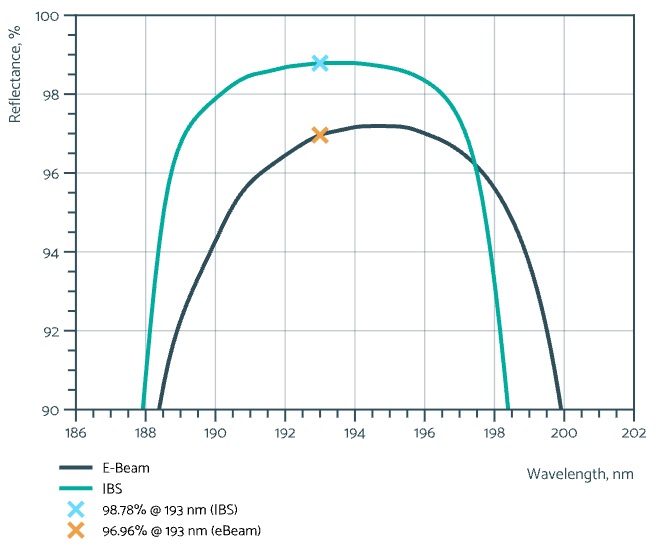
In published results by OPTOMAN, an ion-beam-sputtered mirror designed for 193 nm operation was exposed to approximately five billion pulses at a fluence of around 100 mJ/cm². The reduction in normalized reflectance remained below 0.5%, surpassing evaporated mirror performance.
The result does not define a universal lifetime for DUV optics. It does show why accumulated exposure needs to be considered separately from initial performance and catastrophic damage.
Why Reflectance and LIDT Only Tell Part of the Story
Reflectance defines how well a laser mirror reflects a beam. It influences laser system losses and, ultimately, system efficiency. The laser-induced damage threshold (LIDT) addresses a different question. It identifies the conditions under which laser exposure causes damage, in accordance with a defined test method.
Both are important, but neither directly measures long-term stability over billions of pulses.
After prolonged DUV laser exposure, optical properties can gradually change. Reflectance may drop, absorption may increase, and this may affect wavefront performance, thermal effects, and other parameters influencing overall system performance.
Research into laser optics has also separated damage initiation from damage growth and changes in functional optical performance during operation. Numerical results from studies using different wavelengths and pulse regimes cannot be transferred directly to 193 nm semiconductor systems, but the broader qualification principle still applies.
Catastrophic damage is only one limit on optical performance. For semiconductor equipment, three measurements are particularly useful:
Initial performance shows whether the optic meets the specification when new.
Damage resistance shows the conditions under which damage occurs.
Lifetime stability shows how much performance changes after prolonged exposure.
What Five Billion Pulses at 193 nm Reveal
OPTOMAN’s lifetime test provides one example of long-term optical stability being measured directly. The IBS-coated DUV mirror was exposed to approximately five billion pulses at 193 nm and around 100 mJ/cm². After the test, the normalized reflectance had decreased by less than 0.5%. The coating avoided catastrophic damage, and reflectance remained close to its initial level after a large accumulated exposure.
Testing over billions of pulses is consistent with earlier research into 193 nm lithography optics. One study exposed fused silica to as many as 40 billion 193 nm pulses to investigate changes that became measurable only after prolonged irradiation.
This does not mean that five billion or 40 billion pulses represent universal service-life targets. Pulse count cannot be considered in isolation. Fluence, pulse duration, repetition rate, beam characteristics, materials, and environmental conditions all influence how an optical component responds.
The OPTOMAN result should not be interpreted as a five-billion-pulse lifetime guarantee for every DUV application. Its value is in showing the change in optical performance after a defined accumulated exposure. That provides equipment engineers with information that a day-one reflectance measurement cannot.
Cumulative Exposure Can Change More than Reflectance
Long-term DUV exposure can also affect the substrate and wider optical response. Research on fused silica has demonstrated material densification under repeated 193-nm exposure. Changes in density can alter refractive properties and optical path length. Other studies of DUV optics have examined the relationship between absorption, temperature-induced wavefront deformation, and permanent material changes.
These effects matter because an optic need not show visible damage before it begins affecting the surrounding system. Changes may instead appear as gradual shifts in reflectance, transmission, absorption, scatter, or wavefront performance.
The system-level effect depends on where the component is used. A reduction in mirror reflectance may alter the optical power reaching a downstream process. Increased absorption may contribute to thermal gradients. Changes in optical path length or wavefront performance may increase calibration requirements or reduce the available process margin.
A small optical change may be manageable in one part of a tool and significant in another. Laser beam delivery systems may contain more than 10 mirrors, so effects accumulate as the beam passes through multiple optical components. After ten reflections from degraded mirrors with altered specifications, the resulting laser beam may no longer be suitable for lithography.
The acceptable level of drift should therefore be defined by the requirements of the complete optical system rather than by a general definition of component failure.
Qualifying Optics for Billions of Pulses
For DUV semiconductor systems, optical qualification can be considered in three stages.
Initial performance
The component should meet the required reflectance, transmission, absorption, and wavefront specification when new.
Damage resistance
There should be a sufficient margin between normal operating conditions and the damage threshold measured under a relevant test method.
Lifetime stability
The optical response should remain within the permitted tolerance after the accumulated exposure expected during service.
A meaningful lifetime requirement may need to account for operating wavelength and fluence, pulse duration and repetition rate, cumulative pulse count, beam diameter and profile, angle of incidence, polarization, and allowable optical drift.
Environmental conditions also need to be considered, particularly where contamination or repeated cleaning could affect optical performance.
The acceptable change ultimately depends on the optic’s role within the tool. A reflectance reduction below 0.5% may be well within tolerance in one optical path while requiring closer consideration in another. The important question is whether the change affects the qualified process window, calibration requirements, or maintenance interval.
Initial reflectance shows how an optic starts.
LIDT establishes a damage boundary under defined conditions.
Lifetime testing shows how well the optic performs across the potentially billions of pulses in between.
For semiconductor equipment expected to operate over long service intervals, accumulated exposure should form part of the qualification process.
References
- Lukas Ceizaris, IBS-Coated Optics for the Semiconductor Industry, OPTOMAN.
- ISO, ISO 21254-1:2025 — Lasers and laser-related equipment — Test methods for laser-induced damage threshold — Part 1 — Definitions and general principles, 2025.
- K. R. Kafka, T. Kosc, and S. G. Demos, Methods and apparatus for comprehensive characterization of performance attributes and damage thresholds of ultrafast laser optics, Optical Engineering, 61(7), 071605, 2022.
- C. K. Van Peski, R. Morton, and Z. Bor, Behavior of fused silica irradiated by low-level 193 nm excimer laser for tens of billions of pulses, Journal of Non-Crystalline Solids, 265(3), 285–289, 2000.
- N. F. Borrelli, C. Smith, D. C. Allan and T. P. Seward, Densification of fused silica under 193-nm excitation, Journal of the Optical Society of America B, 14(7), 1606–1615, 1997.
- B. Schäfer, J. Gloger, U. Leinhos and K. Mann, Photo-thermal measurement of absorptance losses, temperature-induced wavefront deformation and compaction in DUV-optics, Optics Express, 17(25), 23025–23036, 2009.

Author Bio
Dr. Sabina Kuprėnaitė is Head of R&D at OPTOMAN, where she develops ion beam sputtering coatings for high-power, ultrafast, and UV laser systems. She holds a PhD focused on functional thin films for optical and acoustic devices, and her current work focuses on optical coating lifetime, laser-induced damage, and long-term performance stability.
Also Read:
Huawei Can’t Shrink Its Chips, So It’s Folding Them
Reducing EUV Exposure Dose Through Underlayer Engineering
ASML’s Path to Lithography Dominance—and the Coming Maskless Revolution
Share this post via:



Hyper-NA EUV: The Next Frontier in Chipmaking Could Arrive in 2036