







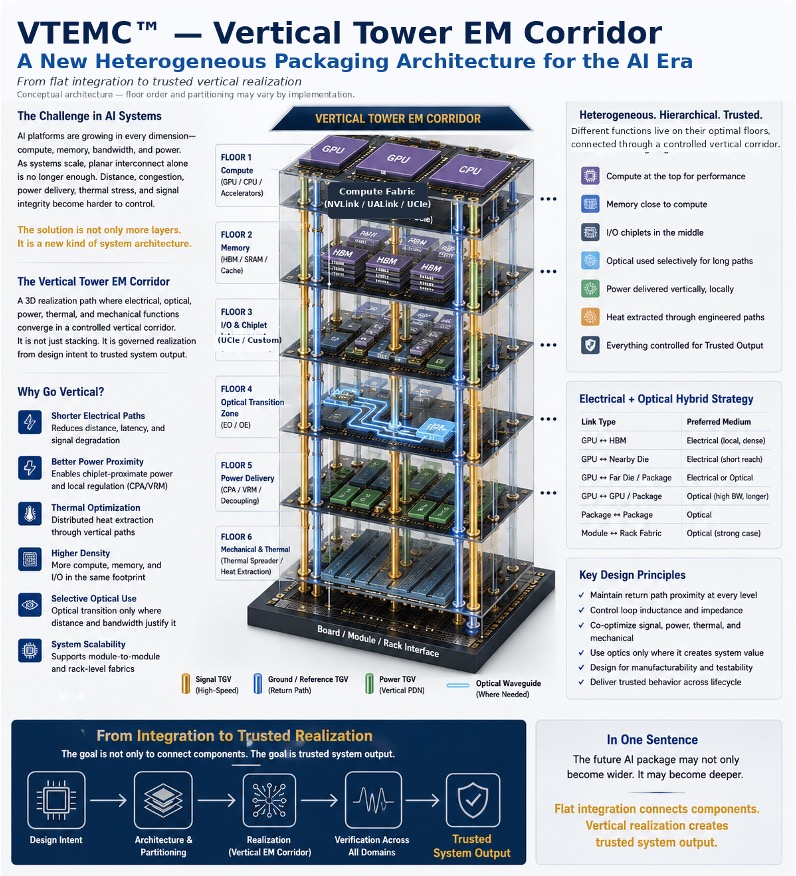
For years, advanced packaging has been described mostly in planar terms: chiplets placed side by side, connected through interposers, bridges, redistribution layers, substrates, and short-reach electrical links. This view remains important. It supports today’s GPU, HBM, chiplet, and 2.5D integration architectures.
But future AI platforms may require something more.
As packages grow larger, bandwidth rises, power density increases, and heterogeneous integration expands, the package may no longer be only a flat routing surface. It may become a vertical realization environment.
This leads to an important concept:
the Vertical System EM Corridor.
A System EM Corridor is the physical path where signal integrity, return current, power integrity, electromagnetic behavior, thermal behavior, mechanical stability, and package geometry interact. In many current systems, this corridor is largely lateral. Signals move across an interposer or substrate. Power enters through board or package structures. Optical engines, when used, are often attached near the edge or placed close to a switch, ASIC, or optical I/O block.
In larger AI systems, that corridor may need to extend vertically.
Glass substrates and through-glass vias make this idea especially interesting. Glass can offer dimensional stability, low electrical loss, flatness, and fine interconnect scaling potential. TGVs can create vertical signal, power, and reference transitions through the package body.
But vertical routing is not enough.
Every high-speed signal needs a return path. If signal TGVs are not supported by nearby ground-reference TGVs or controlled reference transitions, the result can be higher loop inductance, impedance discontinuity, field spreading, reflection, and signal integrity degradation.
So the real issue is not simply whether glass can provide vertical vias.
The real issue is whether the vertical electromagnetic path can become a trusted realization path.
From Vertical Routing to Vertical Realization
A future large AI package may include compute, memory, power delivery, optical transition zones, redistribution layers, and reference structures across multiple vertical regions. Some traffic will remain electrical, especially very short and dense links such as GPU-to-HBM or nearby die-to-die communication. Other traffic, especially longer package-level, package-to-package, board-level, or rack-level movement, may become a better candidate for optical transition.
The future is unlikely to be “all copper” or “all optics.”
It will likely be a hybrid hierarchy:
local electrical links for short dense communication,
vertical electrical corridors for controlled package-level routing,
selective optical transition where distance, bandwidth, and energy justify conversion,
and system-level optical fabrics where copper movement becomes limiting.
That means future AI packaging must answer a harder question:
Where should electrical remain, where should optical begin, and how can the full vertical path produce trusted system output?
This is where the Vertical System EM Corridor becomes more than a package concept. It becomes part of a realization model.
The goal is not only to connect structures. The goal is to create a trusted physical path from design intent to working system behavior.
Power Delivery Also Becomes Vertical
The same concept applies to power.
AI systems are increasingly limited not only by compute, but by power delivery. As current demand rises and transient behavior becomes more aggressive, the power corridor must move closer to the silicon.
This is where chiplet-proximate power architecture becomes important. Power delivery may need to move from the board toward the package, from the package toward the compute region, and from lateral delivery toward vertical proximity.
In a vertical realization architecture, power is not simply supplied from below. It may be distributed through controlled vertical paths, local power regions, embedded decoupling, and package-proximate conversion zones.
That creates a new convergence problem:
signal routing, power routing, return-current control, thermal extraction, optical transition, and mechanical stress are no longer separable.
They interact inside the same physical volume.
Optical Transition Zones
Optics may play a role, but selectively.
The Vertical System EM Corridor does not require every link to become optical. Instead, it creates locations where optical transition becomes meaningful.
For example, electrical links may handle local GPU-to-HBM or GPU-to-nearby-die movement, while optical conversion may be introduced for longer paths across a large package, across a module, or between packages.
In that case, the optical engine is not just an add-on.
It becomes a transition zone inside the realization corridor:
electrical launch → optical conversion → optical routing or fiber coupling → optical/electrical recovery → system fabric
This transition must be managed across electrical, optical, mechanical, thermal, manufacturing, and reliability constraints.
That is why optical interconnect is not only an optical device problem. It is an electro-optical realization problem.
Why This Is Not Just 3D Packaging
The Vertical System EM Corridor is related to 2.5D and 3D integration, but it is not the same concept.
2.5D and 3D packaging describe physical placement and interconnect methods.
The Vertical System EM Corridor describes the physical realization path through which electrical, optical, power, thermal, mechanical, and lifecycle behavior must remain coherent enough to support trusted system output.
A stacked package can still fail if the corridor is not controlled.
A glass substrate can still fail if the return path is discontinuous.
An optical interconnect can still fail if thermal drift, alignment, coupling loss, or test coverage is not controlled.
A power architecture can still fail if local transients, resonance, or thermal stress are not managed.
The question is no longer only:
Can we stack it?
The better question is:
Can the vertical corridor be trusted at scale?
From Integration to Trusted Realization
The industry is moving quickly toward language such as integration, co-design, convergence, optical fabric, glass substrate, chiplet architecture, and advanced packaging. That movement is important.
But integration is only the first step.
The harder step is trusted realization.
A vertical AI package must do more than combine compute, memory, power, optics, and interconnect. It must produce system behavior that remains stable, manufacturable, reliable, and scalable under real operating conditions.
This is the difference between an integrated package and a trusted realization output.
An integrated package connects the pieces.
A trusted realization output shows that the connected system can operate as intended across the full physical path.
Why This Matters Now
AI hardware is forcing packaging to become system architecture.
HBM integration, GPU-to-GPU movement, CPU-GPU coupling, package-to-package signaling, optical I/O, power delivery, thermal extraction, and manufacturing yield are no longer independent problems.
They are becoming one physical realization problem.
That is why the Vertical System EM Corridor matters.
It provides a way to think about future AI systems not as flat packages with more components, but as vertically realized platforms where compute, memory, power, signal, optical, thermal, and reliability paths must be controlled together.
The future AI package may not be only wider.
It may become deeper.
And the winning platforms will not be the ones that simply add more layers, more vias, or more optical channels.
They will be the ones that make the vertical realization path trusted at scale.
Closing Thought
The next frontier in advanced packaging may not be a single material, a single interconnect, or a single optical device.
It may be the ability to build a Vertical System EM Corridor: a controlled physical realization path where electrical connectivity, return-current continuity, power delivery, optical transition, thermal behavior, mechanical stability, manufacturability, and reliability can coexist inside one trusted system architecture.
In short:
Flat integration connects components.
Vertical realization creates trusted system output.
That may define the next AI platform.
Also Read:
From Evidence to Authority: Bounded Gate Authority for Governed Semiconductor Realization
Convergence Evidence Maturity Hierarchy: From Raw Data to Convergence-Authoritative Evidence
Share this post via:



The silent killer of analog reliability: Why SPICE misses floating net