




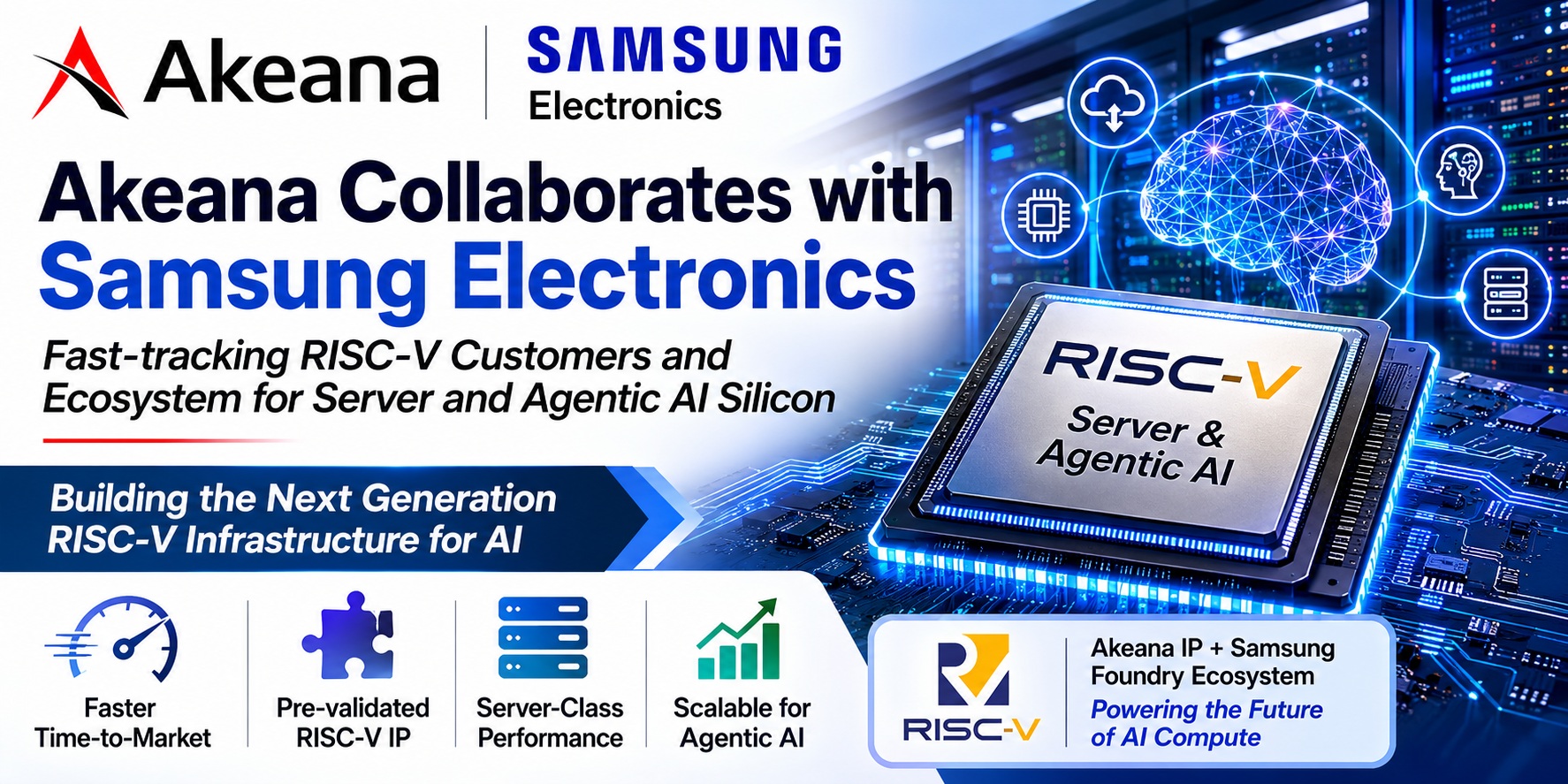

The momentum behind RISC-V continues to accelerate as Akeana announced a strategic collaboration with Samsung Electronics aimed at reducing time-to-market for next-generation server and agentic AI silicon. The partnership combines Akeana’s high-performance RISC-V compute platform with Samsung Foundry’s advanced process technologies and ecosystem infrastructure, providing customers with a streamlined path from architecture to production.
As hyperscale computing, enterprise AI, and autonomous AI agents drive demand for increasingly specialized silicon, the industry is moving beyond traditional CPU-centric architectures. Companies developing AI infrastructure now require customizable compute platforms capable of supporting domain-specific acceleration, large memory footprints, high-bandwidth interconnects, and scalable software ecosystems. RISC-V has emerged as a compelling alternative due to its open instruction set architecture, flexibility, and growing ecosystem support.
Akeana has positioned itself as a provider of enterprise-class RISC-V infrastructure IP rather than simply another CPU core vendor. Its portfolio includes 64-bit high-performance processor cores, cache-coherent interconnect technology, memory subsystem IP, and system-level architecture components designed for datacenter, networking, and AI applications. By focusing on complete compute platforms, Akeana addresses one of the key challenges facing RISC-V adoption: reducing integration complexity for sophisticated SoC designs.
The collaboration with Samsung Electronics strengthens this strategy by aligning Akeana’s IP with Samsung Foundry’s advanced manufacturing capabilities and ecosystem programs. Samsung has invested heavily in enabling design ecosystems through its SAFE™ (Samsung Advanced Foundry Ecosystem) initiative, which brings together EDA vendors, IP providers, packaging partners, and design services companies. Integration within this ecosystem can significantly shorten design cycles by providing customers with pre-validated IP and optimized implementation flows.
For AI silicon developers, time-to-market has become a critical competitive factor. Generative AI and emerging agentic AI workloads are evolving rapidly, forcing semiconductor companies to shorten development schedules while simultaneously increasing design complexity. Traditional custom processor development often requires years of architecture, verification, software enablement, and physical implementation effort. By combining pre-validated RISC-V platforms with an established foundry ecosystem, customers can focus resources on workload-specific differentiation rather than foundational infrastructure.
Agentic AI represents a particularly interesting target market. Unlike conventional AI inference systems, agentic AI platforms require continuous planning, reasoning, orchestration, and communication between multiple software agents. These workloads place significant demands on memory hierarchy, interconnect bandwidth, security mechanisms, and heterogeneous compute resources. As a result, future AI systems are likely to incorporate combinations of general-purpose processors, vector engines, accelerators, and specialized AI cores connected through highly scalable fabrics.
This trend creates an opportunity for RISC-V-based architectures. The open nature of the ISA allows developers to introduce custom instructions and domain-specific extensions without the licensing constraints associated with proprietary architectures. For companies building AI infrastructure silicon, this flexibility can enable performance and power optimizations tailored to emerging workloads.
Samsung also benefits from the partnership as foundries increasingly seek differentiated ecosystem offerings beyond process technology alone. Leading-edge manufacturing remains essential, but customers now evaluate complete platform readiness, software support, IP availability, and ecosystem maturity when selecting silicon development partners. Supporting enterprise-grade RISC-V solutions broadens Samsung’s appeal to AI, cloud, networking, and datacenter customers seeking alternatives to traditional architectures.
The broader significance of the collaboration extends beyond a single partnership announcement. It reflects the continuing evolution of RISC-V from an academic and embedded computing architecture into a viable foundation for high-performance computing and AI infrastructure. As more ecosystem participants—including foundries, EDA vendors, software providers, and IP companies—align around server-class RISC-V solutions, barriers to adoption continue to decline.
Bottom line: For semiconductor companies developing next-generation server processors and AI accelerators, the combination of Akeana’s infrastructure IP and Samsung’s manufacturing ecosystem could provide a faster path to production silicon. In an industry increasingly defined by AI-driven innovation cycles, accelerating design execution may prove just as important as architectural innovation itself.
Also Read:
RISC-V Has Momentum. The Real Question Is Who Can Deliver
Akeana Partners with Axiomise for Formal Verification of Its Super-Scalar RISC-V Cores
Demand Meets Design: RISC-V and the Next Wave of AI Hardware
Share this post via:



Comments
There are no comments yet.
You must register or log in to view/post comments.