Bronco Webinar 800x100 1

Multi-Channel Multi Rate FEC Engine Webinar with Open Silicon

Multi-Channel Multi Rate FEC Engine Webinar with Open Silicon
by Eric Esteve on 11-29-2017 at 12:00 pm

I will be pleased to moderate on December 7[SUP]th[/SUP] the Open-Silicon webinar addressing the benefits of the multi-channel multi-rate forward error correction (MCMR FEC) IP and the role it plays in high-bandwidth networking applications, especially those where the bit error rate is very high, such as high speed SerDes 30G and above.

Open Silicon’s multi channel, multi rate (MCMR) forward error correction (FEC) engine is fully configurable to support 400G/200G/100G/50G/25G rates on multiple channels. The panelist will outline use cases and discuss the key technical advantages that the MCMR FEC IP core offers, such as support for up to 56Gbps SerDes integration, bandwidth of up to 400G, support for KP4 RS (544,514) and KR4 RS (528,514), support for Interlaken, Flex Ethernet and 802.3x protocols, support for configurable alignment marker, and PRBS test pattern generator and loopback test.

If you are not familiar with Reed-Solomon codes, let’s take a quick look at the terminology. The NRZ and the PAM-4 PHY have most of their processing in common, but their biggest difference in the PHY architectures is that the NRZ PHY uses an RS(528,514, t=7, m=10) code with 10-bit symbols (m=10) that has an error-correction capability of t=7 (seven 10-bit symbols can be corrected), whereas the PAM-4 PHY uses an RS(544, 514, t=15, m=10) code with error-correction capability of t=15.

If you look at the above table, the PHY using NRZ signaling, 100GBASE-KR4, only support high quality PCB, when the PAM-4 PHY, 100GBASE-KP4, can support lower quality, standard PCB. When the medium quality is lower, you expect to correct more error, so the higher number (t=15) associated with RS(544,514) than for the NRZ PHY used on high quality PCB, where t=7, associated with RS(528,514).

The panelists will also discuss the architectural advantages of the core, such as its flexibility, configurability and scalability, all of which enable the MCMR FEC IP to be uniquely tailored to address customer specific application requirements. The MCMR FEC IP is part of Open-Silicon’s networking IP portfolio that includes the company’s Interlaken IP core, as well as its new Ethernet PCS and Flex Ethernet IPs, which enable high-bandwidth chip-to-chip, Ethernet endpoint and Ethernet transport applications.

The MCMR FEC IP features list:
Programmable common and unique alignment marker for each lane
Supports both KP4 (544, 514) and KR4 (528, 514) forward error correction and parity calculation. Supports both runtime and static configuration.
PRBS generator for test pattern generator
Support statistics reports, exception detection and error reporting
Runtime configurable FEC bypass operation
Supports lane re-ordering
Supports 50G and 25G SerDes rates
Supports 400G/200G/100G/50G/25G operation

This webinar is ideal for chip designers and SoC architects of high-speed, high-performance communication and computing applications such as packet processing/NPU, traffic management, switch fabric, switch fabric interface, Framer/Mapper, TCAMs, Serial Memory, FPGA and more.

For registration to this webinar, taking place on Thu, Dec 7, 2017 5:00 PM – 6:00 PM CET or 11:00 AM – 12:00 EST, please visit:

Open Silicon FEC Webinar

About Open-Silicon
Open-Silicon is a system-optimized ASIC solution provider that innovates at every stage of design to deliver fully tested IP, silicon and platforms. To learn more, please visit www.open-silicon.com.

By Eric Esteve from IPnest


Outsourced Operations: Reduced Risk, Fast Ramp, and Managed Complexity

Outsourced Operations: Reduced Risk, Fast Ramp, and Managed Complexity
by Daniel Nenni on 11-29-2017 at 7:00 am

One of the more interesting semiconductor success stories is Apple and how they transformed from a struggling computer company to a dominant chip maker. We covered this story in quite a bit of detail in our book “Mobile Unleashed” in Chapter 7 “From Cupertino” but the short answer to how they did it is: Outsourced Operations.


Apple’s outsourced chip design effort started with the brain of the iPod in 2001 and continued with the iPhone in 2007. Apple made the switch to internally developed SoCs nine years later with the A4 SoC which powered the iPhone 4 and the first iPad in 2010. The rest as they say is semiconductor history with Apple now shipping the industry leading A11 Bionic SoC with a blistering 12 month chip cadence that boggles the semiconductor mind, absolutely.

We are seeing the same type of transformation in the IoT industry where chip start-ups and systems companies alike are wading into chip design through outsourcing. A new whitepaper “Outsourced Operations: Reduce Risk, Accelerate Ramp, Manage Complexity” from Presto Engineering captures this concept quite well.

“Outsourced operations is an economically attractive approach that can reduce risk, improve speed of implementation and mitigate against the potential costs of failure…”

The paper starts out covering current chip trends, competition for fab capacity, compressed volume ramps, and mitigating risks. For IoT specifically, the window of opportunity is fast moving so any type of delay could be fatal, especially a silicon related fault.

The bulk of the paper covers outsourced operations, which is what Presto Engineering does, including The 10 highly specialized skill sets of a successfully operations team. The one that I have the most experience with is Device Engineering which includes analyzing yield and interacting with the foundry. This is no small task, believe me, especially if third party IP is involved.

Most systems companies already outsource production using off-the-shelf chips as a mere line item in their Bill of Materials. You can see teardowns of just about every leading product online now so we all know what is on the BOMs. The iPhone is my favorite teardown as the transition from off-the-shelf chips to custom silicon is clear over the last ten years. The Amazon Echo is another one to follow. Amazon is definitely following the Apple recipe for silicon and systems success.

For Apple, the SoC was the starting point but now you can see off-the-shelf chips and commercial semiconductor IP magically disappear inside the SoC further increasing competitive advantages. You can also see first hand the software advantages of a systems company having control over their silicon.

Bottom line (summary of the paper):

[LIST=1]

  • The barriers to entry in semiconductor manufacturing are getting higher as scarce manufacturing capacity is sought by more, larger players.
  • The semiconductor supply chain evolved to support the fabless business model that cannot easily adapt to the needs of the new industrial OEM and IoT customers.
  • Assembling an in-house operations capability requires at least ten specialized skill sets and a significant investment in support infrastructure.
  • Long commitments and slow, costly changes to supply-chain configuration increase the cost of mistakes and the risk of failure.
  • For industrial and IoT projects, outsourced operations is an economically attractive approach that will reduce risk, improve speed of implementation, manage complexity and mitigate against the potential costs of lost opportunity.Presto Engineering, Inc. provides outsourced operations for semiconductor and IoT device companies, helping its customers minimize overhead, reduce risk and accelerate time-to-market. The company is a recognized expert in the development of industrial solutions for RF, analog, mixed-signal and secured applications – from tape-out to delivery of finished goods. Presto’s proprietary, highly-secure manufacturing and provisioning solution, coupled with extensive back-end expertise, gives its customers a competitive advantage.

    The company offers a global, flexible, dedicated framework, with headquarters in the Silicon Valley, and operations across Europe and Asia. If you would like to discuss your operations outsourcing needs in more detail, please contact us at 408-372-9500, info@presto-eng.com, or visit our website at www.presto-eng.com for more information and local contacts worldwide.

CEVA and Local AI Smarts

CEVA and Local AI Smarts
by Bernard Murphy on 11-28-2017 at 7:00 am

When we first started talking about “smart”, as in smart cars, smart homes, smart cities and the like, our usage of “smart” was arguably over-generous. What we really meant was that these aspects of our daily lives were becoming more computerized and connected. Not to say those directions weren’t useful and exciting, but we weren’t necessarily thinking of smart as in intelligent. For most of us, if we thought about artificial intelligence (AI) at all, we mostly remembered a painful track-record of big promises and little delivery.


The AI part of this changed dramatically for most of us with the application of neural nets for recognition in the big tech companies (Google, Facebook, et al.), particularly in image and speech recognition. For the first time, AI methods not only lived up to the promise but are now beating human experts. (In deference to AI gurus, neural nets have been around for a long time. But their impact on the great majority of us took off much more recently.)

These initial recognition systems ran (and still run) in big data-centers, often using specialized hardware (NVIDIA GPUs and Google TPUs for example) in the trainingphase, where they learn to recognize objects/sounds/etc. based on many thousands of labeled examples (in another nod to experts, some level of self-training is now also becoming popular). Once a system is trained, a similar setup can be used in production in a phase called inference to classify objects as needed, for example to recognize a traffic sign or a tumor.

So real, useful AI running on big iron, check. But it didn’t take long to figure out that where we really wanted to exploit intelligence was in applications, and outsourcing this kind of intelligence to cloud services wasn’t going to work out so well in many cases, particularly thanks to unpredictable response times and power demands. This prompted a lot of investment in R&D and applications, with a goal to move inference to applications, a direction that is already enjoying considerable success.

Obvious examples are any applications in a car where recognition must be both excellent and real-time under all conditions, such as in pedestrian detection. Sensor fusion from radar, LIDAR, cameras and other sources, requiring some very sophisticated recognition of complex data in complex environments, can significantly reduce chance of collision with other objects. Lane departure warnings are another example where recognition is essential. As driver safety systems become more advanced, even before we get to driverless cars we can expect to add road-sign recognition to this list of capabilities

Drones, beyond personal entertainment value, are starting show real value in many areas such as disaster response, real-estate marketing (let a prospective buyer get more views of a house) and many more applications such as surveying, mapping, remote inspection and monitoring. Requiring experienced remote pilots to guide these drones is impractical; skilled pilots are not widely available and would be too expensive for most of these uses. Adding intelligence to these devices to self-fly/navigate is an obvious win (there is even some indication that AI-powered drones may be safer than human piloted versions). Again, this requires lots of recognition technology.

Smartphones, which launched the revolution in early smarts, were curiously late to the AI party. Sure they had Siri and similar assistant capabilities but most of the heavy lifting stayed in the cloud. Only relatively recently Apple added neural net technology to the iPhone X for FaceID access. Similarly, Google in the Pixel 2 series has added a dedicated visual engine to support advanced camera functions (at some point, not clear you can access these yet). Intelligent functions like these may shift the balance of AI activity inferencing (eg in voice recognition) towards the device and away from the cloud.

If you weren’t already concerned about big brother, image recognition is now making its way into surveillance systems. We all know the movie/TV set-piece where the cops ask for the tapes from the gas station surveillance system, which they then study for hours to figure out who shot the victim. No more. Now recognition behind those systems can detect people and vehicles, even identifying known (good or bad) players. I have personal (though less dramatic) experience of this technology. I mistakenly drove in the FasTrak lane (without a pass) for a few hundred yards before recognizing my mistake. A few weeks later I got an automated fine, clearly showing my license plate, which I assume FasTrack automatically read and passed on for license ID. Big brother indeed.

I’ll wrap up with one last example. Security is a big topic these days, especially as we increasingly expect to depend on these smart systems. Part of how we address security is through design, in the hardware and the software. But an ever-present reality for defense is that bad actors will always be one step ahead of us; we will always need ways to detect potential intrusion. The classic signature-based approaches are too expensive for smart applications and frankly continue to fall further behind in effectiveness. A more promising approach is behavioral detection where defense systems look not for classic signatures but instead for behavioral signatures which are much more likely to be common across wide families of attack types. This approach is also based on neural nets.

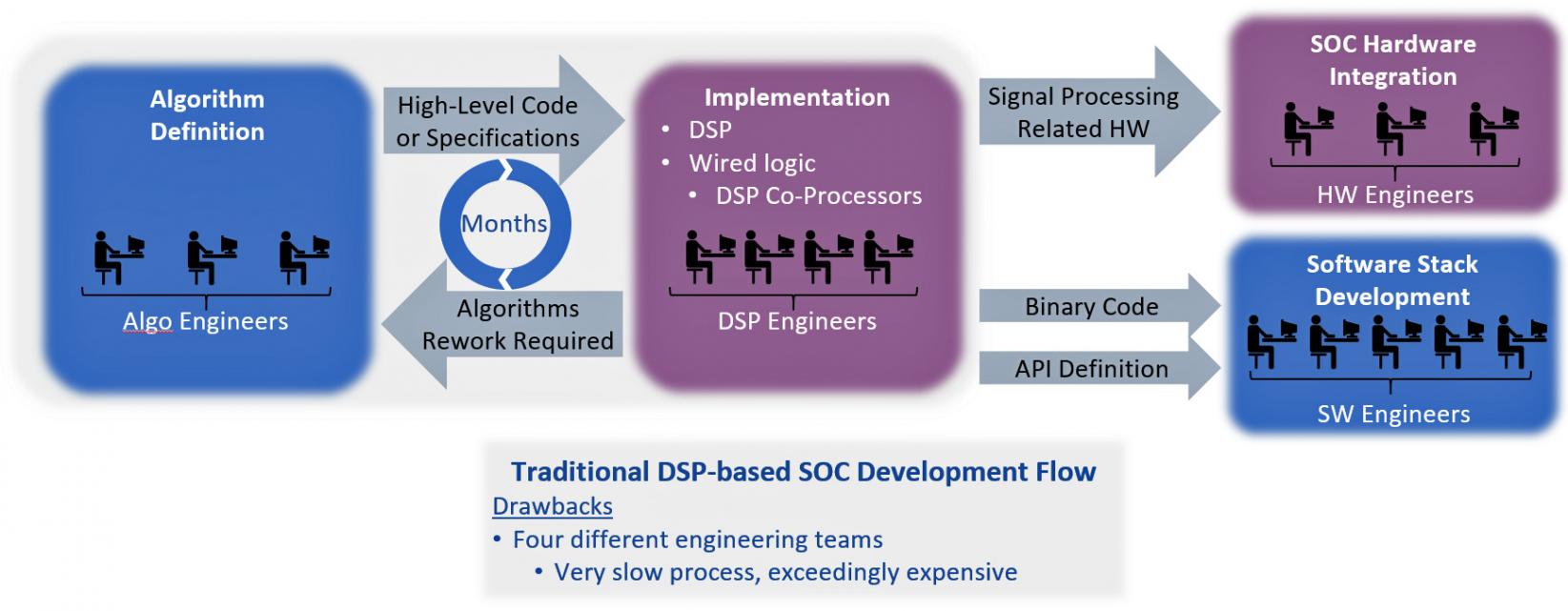
How can these amazing capabilities be deployed on all these platforms? Commonly through neural nets implemented using embedded DSPs, and programmed via translation of trained networks to that dedicated inference platform. You can read CEVA’s take on this direction in a piece in the Embedded Vision Alliance HERE.


Protecting electronics around the world, SEMI insights

Protecting electronics around the world, SEMI insights
by Daniel Payne on 11-27-2017 at 12:00 pm

SEMI is a worldwide organization with local chapters like the one here in Oregon, where I attended a recent half-day presentation by several industry experts on the topic – Globalization, How it shapes the Semiconductor industry:

  • Michael Chen, Director, Mentor – A Siemens Business
  • John Brewer, CEO, Amorphyx
  • Ed Pausa, Director, PricewaterhouseCoopers
  • David D’Ascenzo, IP Attorney

Mentor hosted the breakfast event on their serene campus in Wilsonville and the scent of bacon filled the room as networking quickly started after check-in. Dave Anderson got our attention on the agenda for the day and Michael from Mentor presented first on the topic of, “How do I protect design and value in the global IC manufacturing world?”


Michael Chen, Mentor

On one of his first slides Michael showed the familiar psychology diagram of Maslows’s Needs, then cracked a joke on how there are two more important needs lower on the pyramid – battery life and WiFi. The room roared with laughter and approved of his observation in our mobile-driven society how often we are limited by battery life and WiFi signal to do work or play.

Mr. Chen summarized that the basic technique to protect our design and value is through using Math to protect our IP. The Chinese government has announced ambitious plans to invest some $100B in the semiconductor industry so as to not be reliant on importing so much from abroad, but do we trust the technology and products coming out of China?

The global semiconductor industry is on track to exceed $400B in revenue this year, yet how does it protect against the impact of counterfeit products on the market? Is it just that some distributors are shady in where they get parts? Any electronic part or even passive component can now be counterfeited. Oddly enough, even counterfeit electronics can outperform the legal parts.

In the USA we have a Joint Strike Fighter program (aka F-35) that has parts coming from 14 different countries during assembly, so how does Lockheed Martin know where each component has been, and who has touched it before shipping?

One way to instill trust and slow down counterfeit parts is to use only a trusted fab, like IBM in the old days. Does anyone have security concerns with IBM being sold to GLOBALFOUNDRIES which is owned by Abu Dhabi?

Another technology solution is for IC design companies to use an IC fingerprinting approach that allows secure field tracking of all devices ever sold. Our industry only uses IDs in about 30% of all electronic components, so we still have a long way to go on this effort.

On the software side Michael introduced the concept of Roots of Trust (RoT), a set of functions in the trusted computing module that is always trusted by the computer’s operating system. Crypto technology is used to uniquely ID each chip, something that gets security encoded inside each chip, also called a Physically Un-clonable Function (PUF).

Another approach for hardening the security of an IC is to actually camouflage layers on the IC design in order to thwart the reverse engineering process. Mentor has some software in this area to camouflage.


Ed Pausa from PwC provided more numbers, charts and graphs than I could digest in a lifetime, all on the topic of historical and projected growth of semi in China. If this area concerns you, then please visit their site for more details. As an example, he showed a chart on worldwide semi consumption market by region, showing the growing of China from 2003 – 2016:


John Brewer, Amorphyx

Hailing from Oregon, John Brewer’s latest startup company has transferred their quantum-based display technology to a major Chinese company, but not as a black box, rather as a fully disclosed, physics based approach. He predicts that within a few years we will buy a 65″ TV for less than $1,000 from our local retailer or Amazon.com online, because of the new technology that Amorphyx has discovered and licensed. They limit their technology transfer to a specific screen size and chemistry, so when a TV company wants to go to a different size display they need to buy into another technology transfer.


Advanced ASICs – It Takes an Ecosystem

Advanced ASICs – It Takes an Ecosystem
by Mike Gianfagna on 11-26-2017 at 2:00 pm

I remember the days of the IDM (integrated device manufacturer). For me, it was RCA, where I worked for 15 years as the company changed from RCA to GE and then ultimately to Harris Semiconductor. It’s a bit of a cliché, but life was simpler then, from a customer point of view at least. RCA did it all. We designed all the IP, did the physical design, owned fabs, assembly and test facilities and took full responsibility for every custom chip we built from handoff to volume production. We even developed and supported a complete suite of design tools. It was called CAD then, not EDA.

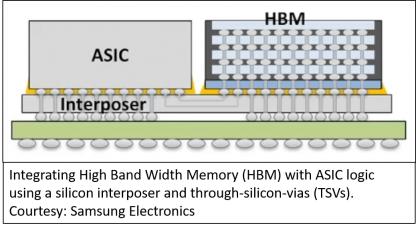
Things are different now. Building a custom chip now requires a lot of contributions from a lot of companies. Design, fab, packaging, IP, test and EDA are all delivered by different organizations with a laser focus on doing a particular part of the job very well. If you look at the challenges of FinFET and 2.5 designs for markets such as the cloud and AI, the complexity and number of players goes up yet again due to things like HBM memory stacks, interposers, advanced packages and enabling IP.

It is against this backdrop that I am pleased to say, “help is on the way”. eSilicon has been working with an extended family of ecosystem partners for many years, and a group of us will be taking it on the road soon, in Shanghai and Tokyo, to show how a team of companies can work as one to deliver advanced ASICs. We’ll be presenting at the Tokyo Conference Center, Shinagawa, Japan on Monday, December 11 and at the Kerry Hotel, Pudong, Shanghai, China on Thursday, December 14.

Over the course of the day from 10:30 AM to 4:00PM, you’ll hear from Samsung Memory about their HBM2 solutions, Samsung Foundry about their advanced 14nm FinFET solutions, ASE Group about their advanced packaging solutions, eSilicon, about their ASIC and 2.5D design/implementation and IP solutions, Rambus about their high-performance SerDes solutions and Northwest Logic about their HBM2 controller solutions. A complete ecosystem to address the requirements of advanced ASICs for markets such as high-performance computing, networking, deep learning and 5G.

There will also be cocktails and networking from 3:00PM to 4:00PM, with many very interesting lucky draw prizes to award.

Find out more about this valuable event and sign up to attend. It’s free, but space is going fast. We hope to see you there.

AbouteSilicon

eSilicon is an independent provider of complex FinFET-class ASIC design, custom IP and advanced 2.5D packaging solutions. Our ASIC+IP synergies include complete, silicon-proven 2.5D/HBM2 and TCAM platforms for FinFET technology at 14/16nm. Supported by patented knowledge base and optimization technology, eSilicon delivers a transparent, collaborative, flexible customer experience to serve the high-bandwidth networking, high-performance computing, artificial intelligence (AI) and 5G infrastructure markets.

Related Blog


Worldwide Interface IP Revenue Grew by 13.5% in 2016 (Source: IPnest)

Worldwide Interface IP Revenue Grew by 13.5% in 2016 (Source: IPnest)
by Eric Esteve on 11-26-2017 at 2:59 am

IPnest has released the 9[SUP]th[/SUP] version of the Interface IP Survey, ranking by protocol the IP vendors addressing the Interface segments: USB, PCI Express, (LP)DDRn, MIPI, Ethernet & SerDes, HDMI/DP and SATA. When the 1[SUP]st[/SUP] version has been issued in 2009, the IP segment was weighting $225 million and the 2009 to 2008 growth was negative due to the 2008 economic crisis. The same segment has generated $550 million in 2016!

As you can see on the below chart, Synopsys is clearly leading with 49% market share, followed by Cadence and Avago, each company enjoying about 10% market share, Rambus and Faraday ending this top 5 with less than 5% market share. In fact, as the interface IP market is essentially made of up-front license, IPnest has not included royalty in this ranking. If we take royalty into account, Rambus share would grow up to the Cadence level.

Since the first research, IPnest has built this survey by protocol, offering vendor ranking and competitive analysis for all the above-mentioned protocols. That’s why it’s possible to more precisely monitor the evolution of this dynamic market by protocol and for example compute the CAGR for each of the top 5 protocols: USB, PCIe, (LP)DDRn, MIPI and Ethernet & Very High Speed (VHS) SerDes. This ranking by CAGR appears on the below chart. If you compare USB and MIPI, what you see is that USB IP segment is much larger than MIPI (the smallest of the top 5), but that MIPI IP 25% CAGR is the largest, when USB IP segment has the lowest CAGR with 9%. But USB is, with Ethernet, the oldest protocol, issued in the 1990’s, when MIPI is more recent (mid 2000’s).

In fact, you can find much more information in this report, like the evolution of the number of design starts by protocol, as well as the evaluation of the number of commercial design starts, when a SoC integrates a specific interface IP externally sourced. This methodology allows to build 5 years forecast, that IPnest do every year. Obviously, you need a bit more than Excel to build such a forecast, let’s call it “IP intelligence”. You need to know the market trends for each protocol, the expected pervasion of specific protocol in market segment where it wasn’t used before (like PCI Express in automotive) … that’s why I spend so much time at phone or reading IP related news! But the result is satisfying, and no customer has ever complained about IPnest forecast accuracy, usually in the 5% to 10% range at 5 years at worst. Which is useful when you do the same work for about 10 years is that you can verify at year Y+5 the validity of the forecast made 5 years ago, at year Y…


For example, I can predict today that the Interface IP market will pass the $1 billion mark in 2022, growing at 12% CAGR between 2016 and 2022


This lead to another interesting point: the relative weight of the Interface IP segment in respect with the total Design IP market. As shown in the “Design IP Report” issued in 2017 by IPnest, the total IP market was $3.423 billion in 2016 and the license part was $1.956 billion. If we compare the license only revenue generated by the interface IP ($530 million) with the total license revenue, the interface IP segment is weighting 27% of the total.

In other words, the (license part) revenues of the interface IP segment is equivalent to the (license part) revenues of the processor IP segment (CPU, GPU and DSP).

But the main difference is that the processor IP segment is generating royalties, and the royalty share of the design IP segment has reached almost $1.5 billion in 2016, or 19% YoY growth!

If you work in a company addressing design IP, you should feel safe about future as this market has grown by 13% last year (9% for license revenues, 19% for royalty revenues). If your company address interface IP, you must know that this segment has grown by 13.5% in 2016 (licenses only), and will grow with 12% CAGR up to 2021.

IPnest has noticed some very interesting points: if Synopsys is the clear leader with 50% market share, this segment is becoming attractive, and different players attack this market. Rambus is well-known for patent licensing, but the company is now repositioning on IP licensing, the Snowbush IP group acquisition is a strong signal sent to the market.

Another group of vendors, the ASIC companies, is becoming very active in the interface IP segment. We can mention Invecas, working closely with GlobalFoundries, who is building a strong interface IP port-folio by acquisitions (Kool Chip, Krivi and Lattice IP group).

Nevertheless, the strongest Synopsys competitor is must probably Broadcom Ltd. (LSI Logic + Avago + Broadcom), even if the company doesn’t position as an IP vendor as they only sell IP like VHS SerDes to their ASIC customers.

If you consider the size of the interface IP market, reaching $950 million in 2021, there should be room for multiple players… but the winners will be the vendors building a strong engineering team, able to manage advanced PHY solutions based on VHS SerDes and supporting PCI Express and Ethernet running at 32 Gbps (PCIe 5.0) and 112 Gbps (PAM 4 SerDes for 100G Ethernet). And also able to address mainstream customers, offering one-stop-shop solutions targeting wide technology node spectrum…

Eric Esteve from IPnest

Just contact me at eric.esteve@ip-nest.com if you need more information about:
– the “Interface IP Survey 2012-2016 – Forecast 2017-2021”
– or the “Design IP Report” 2017


Seeking Solution for Saving Schematics?

Seeking Solution for Saving Schematics?
by Tom Simon on 11-24-2017 at 7:00 am

Schematics are still the lynchpin of analog design. In the time that HDL’s have revolutionized digital design, schematics have remained drawn and used much as they have been for decades. While the abstraction of HDL based designs has made process and foundry porting relatively straightforward, porting schematic based designs largely has remained difficult and time consuming. Fortunately, Munich based MunEDA has just significantly upgraded their schematic porting tool called SPT. Even more fortunately I had the opportunity to travel to Munich to attend the MunEDA user group meeting in November to learn more about SPT and their other offerings. While I missed Octoberfest, the MunEDA team made the event extremely worthwhile and even entertaining.

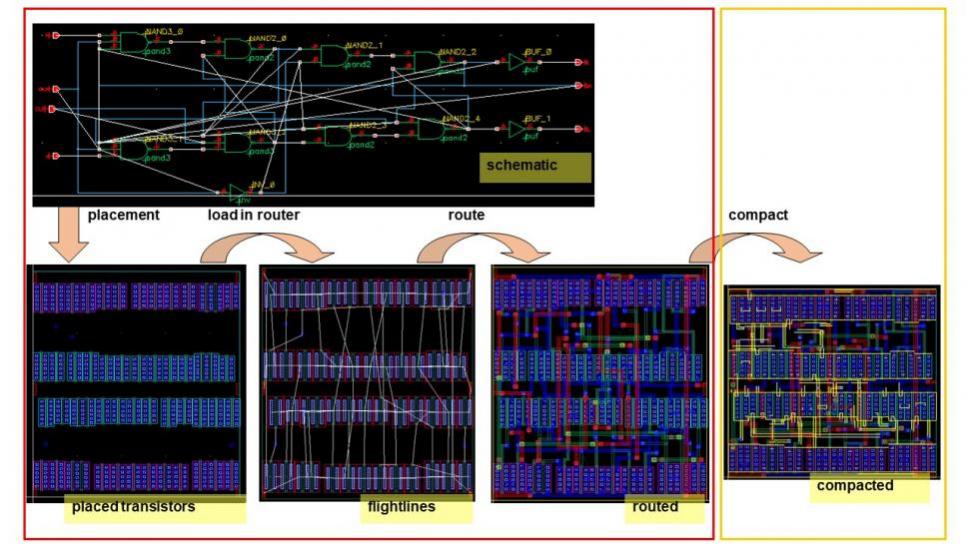
Rather than starting from scratch, reusing an existing schematic can save a lot of time, and preserves the initial investment in its development. For this to happen several distinct steps are needed. The devices in the existing design need to be converted to the corresponding devices in the new pdk. Rough scaling should be applied to arrive at preliminary property values. The placement, scaling and orientation of the symbols must be adjusted to match the original. Terminals that have name changes must be dealt with. Lastly any new or deleted terminals have to be accounted for.

Without a porting tool there are only a few alternative methods to accomplish the porting task. In Virtuoso ad-hoc or custom Skill code could be written, but this replaces a schematic editing task with a coding task – one that is not necessarily any easier and creates new problems in terms of support and adoption by larger teams. It is also possible to pay for porting services. However, just like remodeling a kitchen or bathroom, you can expect to pay top dollar. Also, each subsequent design requires a new investment. Lastly, an ambitious designer might embark on the task of manually converting a design, but as mentioned above, this can be time consuming, difficult and possibly error prone.

The latest version of MunEDA SPT is largely GUI driven, making the entire conversion process flow much more smoothly. No more creating off-line spreadsheets to set up the process. After the GUI is launched and the source and target pdk’s are specified, SPT lists cell mappings based on matching up cell names. For each cell, a set of property conversion rules is created. Along with that terminal matching rules are set up. An expression for each property mapping can be created to handle systematic changes such as scaling.

One of the things that makes the upgraded SPT attractive is that after the pin mappings are entered, it evaluates the symbols to decide the optimal orientation for the new symbol instances. The user still has final control of all the orientation parameters, but having a suggested orientation based on source and target pin placements will undoubtedly speed up the process and reduce manual intervention.

The GUI also has a feature to allow easy modification of property and symbol mappings. Once the conversion is configured, SPT lets users save the set up for future use. When it is time to convert a schematic, it can be done in 4 clicks. After opening SPT, simply select File->Run, then select the lib and cell.

OK, so we have all been around the block and know that a converted schematic most likely will not work. MunEDA’s expertise in circuit optimization comes into play next. MunEDA suggests looking at operating parameters first. Are saturated transistors still in saturation? Are linear transistors likewise still operating in the linear region? Operating specs across voltage and temperature need to be validated. Power is also a major consideration: is the design still in power spec?

MunEDA’s optimization flow can easily and nearly automatically help adjust circuit parameters to bring the ported schematic up to spec. MunEDA suggests fulfilling design constraints, optimizing at nominal conditions, optimizing specs at worst case operating conditions, and lastly using design centering to improve robustness.

While some analog designs can remain at legacy nodes, many are required to move to newer more advanced nodes for a multitude of reasons. Sometimes they are enabling technology for digital designs that are compelled to move due to power or capacity issues. Many IoT designs benefit from lower threshold voltages found on newer nodes. Regardless the reason, it is potentially a huge time saver to have a tool like MunEDA’s SPT to make the task faster and easier. However, as indicated above, moving the schematic to a new pdk is only a prerequisite to the actual task of getting the circuit to work on a new process. MunEDA is uniquely helpful with the later task.

The user group meeting lasted two days and was full of MunEDA and customer presentations. I’ll be highlighting many of these in the weeks and months ahead. It certainly was informative and as the updates on SPT show, they have been busy enhancing their entire line to tools for circuit design and optimization. For further information on SPT and MunEDA’s other products please look at their website.


Big Data Analytics and Power Signoff at NVIDIA

Big Data Analytics and Power Signoff at NVIDIA
by Bernard Murphy on 11-23-2017 at 7:00 am

While it’s interesting to hear a tool-vendor’s point of view on the capabilities of their product, it’s always more compelling to hear a customer/user point of view, especially when that customer is NVIDIA, a company known for making monster chips.


A quick recap on the concept. At 7nm, operating voltages are getting much closer to threshold voltages; as a result, margin management for power becomes much more challenging. You can’t get away with correcting by blanket over-designing the power grid, because the impact on closure and area will be too high. You also have to deal with a wider range of process corners, temperature ranges and other parameters. At the same time, surprise, surprise, designs are becoming much more complex especially (cue NVIDIA) in machine-learning applications with multiple cores and multiple switching modes and much more complexity in use-cases. Dealing with this massive space of possibilities is why ANSYS built the big-data SeaScape platform and RedHawk-SC on that platform, to analyze and refine those massive amounts of data, to find just the right surgical improvements needed to meet EMIR objectives.

Emmanuel Chao of NVIDIA presented on their use of RedHawk-SC on multiple designs, most notably their Tesla V100, a 21B gate behemoth. He started with motivation (though I think 21B gates sort of says it all). Traditionally (and on smaller designs) it would take several days to do a single run of full-chip power rail and EM analysis, even then needing to decompose the design hierarchically to be able to fit runs into available server farms. Decomposing the design naturally makes the task more complex and error-prone, though I’m sure NVIDIA handles this carefully. Obviously, a better solution would be to analyze the full chip flat for power integrity and EM. But that’s not going to work on a design of this size using traditional methods.

For NVIDIA, this is clearly a big data problem requiring big data methods, including handling distributed data and providing elastic compute. That’s what they saw in RedHawk-SC and they proved it out across a wide range of designs.

The meat of Emmanuel’s presentation is in a section he calls Enablement and Results. What he means by enablement is the ability to run multiple process corners, under multiple conditions (e.g. temperature and voltage), in multiple modes of operation, with multiple vector sets and multiple vectorless setting, and with multiple conditions on IR drop. And he wants to be able to do all of this in a single run.

For him this means not only all the big data capabilities but also reusability in analysis – that it shouldn’t be necessary to redundantly re-compute or re-analyze what has already been covered elsewhere. In the RedHawk-SC world, this is all based on views. Starting from a single design view, you can have multiple extraction views, for those you have timing views, for each of these you can consider multiple scenario views and from these, analysis views. All of this analysis fans-out elastically to currently available compute resources, starting on components of the total task as resource becomes available, rather than waiting for all compute resources to be available, as would be the case in conventional parallel compute approaches.

Emmanuel highlighted a couple of important advantages for their work, first that it is possible to trace back hierarchically through views, an essential feature in identifying root causes for any identified problems. The second is that they were able to build custom metrics through the RedHawk-SC Python interface, to select for stress on grid-critical regions, timing-critical paths and other aspects they want to explore. Based on this, they can score scenarios and narrow down to the smallest subset of all parameters (spatial, power domain, frequency domain, ..) which will give them maximum coverage for EMIR.

The results he reported are impressive, especially in the context of that earlier-mentioned multi-day, hierarchically-decomposed single run. They ran a range of designs from ~3M nodes up to over 15B nodes, with run-times ranging from 12 minutes to 14 hours, scaling more or less linearly with the log of design size. Over 15B nodes analyzed flat in 14 hours. You can’t tell me that’s not impressive.

Fast is good, but what about silicon correlation? This was equally impressive. They found voltage droop in analysis was within 10% of measurements on silicon and they also found peak-to-peak periods in ringing (in their measurement setup) were also within 10%. So this analysis isn’t just blazing fast compared to the best massively parallel approaches. It’s also very reliable. And that’s NVIDIA talking.

You can access the webinar HERE.


7nm SERDES Design and Qualification Challenges!

7nm SERDES Design and Qualification Challenges!
by Daniel Nenni on 11-22-2017 at 7:00 am

Semiconductor IP is the fastest growing market inside the fabless ecosystem, it always has been and always will be, especially now that non-traditional chip companies are quickly entering the mix. Towards the end of the year I always talk to the ecosystem to see what next year has in store for us and 2018 looks to be another year of double digit growth for IP companies, absolutely.

One of the more interesting conversations we have had (Tom Dillinger and myself) was with Analog Bits CEO Alan Rogers and EVP Mahesh Tirupattur. Analog Bits is well known for high performance and low power mixed-signal IP including SERDES which brings us to the most interesting part of our discussion and that is 7nm design and qualification challenges:

What are the major challenges for advanced node SERDES design?
“Starting with 28nm, we realized we had to re-think our design approach. We looked at our SERDES microarchitecture and layouts. We had to design the metal first, then the devices, then do our schematic based analysis. High-speed is a metal-dominated design.”

What are the analysis challenges in advanced nodes?
“EM, for sure. I*R voltage drop. RC delays will continue to be problematic.”

How do you support the greater diversity in back-end technology options?
“As an IP provider, the fewer metal stacks we have to support is better. The first 4-6 base levels are pretty standard. We do customer-driven customizations for the top metals, to embed inductors, distribute clocks, and meet the customer’s specific pad technology.”

At 7nm, there are additional constraints on physical design and analysis flows. Parameter variations are a major issue. How are you addressing those new requirements?
“We’re finding that reliability tools are a weak point. Rather than using pass/fail criteria, we need to understand design margins. For physical design, the series gate resistance of the FinFET is an increasing issue. We’re limiting the number of fins, and double-driving from both input ends. That has an impact on our layout styles, as well.”

How are you balancing technology scaling with increasing difficulty in meeting reliability targets, such as ESD?
“Our customers expect us to use the standard, qualified ESD structures from the foundry. We have to design our I/O circuits to meet the target matching impedance of the system at the frequency of interest, say 50 ohms. That implies adding inductance to offset the ESD capacitance. It impacts area, and introduces some channel loss, which impacts the overall cost.”

The application markets for 7nm are quite diverse, introducing requirements such as temperatures up to 150 degrees C. How has that been an impact?

“Leakages at 150 are higher… they all add up. Again, it comes down to cost.”

What modeling and/or CAD challenges are present at advanced nodes?
“IBIS-AMI modeling is becoming a must have that we need to provide to our customers.”

Any other SERDES design challenges that you would like to highlight?

“More customers are needing SERDES for data transmission requirements. We’re seeing SERDES I/O banks 2 or 3 deep, on all 4 sides of the die. Our IP must be designed to be arrayable in multiple dimensions. Even consumer applications, such as video transmission, are requiring greater transmission bandwidth — that adds to the cost of the silicon, to be sure, but increasingly, the package and PCB are becoming a greater cost factor.”

About Analog Bits

Founded in 1995, Analog Bits, Inc. (www.analogbits.com), is a leading supplier of mixed-signal IP with a reputation for easy and reliable integration into advanced SOCs. Products include precision clocking macros such as PLLs & DLLs, programmable interconnect solutions such as multi-protocol SERDES and programmable I/O’s as well as specialized memories such as high-speed SRAMs and TCAMs. With billions of IP cores fabricated in customer silicon and design kits supporting processes from 0.35-micron to 7-nm, Analog Bits has an outstanding heritage of “first-time-working” with foundries and IDMs.