You are currently viewing SemiWiki as a guest which gives you limited access to the site. To view blog comments and experience other SemiWiki features you must be a registered member. Registration is fast, simple, and absolutely free so please,
join our community today!
WP_Term Object
(
    [term_id] => 178
    [name] => IP
    [slug] => ip
    [term_group] => 0
    [term_taxonomy_id] => 178
    [taxonomy] => category
    [description] => Semiconductor Intellectual Property
    [parent] => 0
    [count] => 2040
    [filter] => raw
    [cat_ID] => 178
    [category_count] => 2040
    [category_description] => Semiconductor Intellectual Property
    [cat_name] => IP
    [category_nicename] => ip
    [category_parent] => 0
    [is_post] =>
)
Three-year old CacheQ, founded by two former Xilinx executives and a clever group of engineers, produces a distributed heterogenous compute development environment targeting software developers with limited knowledge of hardware architecture.
The promise of compiler tools for heterogeneous compute systems intrigued… Read More
In today’s System-on-Chip (SOC), analog blocks are used in many places such as I/O cells for communication, PLLs for generating clocks, LDO’s for converting supply voltage to internal rail voltage, Sensors for qualifying external characteristics such as temperature, light, motion, etc. However new advanced designs now require… Read More
This standard has been around in one form or another for over ten years and was then arguably ahead of its time. RTL designers were confused: ‘We already have RTL. Why do we need something else?’ I also didn’t get it. Still, the standard plugged ahead among the faithful and found traction among IP vendors. Particularly as a common format… Read More
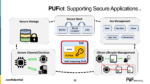
The continued innovation and widespread adoption of connected devices — the internet of things (IoT) — has resulted in a vast range of conveniences that improve our lives every day. At the same time, the ubiquity of IoT devices, which market watchers estimate to be in the tens of billions, also makes it more attractive to bad actors… Read More
Throughout history, people have sought after security as a basic right and expectation within a civilized society. Even as recent as a few centuries ago, things were very simple. Subjects looked to their rulers to provide security for their lives and assets. Assets were mostly hard assets such as jewelry, coins or real estate. … Read More
Let me acknowledge up front that Avery isn’t the most visible EDA company around. If you know of them, you probably know their X-propagation simulator. Widely respected and used, satisfying a specialized need. They have also been quietly building over the years a stable of VIPs and happy customers, with a special focus on VIPs for… Read More
Thanks to advanced hardware and software, smart vehicles are improving with every generation. Capabilities that once seemed far-off and futuristic—from automatic braking to self-driving at the very pinnacle—are now either standard or within reach. However, considering how vehicle architectures have continued to evolve,… Read More
Arteris IP recently spoke at the Spring Linley Processor Conference on April 21, 2021 about Automotive systems-on-chip (SoCs) architecture with artificial intelligence (AI)/machine learning (ML) and Functional Safety. Stefano Lorenzini presented a nice contrast between auto AI SoCs and those designed for datacenters.… Read More
During the week of April 19th, Linley Group held its Spring Processor Conference 2021. The Linley Group has a reputation for convening excellent conferences. And this year’s spring conference was no exception. There were a number of very informative talks from various companies updating the audience on the latest research and… Read More
Among marketing principles, “Stay Visible’ must rank as one of the highest. Meaning that if you don’t have something new to announce on a regular basis, you disappear. Most important, among the people you hope to influence, you cease to exist. As true for small ventures as large, though small ventures struggle to understand or prioritize… Read More









The silent killer of analog reliability: Why SPICE misses floating net