You are currently viewing SemiWiki as a guest which gives you limited access to the site. To view blog comments and experience other SemiWiki features you must be a registered member. Registration is fast, simple, and absolutely free so please,
join our community today!
WP_Term Object
(
    [term_id] => 6435
    [name] => AI
    [slug] => artificial-intelligence
    [term_group] => 0
    [term_taxonomy_id] => 6435
    [taxonomy] => category
    [description] => Artificial Intelligence
    [parent] => 0
    [count] => 947
    [filter] => raw
    [cat_ID] => 6435
    [category_count] => 947
    [category_description] => Artificial Intelligence
    [cat_name] => AI
    [category_nicename] => artificial-intelligence
    [category_parent] => 0
    [is_post] =>
)
One of the perks of blogging on SemiWiki is the events you get to attend for FREE and the amazing people you get to meet and Wally Rhines is certainly one of those people. You will not find a more intelligent, innovative, and genuinely nice group of people in my experience. Having traveled the world meeting thousands of people I can tell… Read More
As much as I love all EDA vendors I must say Cadence did the best DAC this year. Great booth, great location, excellent content, and of course a great party. The 5G presentation in the Cadence booth by Ian Dennison was of great interest to me as I am still trying to wrap my head around this whole 5G thing. I was able to meet with Ian privately… Read More
SLAM – simultaneous localization and mapping – is critical for mobile robotics and VR/AR headsets among other applications, all of which typically operate indoors where GPS or inertial measurement units are either ineffective or insufficiently accurate. SLAM is a chicken and egg problem in which the system needs to map its environment… Read More
Tuesday for lunch at #56DAC I caught up to the AI/ML experts at the panel discussion hosted by Cadence. Our moderator was the affable and knowledgable Prof. Andrew Kahng from UC San Diego. Attendance was good, and interest was quite high as measured by the number of audience questions. I learned that EDA tools that use heuristics… Read More
If there was ever a time that ethics should be formally applied to technology, it is with the emergence of Artificial Intelligence. Yet most of the big AI companies struggle with what should seem a simple task: defining ethics for the use of their products. Without the underpinnings of a moral backbone, powerful tools often become… Read More
Machine learning (ML) is already making its way into EDA tools and flows, but the majority of announcements have been around implementation, especially in guiding toward improved timing and area. This is a pretty obvious place to start; ML is in one sense an optimization technique, trained on prior examples, which should be able… Read More
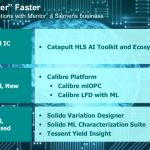
Mentor are stepping up their game in AI/ML. They already had a well-established start through the Solido acquisition in Variation Designer and the ML Characterization Suite, and through Tessent Yield Insight. They have also made progress in prior releases towards supporting design for ML accelerators using Catapult HLS. Now… Read More
Standards committees, the military and governmental organizations are drawn to acronyms as moths are drawn to a flame, though few of them seem overly concerned with the elegance or memorability of these handles. One such example is SOTIF – Safety of the Intended Function – more formally known as ISO/PAS 21448. This is a follow-on… Read More
Hardware is roaring back into prominence in technology innovation, from advanced cars to robots, smart homes and smart cities, 5G communication and the burgeoning electronification of industry, medicine and utilities. While software continues to play a role, all of these capabilities depend fundamentally on advances in … Read More
Anirudh Devgan (President of Cadence), gave the third keynote at CDNLive Silicon Valley this year. He has clearly become adept in this role. He has a big, but supportable vision for Cadence across markets and technologies and he’s become a master of the annual tech reveals that I usually associate with keynotes.
Anirudh opened … Read More











SEMICON West’s Autonomous Fab Vision Needs a Decision-Escalation Design