You are currently viewing SemiWiki as a guest which gives you limited access to the site. To view blog comments and experience other SemiWiki features you must be a registered member. Registration is fast, simple, and absolutely free so please,
join our community today!
WP_Term Object
(
    [term_id] => 6435
    [name] => AI
    [slug] => artificial-intelligence
    [term_group] => 0
    [term_taxonomy_id] => 6435
    [taxonomy] => category
    [description] => Artificial Intelligence
    [parent] => 0
    [count] => 947
    [filter] => raw
    [cat_ID] => 6435
    [category_count] => 947
    [category_description] => Artificial Intelligence
    [cat_name] => AI
    [category_nicename] => artificial-intelligence
    [category_parent] => 0
    [is_post] =>
)
“AI is the biggest risk we face as a civilization.” Words from the visionary Tesla CEO, Elon Musk. After each iteration of innovation, artificial intelligence edges closer to replicating the human brain; people fear that AI would soon steal their jobs, which has already started happening in some parts of the world. Yet, humans … Read More
Blockchain and Artificial Intelligence are two of the hottest technology trends right now. Even though the two technologies have highly different developing parties and applications, researchers have been discussing and exploring their combination [6].
PwC predicts that by 2030 AI will add up to $15.7 trillion to the world… Read More
At first glance, this seems like a ho-hum topic- just use whatever Arm or RISC-V solution you need – but think again. We’re now expecting to push an awful lot of functionality into these edge devices. Our imaginations don’t care about power, performance and cost; everything should be possible so let’s keep adding cool features.… Read More
Steven Woo, Fellow and Distinguished Inventor presented at the just concluded Linley Spring Processor Conference a talk about AI in the Era of Connectivity. As he put it, the world is becoming increasingly connected, with a marked surge of digital data, causing a dependence on said data. With the explosion of digital data and AI,… Read More
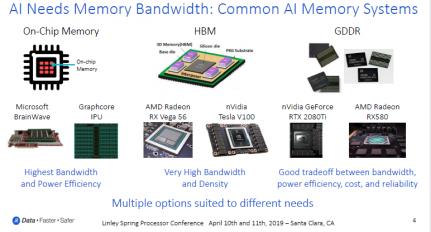
No, I’m not going to talk about in-memory-compute architectures. There’s interesting work being done there but here I’m going to talk here about mainstream architectures for memory support in Machine Learning (ML) designs. These are still based on conventional memory components/IP such as cache, register files, SRAM and various… Read More
We are all pretty familiar with augmented reality, where real world images are overlaid with computer generated images, graphics and even audio. Of course, our first exposure to augmented reality might have been images of heads up displays in fighter jets or perhaps in the movie The Terminator. Augmented reality is moving rapidly… Read More
The basic principles used for neural networks have been understood for decades, what have changed to make them so successful in recent years are increased processing power, storage and training data. Layered on top of this is continued improvement in algorithms, often enabled by dramatic hardware performance improvements.… Read More
Spring Forward with AIby admin on 03-28-2019 at 5:00 amCategories: AI, EDA, Security
The euphoria of NCAA March Madness seems to spill over into the tech world. The epicenter of many tech talks this month spanning from GPU conference, OCP, SNUG to CASPA has evolved around an increased AI endorsement by many companies and its integration into many silicon driven applications. At this year CASPA Spring Symposium,… Read More
One of the great pleasures in what I do is to work with people who are working with people in some of the hottest design areas today. A second-level indirect to be sure but that gives me the luxury of taking a broad view. A recent discussion I had with Kurt Shuler (VP Marketing at Arteris IP) is in this class. As a conscientious marketing… Read More
Webinars are a quick way to come up to speed with emerging trends in our semiconductor world, so I just finished watching an interesting one from Moortec about the benefits of embedded in-chip monitoring for Data Center and AIchip design. My first exposure to a data center was back in the 1960s during an elementary school class where… Read More












SEMICON West’s Autonomous Fab Vision Needs a Decision-Escalation Design