





As architects push toward advanced nodes and increasingly demanding workloads, modern silicon design has entered an era of unprecedented complexity. A single design respin can cost millions of dollars and delay market entry. Against this backdrop, designs must be balanced for performance, bandwidth, power efficiency, security and reliability.
In this environment, semiconductor IP selection is no longer a downstream sourcing decision. It is a foundational architectural choice that influences an SoC’s power envelope, performance, foundry compatibility, security posture, and time-to-market.
Today’s systems depend on a broad ecosystem of building blocks, including foundation IP, physical IP, interface IP, functional IP, security IP, IP subsystems, and chiplets. The challenge is not simply selecting individual blocks but rather ensuring that these components integrate seamlessly and perform reliably as a complete system.
A unified semiconductor IP strategy enables companies to reduce design risk, accelerate development, and focus engineering resources on differentiated innovation.
This article highlights key themes from the Synopsys eBook “Silicon Starts With Proven IP,” which explores how a coordinated IP approach helps companies address complexity across AI, edge, automotive, and next-generation computing markets.
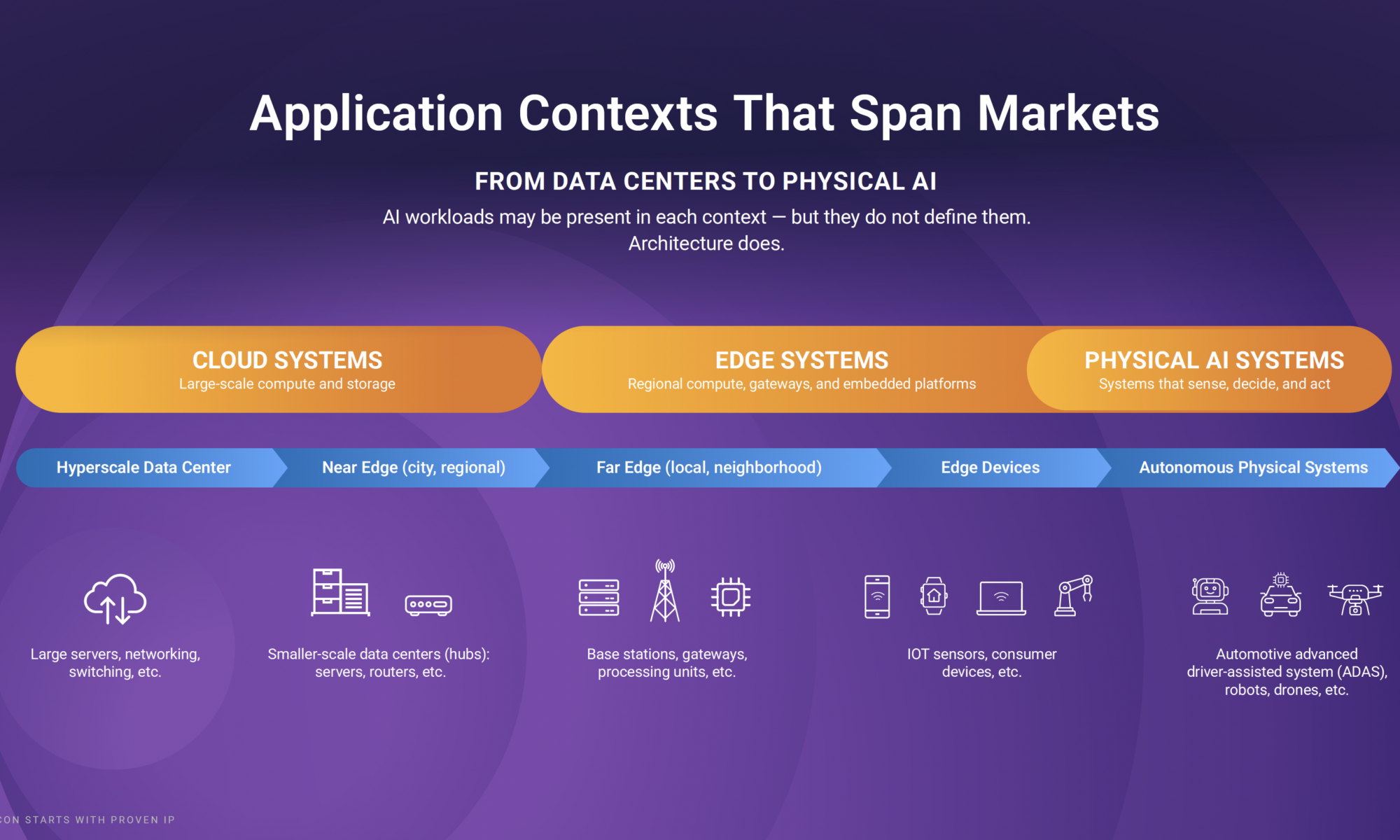
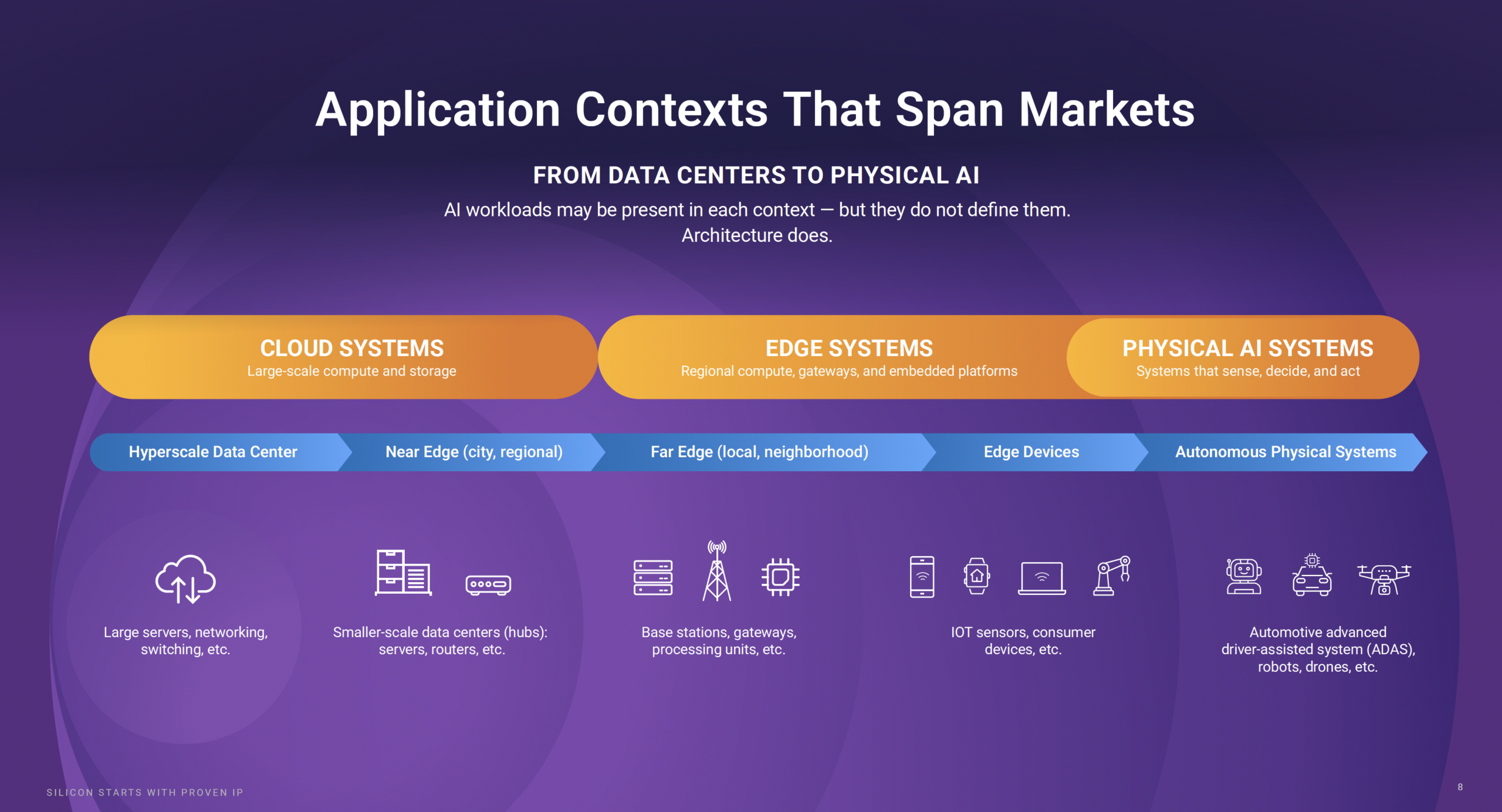
One Strategy, Three Contexts: Delivering Customer Value Across Markets
AI is reshaping nearly every industry, but the requirements for silicon vary significantly by application. A proven IP strategy enables architects to address three critical market realities: performance at scale, efficiency under constraint, and safety in the physical world.
Data Centers: Scaling Performance for AI Infrastructure
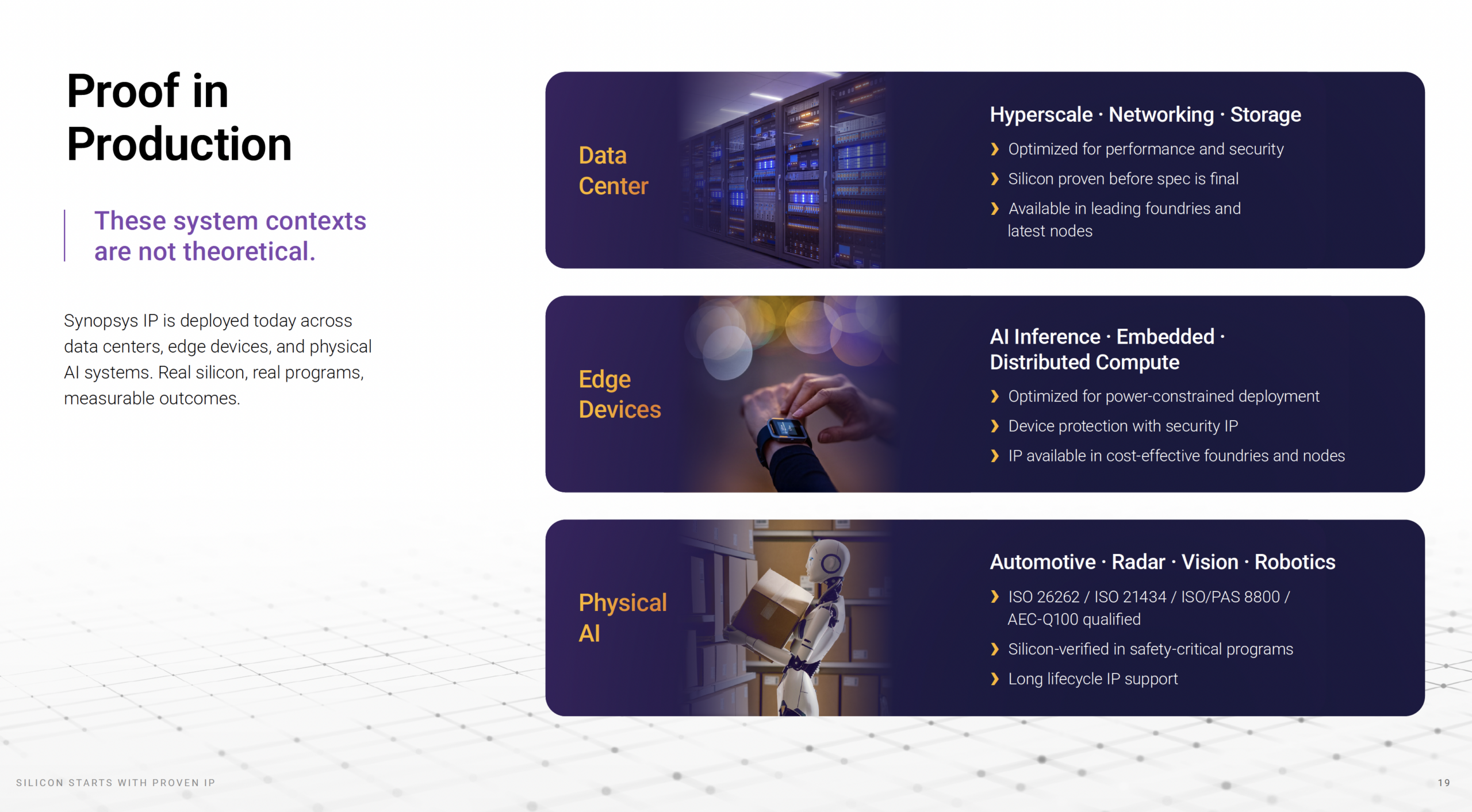
AI infrastructure requires unprecedented compute capacity, memory bandwidth, and system connectivity. To meet these demands, designers are increasingly adopting chiplet architectures and advanced interconnect technologies such as UCIe and die-to-die connectivity.
High-performance interface IP such as PCI Express®, CXL, DDR, and D2D connectivity have become critical foundational elements for scalable AI systems. Synopsys’ broad deployment experience across these technologies helps customers reduce integration risk and accelerate next-generation architectures. For instance, the company holds a 63% market share in PCIe/CXL interface IP space. [Source: 2025 Interface IP Survey, available for purchase from SemiWiki]
For data center customers, proven IP provides the foundation for scalable systems that address bandwidth growth while managing power and thermal constraints.
Edge Devices: Maximizing Efficiency Under Tight Power Constraints
At the edge, every picojoule matters. Battery-powered and always-on systems require aggressive optimization of power, performance, and area (PPA).
Through Tool-IP Co-optimization, Synopsys aligns IP development with EDA implementation flows to help designers achieve measurable PPA improvements, including reported area advantages of 4–11% and speed improvements of 3–10%.
Synopsys’ widely adopted interface IP across technologies such as USB and MIPI also enables customers to leverage silicon-proven solutions for mobile, embedded, and edge applications. The company holds a 75% market share in USB and 80% market share in MIPI. [Source: 2025 Interface IP Survey, available for purchase from SemiWiki]
For edge AI systems, proven semiconductor IP helps deliver the efficiency and predictability required for competitive products.
Physical AI: Enabling Safety and Deterministic Operation
Autonomous vehicles, robots, drones, and industrial systems require silicon that can reliably sense, decide, and act in the physical world.
These applications demand semiconductor IP designed for functional safety, cybersecurity, and deterministic operation. Synopsys IP is qualified for standards such as ISO 26262 and ISO 21434, helping customers reduce certification risk and accelerate development of safety-critical systems.
For physical AI, reliability is a prerequisite for deployment.
The Compounding Advantage: De-Risking the Full Lifecycle
The greatest value of a unified semiconductor IP strategy comes from how individual IP elements work together as a coordinated ecosystem.
Reducing Integration Complexity with IP Subsystems
Integrating IP from multiple sources can introduce interoperability challenges, qualification delays, and additional engineering effort.
Configurable, pre-verified IP subsystems combine components such as PHYs, controllers, security functions, and memory interfaces into qualified solutions. With more than 275 subsystem designs executed and production-deployed, Synopsys helps customers simplify integration and focus resources on product differentiation.
A broad interface IP portfolio spanning PCIe, CXL, DDR, USB, MIPI, SerDes and D2D connectivity provides customers with a consistent foundation for increasingly complex SoC architectures.
Building Trust from Silicon to System
Security must be designed into modern silicon from the beginning. Connected systems require protection that extends across critical data paths and establishes trust from the hardware foundation upward.
Interface-aware security helps protect technologies such as PCIe and CXL through capabilities such as inline encryption. A Hardware Root of Trust provides a secure silicon foundation by enabling device authentication from boot through operation.
For customers, security becomes an architectural advantage rather than a late-stage addition.
Extending Reliability Beyond Tape-Out
A silicon program does not end at tape-out. Automotive, industrial, and infrastructure products often require reliable operation for a decade or longer.
Silicon Lifecycle Management (SLM) provides embedded visibility into real-world device behavior, helping customers improve yield ramp, detect potential issues, and maintain reliability throughout product lifetimes.
For long-life applications, lifecycle intelligence is essential to protecting silicon investments.
Summary: Building Silicon for Long-Term Success
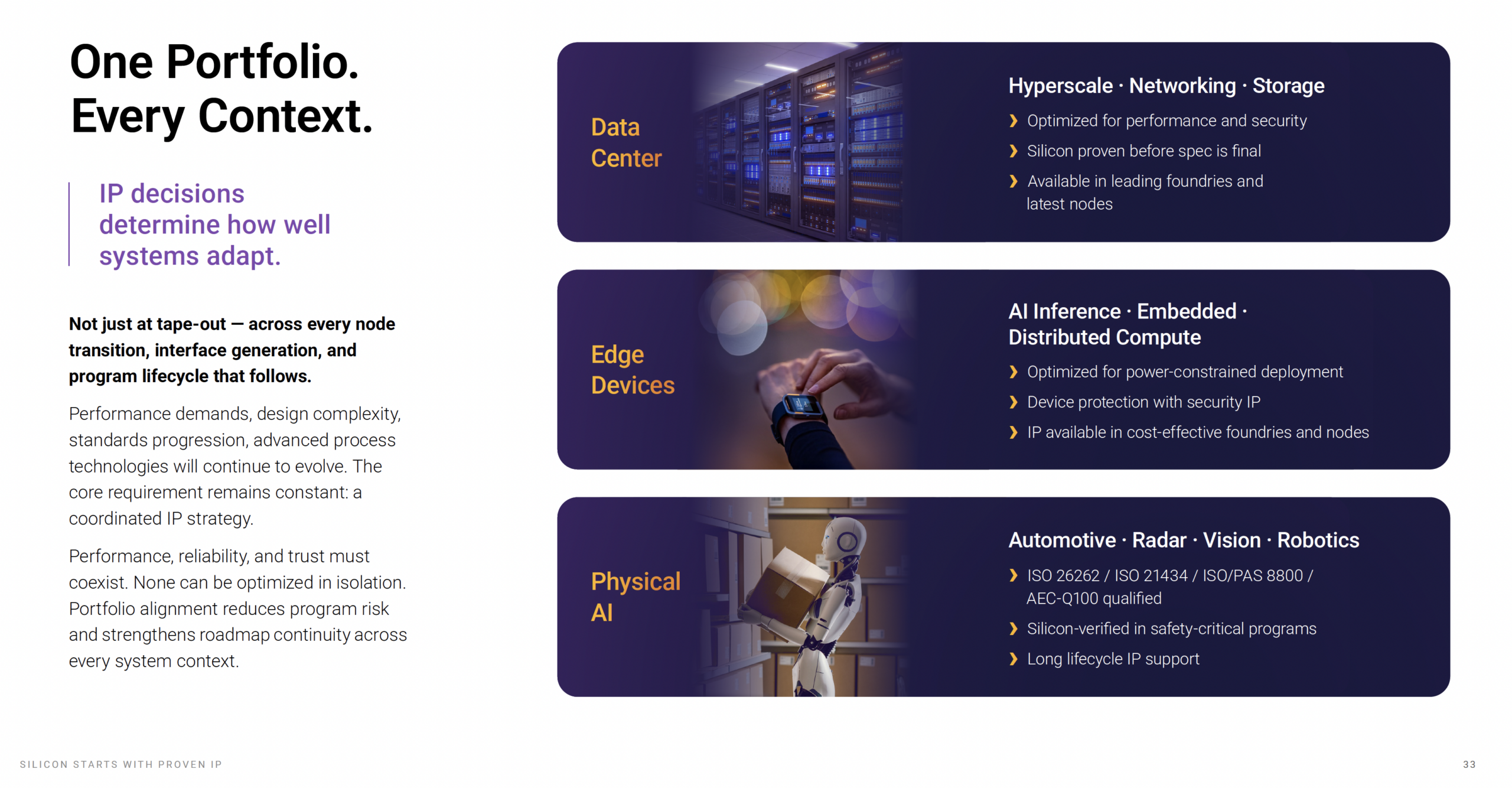
As semiconductor complexity continues to increase, IP strategy has become one of the most important architectural decisions in SoC development.
By addressing IP qualification, interface selection, security requirements, and reliability considerations early, companies can reduce risk and improve execution confidence.
A proven unified semiconductor IP strategy provides architectural confidence. This foundation enables innovation across AI infrastructure, edge computing, automotive systems, and next-generation physical AI platforms.
Explore how proven IP can support your next SoC design by downloading the Synopsys eBook “Silicon Starts With Proven IP” and learning how a comprehensive semiconductor IP portfolio can be tailored to your architectural requirements.
Also Read:
Synopsys at Design Automation Conference 2026
From Detection to Safety: Reframing Fault Simulation for Functional Safety
Foundation IP for Intel 18A: Technical Overview and Why It Matters
Share this post via:



Comments
There are no comments yet.
You must register or log in to view/post comments.