







The automotive semiconductor industry is undergoing a major architectural transition as vehicles evolve into centralized, software-defined computing platforms capable of supporting advanced driver assistance systems (ADAS), autonomous driving, and AI-enabled cockpit applications. This shift is driving demand for deterministic, high-bandwidth, low-latency in-vehicle networking technologies, particularly at the sensor interconnect layer. Against this backdrop, the MIPI Alliance has launched a formal compliance program for its A-PHY specification, a move designed to accelerate ecosystem interoperability and strengthen deployment confidence across the automotive supply chain.
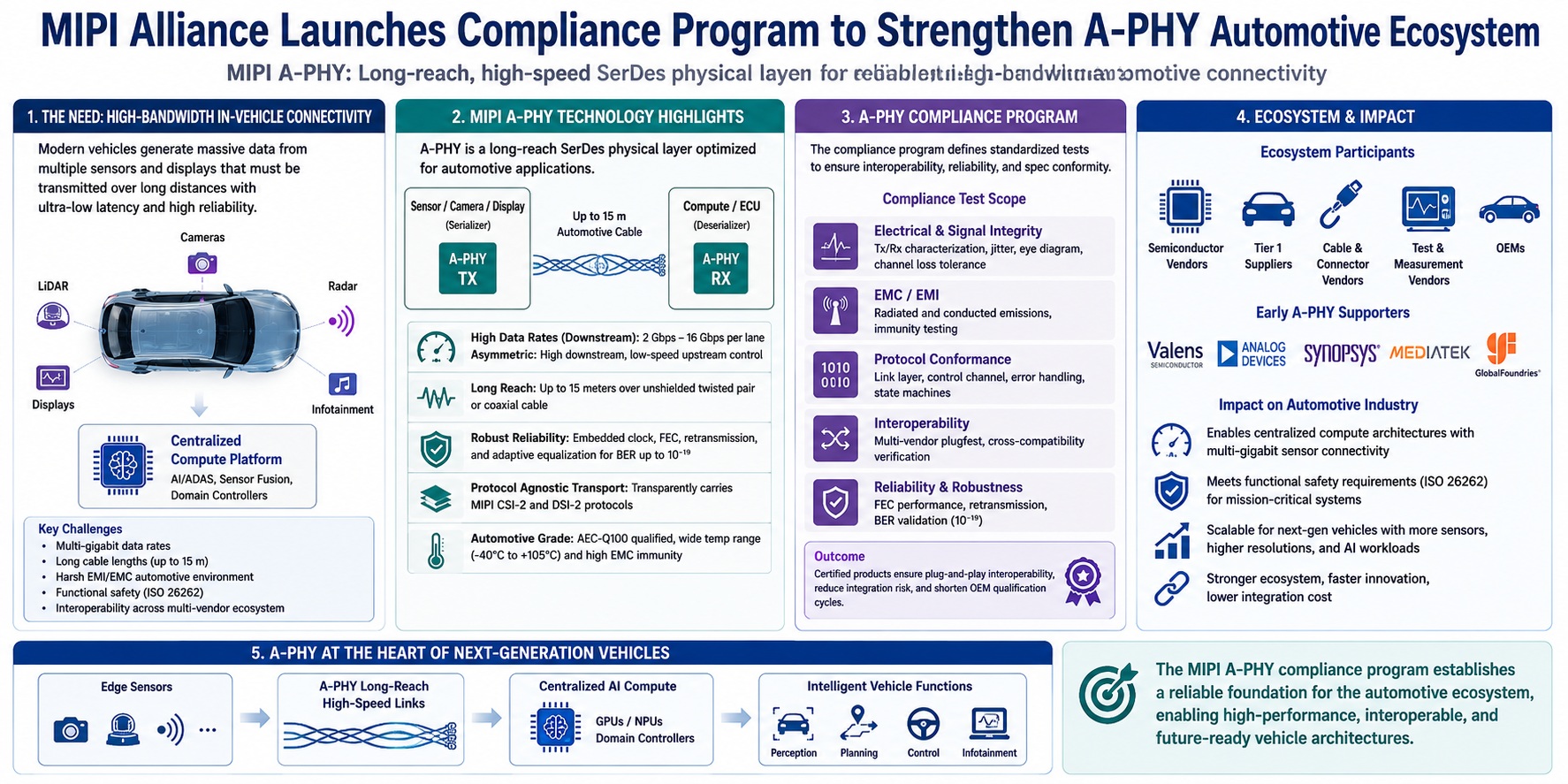
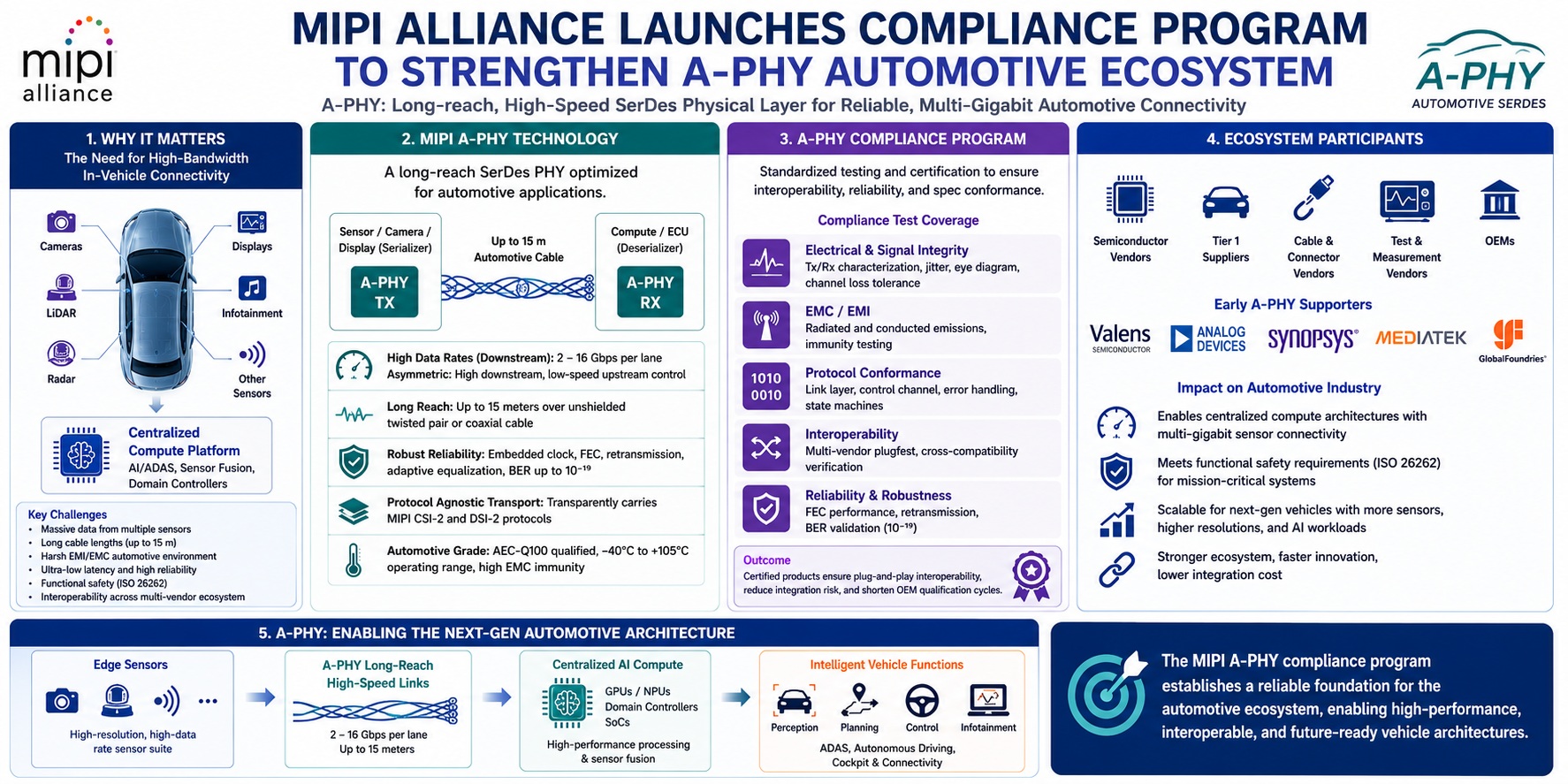
MIPI A-PHY is a long-reach Serializer/Deserializer (SerDes) physical layer specification optimized for automotive applications requiring multi-gigabit connectivity between cameras, displays, sensors, and centralized compute platforms. Unlike conventional short-reach PHY technologies used in consumer electronics, A-PHY was engineered specifically for automotive environments characterized by high electromagnetic interference (EMI), wide operating temperature ranges, strict functional safety requirements, and cable lengths extending up to 15 meters.
At the physical layer, A-PHY uses a highly robust embedded-clock architecture combined with advanced forward error correction (FEC), retransmission mechanisms, and adaptive equalization to maintain ultra-low packet error rates under harsh automotive conditions. The specification targets bit error rates (BER) on the order of 10^-19 at the application layer, a critical requirement for safety-relevant ADAS and autonomous driving workloads.
A-PHY supports asymmetric high-speed data transport, enabling downstream transmission rates ranging from 2 Gbps to 16 Gbps per lane while simultaneously supporting lower-bandwidth upstream control traffic. This architecture is particularly well suited for image sensor aggregation where large volumes of video data flow from edge sensors toward centralized AI processors. Modern ADAS camera modules generating uncompressed or lightly compressed high-resolution video streams require deterministic throughput with extremely low latency, making traditional automotive buses increasingly inadequate.
One of A-PHY’s key differentiators is its ability to transport native MIPI protocols including CSI-2 and DSI-2 transparently across long automotive cable assemblies. This preserves compatibility with the broader MIPI imaging and display ecosystem while enabling automotive-grade reach and reliability. The technology effectively extends the mobile imaging ecosystem into automotive applications, leveraging years of industry investment in MIPI camera and display interfaces.
The newly announced compliance program introduces a formalized interoperability and certification framework covering electrical, protocol, channel, and system-level validation. Compliance testing includes transmitter and receiver characterization, channel loss tolerance, jitter analysis, electromagnetic compatibility (EMC), signal integrity validation, forward error correction performance, and interoperability verification across multi-vendor implementations.
From a system architecture perspective, the compliance initiative is critical because automotive OEMs increasingly rely on heterogeneous supply chains. Camera modules, image sensors, processors, serializers, deserializers, connectors, and cabling infrastructure frequently originate from different vendors. Without rigorous compliance validation, interoperability challenges can create costly qualification delays and increase system integration risk.
The MIPI Alliance compliance framework is therefore intended to establish deterministic interoperability across the ecosystem, reducing engineering overhead for Tier 1 suppliers and automotive OEMs. Standardized conformance testing also improves scalability for software-defined vehicle architectures where sensor counts and aggregate bandwidth requirements continue to increase rapidly.
The importance of high-speed automotive SerDes technologies is growing alongside the industry transition toward centralized zonal architectures. Traditional vehicles relied on distributed electronic control units connected via CAN, LIN, FlexRay, or Automotive Ethernet. However, next-generation AI-enabled vehicles increasingly consolidate perception, sensor fusion, and decision-making into centralized compute clusters powered by GPUs, NPUs, and domain controllers.
This architectural shift dramatically increases demand for high-bandwidth sensor interconnects capable of supporting multiple 8-megapixel or higher-resolution cameras, LiDAR arrays, radar systems, and immersive cockpit displays. A single autonomous driving platform may process tens of gigabits per second of real-time sensor data. A-PHY is positioned as a foundational transport layer capable of supporting these next-generation sensor fusion architectures.
Several semiconductor vendors are actively building products around the A-PHY ecosystem. Valens Semiconductor has emerged as an early leader through its VA7000 chipset family, which targets ADAS and autonomous vehicle connectivity platforms. Analog Devices has also supported A-PHY adoption through high-speed automotive connectivity solutions, while Synopsys provides IP and verification tools supporting integration into automotive SoCs.
The compliance program also carries important implications for automotive functional safety. High-speed sensor connectivity links increasingly carry mission-critical perception data directly impacting braking, steering, and autonomous navigation decisions. A-PHY’s error correction mechanisms, redundancy capabilities, and deterministic reliability characteristics align closely with ISO 26262 safety requirements and ASIL-rated system architectures.
From an ecosystem perspective, the launch of the compliance program represents a maturation point for A-PHY as it moves from specification development toward large-scale automotive deployment. Certification infrastructure helps accelerate OEM qualification cycles, improve supplier interoperability, and reduce validation complexity across increasingly sophisticated vehicle platforms.
Bottom line: As automotive AI workloads continue scaling, the industry’s networking bottleneck is shifting closer to the sensor edge. The MIPI Alliance’s A-PHY compliance initiative positions the specification as a strategic enabling technology for next-generation autonomous and software-defined vehicle architectures, where reliable multi-gigabit connectivity becomes as important as compute performance itself.
Also Read:
Chips&Media’s Next-Generation Video CODEC IP Powers Ambarella’s Expanding Edge AI Portfolio
Share this post via:



The silent killer of analog reliability: Why SPICE misses floating net