


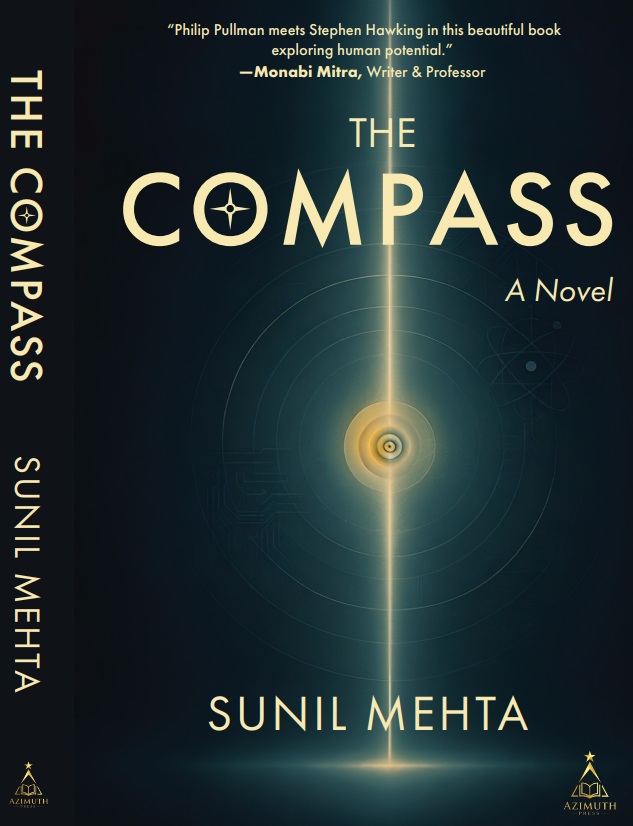



 What makes a breakthrough possible? Intelligence, certainly, but also curiosity, persistence and the courage to follow an idea before anyone can see where it leads. Sunil Mehta’s novel The Compass builds its premise around this question. Four students discover a mysterious compass that allows them to travel through time by entering the minds of people from the past. Their encounters with Albert Einstein, Robert Noyce and Steve Jobs offer an imaginative route into the human experiences behind scientific and technological change.
The distinction between visiting the past and entering another person’s mind gives the premise its particular appeal. Observing a famous discovery from the outside can reinforce the impression that history belongs to exceptional people whose achievements were almost inevitable. Encountering the doubts, ambitions and uncertain intuitions behind those achievements suggests something more useful. Ideas emerge through struggle. Their significance may be unclear even to the people pursuing them. For young readers, that perspective can make the distance between ordinary curiosity and extraordinary accomplishment feel less intimidating.
The choice of historical figures also gives the book a broad intellectual horizon. Einstein, Noyce and Jobs represent different forms of invention: rethinking fundamental questions about the universe, advancing the technologies underlying computing, and imagining how people might experience those technologies. Bringing them into one narrative invites readers to consider connections between scientific understanding, engineering and design. It raises a valuable question: how does an idea travel from a possibility in someone’s mind to something that changes the lives of millions?
That question matters because the devices surrounding us can conceal their own histories. A phone or computer arrives as a finished object, with little indication of the experiments, decisions and competing visions that made it possible. A story centered on the people behind innovation can restore that missing sense of development. It encourages readers to see technology as the outcome of human choices. Once those choices become visible, the future can seem more open to participation, questioning and invention.
The four students are central to this promise. Their presence places learning inside an adventure, giving readers companions who approach the past with questions of their own. The compass offers a striking image for education itself: an instrument that helps people find direction without determining every step of their journey. As a metaphor, it suggests that knowledge becomes valuable when it changes how we navigate. Learning about great thinkers can help students examine their own assumptions, recognize possibilities and decide which questions deserve their attention.
There is also an ethical dimension to the idea of entering another mind. Understanding innovation requires more than celebrating results; it requires attending to the person making decisions under conditions of uncertainty. The premise invites empathy alongside intellectual curiosity. It asks readers to imagine what ambition feels like before success confirms it, and what doubt feels like when an answer remains beyond reach. That invitation matters in a culture often eager to admire achievement while overlooking the vulnerability and effort that precede it.
A novel built around celebrated pioneers also creates an opportunity for further questions. Who else contributed to their achievements? Which institutions, collaborators and circumstances helped ideas take shape? Readers can carry those questions beyond the story, developing a fuller understanding of how discovery happens. The book’s digital companion offers a possible starting point for that continued exploration.
Ultimately, The Compass matters for the invitation contained in its premise: to approach the past with imagination and the future with agency. Its journey connects learning with possibility, suggesting that understanding yesterday’s breakthroughs can sharpen our questions about tomorrow. For students beginning to consider their place in the world, that is a meaningful proposition. They need opportunities to wonder, experiment and persist. A story that makes the minds behind innovation feel accessible can help readers recognize their own curiosity as something worth following, even when its eventual destination is unknown and the first steps feel small or uncertain.
Here are Amazon links for the book: Paperback edition, Kindle edition. The novel has received some great reviews, and the Kindle edition is currently a bestseller in the Teen & Young Adult Biographical Fiction eBooks category.
Share this post via:


TSMC’s Patent and the Harsh Realities of 3D DRAM Competition