





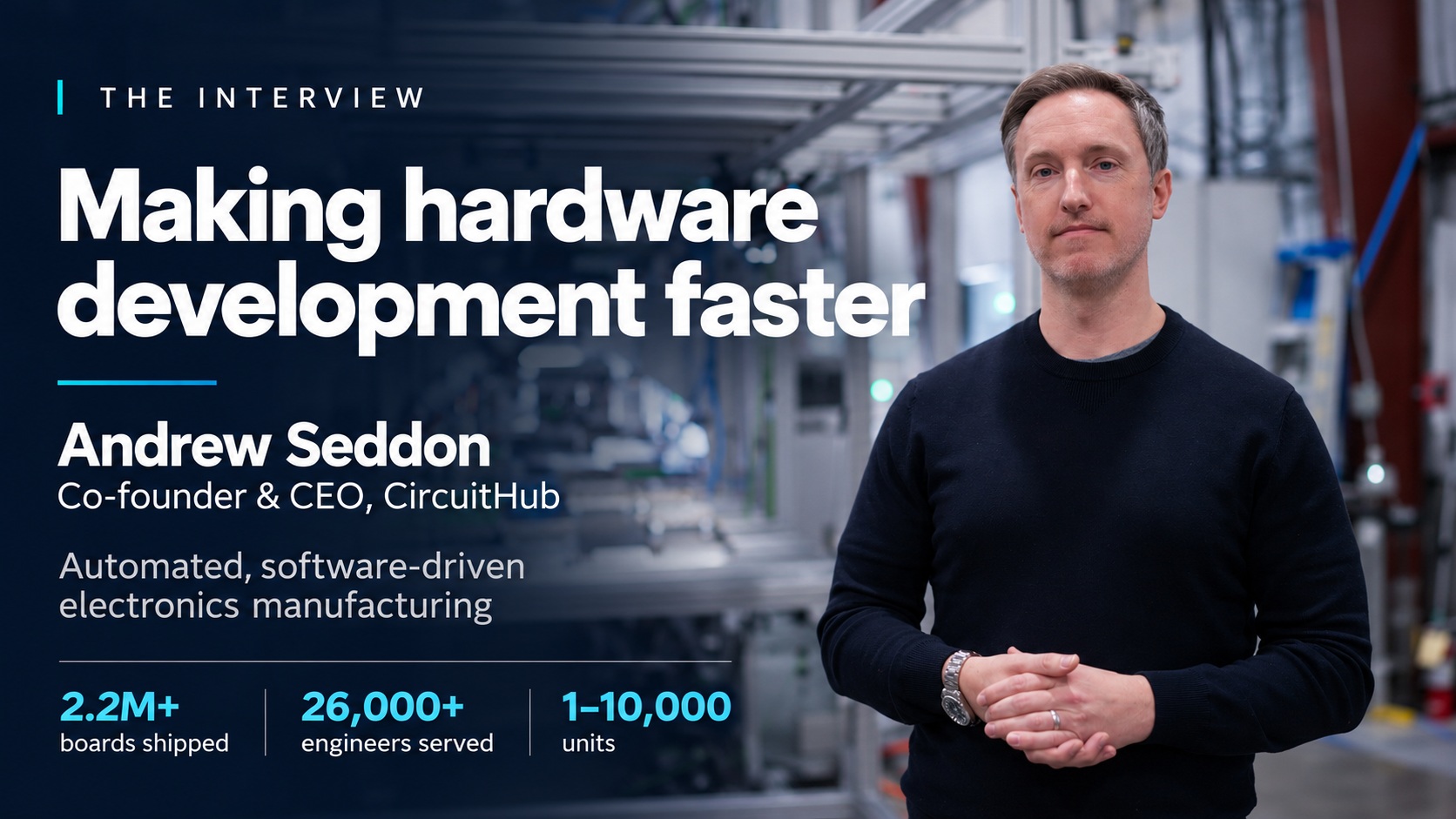
Andrew Seddon is a British engineer and the co-founder and CEO of CircuitHub. His product design background spans industrial equipment, medical devices and special effects equipment, including work on a motion-capture headset for A Christmas Carol. His experience of working with electronics manufacturers led him to establish CircuitHub to make hardware development faster through automated, software-driven manufacturing.
Tell us about your company?
CircuitHub builds automated, software-driven factories for on-demand electronics manufacturing. We help engineers turn their designs into assembled circuit boards, from a single unit to batches of 10,000.
The idea came from my own experience as a product design engineer developing industrial equipment. I spent a lot of time working with manufacturers and on factory floors. Getting hardware made was an arduous process, with expensive, slow iteration cycles. I wanted to build the electronics manufacturing service I wished I could use myself.
Our manufacturing system, The Grid, operates in Massachusetts. CircuitHub has shipped more than 2.2 million boards, placed over 150 million components and served more than 26,000 engineers. We have now reached price parity with comparable manufacturers in China, with an average turnaround of four days versus nine for a typical Chinese quick-turn shop.
What problems are you solving?
It is difficult to separate hardware design from manufacturing. If manufacturing is slow, it slows down product development.
High-volume electronics manufacturing is already highly automated. But when you move into smaller batches and a greater mix of designs, much of the process still depends on people operating machines and coordinating production.
Around 95% of projects involve fewer than 10,000 units, leaving a large number of teams underserved by manufacturing facilities geared towards mass production.
We have approached that problem by developing technology to automate high-mix electronics manufacturing. Each board takes its own route through The Grid, allowing multiple orders to run simultaneously without changeovers between designs. One unit of 100 designs can run as easily as 100 units of one design.
The customer benefit is faster iteration: getting boards back in days so engineers can test their designs and move on to the next version.
What application areas are your strongest?
We work with engineers across several sectors, including self-driving vehicles, satellites, robotics, and industrial equipment.
Our customers include a leading US electric vehicle manufacturer and one of the world’s largest AI labs.
Teams developing new products need to build and test different designs quickly. That remains valuable even when their eventual volume production takes place elsewhere.
For the semiconductor industry, we sit downstream of chip fabrication. We assemble chips and other components onto circuit boards that go into the devices people use.
What keeps your customers up at night?
The time and cost involved in getting hardware built. Each iteration can be expensive, and long manufacturing lead times slow the development process.
When I was developing products, I had to coordinate different manufacturers and engineering consultancies to get everything made on a short schedule. That experience was a major reason for starting CircuitHub.
Our focus is on shortening that cycle. Customers upload their designs, receive an automated quote and get digital status updates as their boards move through production. That visibility helps teams plan their work around when the boards will return.
As AI accelerates design, the ability to manufacture quickly becomes increasingly important. Teams need to be able to build and test what they are designing.
What does the competitive landscape look like and how do you differentiate?
The industry includes large electronics manufacturing services companies, smaller contract manufacturers and platforms that connect customers with networks of factories. Some hardware companies also build manufacturing capabilities in-house.
Our approach is to develop and integrate the manufacturing technology ourselves. We build the software and automation that control the production process.
We have taken inspiration from semiconductor fabs, applying techniques from highly automated chip manufacturing to electronics assembly.
The Grid uses levitating movers to carry boards between robots that print solder paste, place components, solder and inspect. Software and AI orchestrate the system, with each board following its own route.
That architecture allows us to handle different designs simultaneously and make small-batch production competitive onshore. The technology behind it combines software, robotics and manufacturing processes developed together over several years.
What new features/technology are you working on?
We are increasing capacity at our Massachusetts site fivefold and plan to open a UK factory in 2027.
Our research and development team is predominantly focused on software. We use classical control techniques and computer vision, and we are exploring AI agents for higher-level factory control and precision.
How do customers normally engage with your company?
Customers start by uploading their circuit board design files to our website. We provide an automated quote for quantities from one to 10,000 units.
Once an order is placed, customers receive digital status updates and can track its progress through manufacturing.
The aim is to make accessing manufacturing straightforward, so engineers can get their boards built quickly, test them and continue developing their products.


TSMC’s Patent and the Harsh Realities of 3D DRAM Competition