





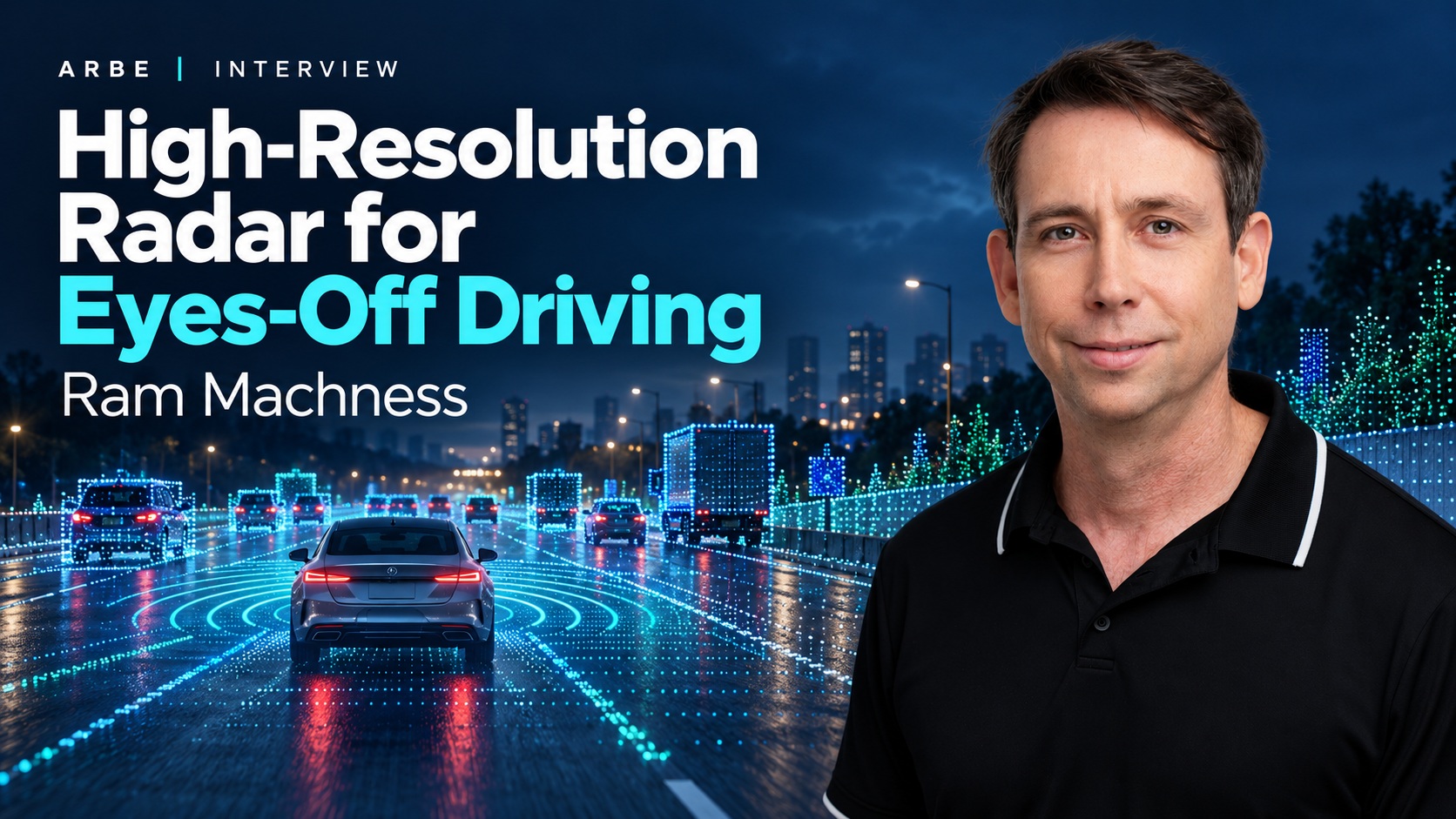
Ram Machness is the Chief Executive Officer at Arbe, a global leader in high-definition radar solutions for autonomous vehicles. He has three decades of experience in the semiconductor and automotive industries. In his previous role at Arbe as Chief Business Officer, he led product strategy and management, forged partnerships with OEMs and Tier 1 suppliers, and expanded the company’s footprint in key markets worldwide.
Before joining Arbe, Ram held senior global leadership roles at Texas Instruments, leading multiple automotive and wireless connectivity product lines across the US, Europe, and Asia, and scaled their businesses to $300M+. Prior to that, he led product management at Microsoft and DSP Group. Ram’s technical background, combined with commercial acumen, allow him to help drive the evolution of sensor technologies and the transition to physical AI.
Tell us about your company?
Arbe (Nasdaq: ARBE), a global leader in ultra-high-resolution radar solutions, is driving a radar revolution. Its cutting-edge radar chipset and 4D imaging radar delivers up to 100 times more detail than other radar systems on the market, empowering automakers, radar Tier-1s, and industrial OEMs to develop safe systems for L3 to full autonomy. Arbe’s technology addresses the most critical use cases by delivering real-time, 4-dimensional imaging that enables the perception stack with information such as precise mapping of drivable free space and robust object detection across highway, urban, and off-highway environments in all weather and lighting conditions. With its transformative impact across passenger, commercial, and industrial vehicle segments, as well as other advanced defense and security applications, Arbe is redefining the role of radar in next-generation autonomous operations.
Radar resolution is determined by the number of virtual channels, much like camera resolution is defined by pixels. Traditional automotive radars offer around 16 channels, and even advanced radars reach approximately 200 channels. Arbe has made a groundbreaking leap, delivering a 2,304-channel array – 10 times more than leading alternatives – providing unparalleled resolution and performance. This innovation makes it possible, for the first time, to rely on radar as a key sensor for automotive perception. Arbe’s Perception Radar supports over 100,000 detections per frame, generating a point cloud two orders of magnitude denser than any other radar solution.
Arbe’s Perception Radar is designed based on a proprietary chipset that includes:
-
A proprietary automotive grade radar RF chipset – transmitter and receiver chips of 48 receiving and 48 transmitting channels. The chipset provides best-in-class performance for channel isolation, noise figure, and transmit power at the lowest cost per channel in the market.
-
An industry first high definition Radar Processing Chip that allows the processing of massive amounts of raw data in real-time with unprecedented computational abilities (equivalent to 3Tb per second). The proprietary processor can scale from high resolution to ultra-high resolution and support the data generated from 2304 virtual channels (48*48), which is much higher than what has been achieved on a chip, in the automotive industry, while maintaining low power consumption.
What problems are you solving?
Arbe’s Perception Radar is critical for the evolution of the automotive industry. Specifically for eyes-off driving and higher autonomy, Arbe’s Perception Radar is imperative because its precision and reliability are essential for meeting the rigorous safety standards of NHTSA (U.S.) and NCAP (Europe) while addressing vital autonomous driving challenges by offering HD sensing in long-range which is critical for highway autopilot at full speed (not offered today). Arbe’s Perception Radar operates effectively in all environmental conditions, from detecting pedestrians at night and overcoming glare and light saturation, to making crucial driving decisions in adverse weather like snow, fog, and heavy rain.
Additionally, Arbe’s Perception Radar offers accurate free space mapping, enabling vehicles to distinguish drivable from non-drivable areas with precision. It can detect objects at long-range in elevation and azimuth and can separate objects accurately. Arbe’s perception radar is superior at stationary object detection, constant detection through partial and full occlusion, and “under-” and “over-drivability” identification.
What application areas are your strongest?
Arbe pioneers a radar-based solution with sufficient detail required to support integration with camera sensor data for comprehensive environmental perception. Arbe’s ultra-high-resolution radar achieves object tracking, boundary mapping, and classification to support critical safety and navigation applications. By fusing this data with camera input, Arbe’s Perception Radar transcends individual sensor limitations, ensuring consistent perception in all weather and lighting conditions.
What keeps your customers up at night?
What keeps our customers up at night is the risk of investing in autonomy platforms that consumers will not adopt or pay for. OEMs still see eyes-off autonomy as a major competitive opportunity, but recent Level 3 program pauses show how difficult it is to make the business case work with first-generation sensing architectures. Their concern is not only whether the technology can function in limited conditions, but whether it can deliver a feature that is reliable, scalable, cost-effective, and valuable enough for consumers to use and monetize.
In practical terms, our customers worry about four things:
-
Limited operating domains
If eyes-off systems only work in narrow conditions, such as specific roads, low speeds, clear weather, or daylight, the consumer experience becomes fragmented and disappointing. -
Cost versus value
OEMs need to justify the cost of the sensing suite. If the system is expensive but usage is limited, the feature becomes difficult to monetize. -
Consumer trust and adoption
Drivers will not pay meaningfully for autonomy that feels intermittent, abrupt, or unreliable. Arbe’s survey shows demand is high, but only when the system delivers safety, smooth operation, all-condition availability, and full highway-speed performance. -
Competitive risk
Reliable eyes-off autonomy can influence brand choice. Arbe’s research found that many consumers would consider switching brands for a reliable eyes-off system, which means OEMs risk losing technology leadership if they cannot deliver the right experience.
Our customers are worried about choosing the wrong technology foundation for next-generation autonomy. They need sensing solutions that can help them move beyond limited L3 deployments and deliver eyes-off systems that work reliably, continuously, and at a cost structure that supports a real business case.
What does the competitive landscape look like and how do you differentiate?
The competitive landscape is evolving quickly as automakers move from basic ADAS toward L3 and eyes-off autonomy. The market includes camera-first systems, LiDAR-based approaches, conventional radar, and increasingly multi-sensor stacks. The main challenge is delivering reliable perception at highway speeds and in difficult conditions such as rain, glare, darkness, and dense traffic.
We differentiate by leveraging a massive channel array, turning radar from a supporting sensor into a high-resolution perception layer. Our HD imaging radar delivers long-range detection, velocity accuracy, object separation, and all-weather performance, helping automakers add the redundancy and reliability needed for scalable eyes-off driving without depending on any single sensor modality.
What new features/technology are you working on?
We see the same core perception challenge across multiple markets: passenger cars, trucks, industrial vehicles, defense platforms, autonomous robots, and other safety-critical systems all need to detect and track objects reliably in difficult environments. That includes darkness, glare, dust, fog, rain, smoke, cluttered scenes, high speeds, and situations where cameras or other sensors may be limited.
We are working on high-resolution, real-time radar perception technology that can be adapted across these use cases. The focus is on improving object separation, long-range detection, velocity accuracy, and free-space understanding, while keeping the system scalable for automotive and non-automotive platforms. In practical terms, the goal is to give machines a more reliable perception layer that works in conditions where safety cannot depend on clear visibility alone.
For the automotive sector, our technology roadmap is centered on enabling scalable eyes-off driving and higher levels of autonomy. The goal is to help automakers move from limited hands-free systems to continuously available, trusted eyes-off functionality.
Also Read:


TSMC’s Patent and the Harsh Realities of 3D DRAM Competition