You are currently viewing SemiWiki as a guest which gives you limited access to the site. To view blog comments and experience other SemiWiki features you must be a registered member. Registration is fast, simple, and absolutely free so please,
join our community today!
Four panelists from big-name semiconductor design companies spoke about their circuit simulation experiences at #53DAC in Austin this year, so I attended to learn more about SPICE and Fast SPICE circuit simulation. I heard from the following four companies:… Read More
Most mergers and acquisitions in the EDA world simply don’t work out financially a year or two after the deal is done, however I was pleasantly surprised to learn that Tanner EDA is doing quite well at #53DAC this year after the acquisition by Mentor Graphics back in March 2015. Everyone that I’ve been meeting with at … Read More
In our semiconductor ecosystem we often specialize the engineers and therefore EDA tools into separate silos like Foundry, front-end design, back-end design, tapeout, etc. What I discovered at #53DAC a few weeks ago was that some EDA companies actually bridge the gap between foundry engineers and IC designers with their tools.… Read More
At the #53DAC earlier this month held in Austin, Texas I met up with Renee Donkers, the founder of Fractal Technologies. His company has been focused on improving the quality of semiconductor IP cells through the use of automated checking software. The highest area of growth in EDA as measured by the ESD Alliance is in the reusable… Read More
IC design challenges are different at advanced nodes like 7nm, so to learn more about the topic I attended a panel luncheon at DAC sponsored by Cadence. The moderator was both funny and technically astute, quite the rare combination, so kudos to Professor Rob Rutenbar, a former Neolinear guy now at the University of Illinois. Panelists… Read More
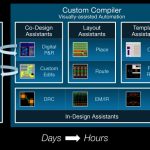
Last week at the #53DAC conference there was a lot of excitement in the air about custom IC design, especially at the luncheon that I attended on Tuesday from Synopsys where they had customers like STMicroelectronics, GSI Technology, Samsung Foundry and the Synopsys IP group talk about their experiences using the new Custom Compiler… Read More
The number one EDA+IP vendor in our industry today is Synopsys, and their eloquent leader is Aart de Geus, so I expect that the Monday interview at #53DAC on June 6th will be well attended and worthwhile to witness in the DAC Pavilion, start time is 11:30AM, so arrive early to get a seat. One of Aart’s coined words is Technomics,… Read More
For bloggers like myself spending four days at #53DAC is almost a non-stop blur of activity, visiting EDA vendors, IP providers and foundries to learn about what’s happening in our semiconductor industry. Cadence is both an EDA vendor and IP provider, so DAC is a great showcase for them to tell us what’s new in 2016 and… Read More
I live in Tualatin, Oregon just a few miles away from the corporate headquarters of the #3 EDA company in the world, Mentor Graphics. Since DAC is fast approaching, I thought it would be useful to give you a quick overview of what Mentor is going to be talking about in Austin, Texas during June 5-9. … Read More
When I hear the company name of ANSYS the first EDA tool category that comes to mind is power noise sign-off. Going to DAC is a great way to find out what’s new with EDA, IP and foundries. There are three places that you can find ANSYS at DAC this year:… Read More






















Why ASML Is Racing to Build 110 EUV Machines