





Abhi Kolpekwar, VP & General Manager, Digital Verification Technologies at Siemens EDA met with me at #DAC2026 to provide the big picture on smart verification tools, something they call Questa One. Their verification tools are infused with AI to improve productivity on projects like SoCs, 3D IC and chiplets. Abhi shared that complex electronic systems can take 3-4 years for new product development, and that the size of the designs is moving beyond the traditional EDA tool capacity and performance limitations.
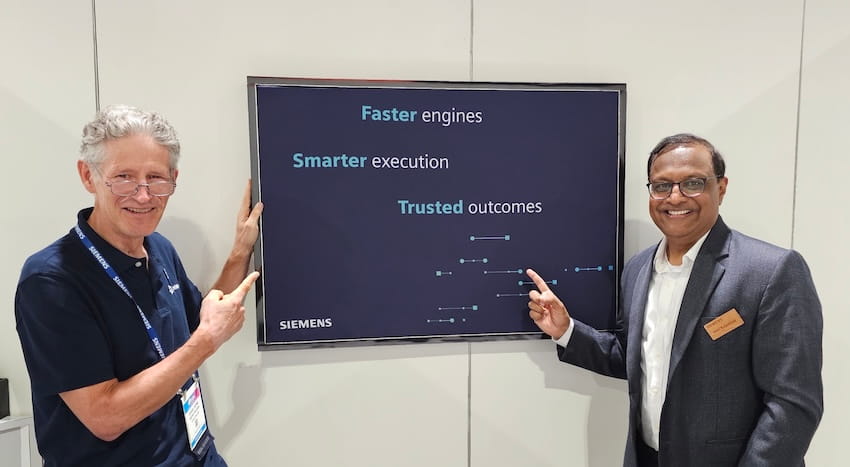
Faster Engines
At Siemens the response to these challenges has come in three EDA features. The first feature is through faster engines. In addition, the engines can talk to each other bidirectionally by using micro-services in the engines, even agents can use these. This also allowed Siemens to enable Model Context Protocol (MCP), an open standard created by Anthropic to let AI models connect to tools, files and databases.
As an example consider the case of an RTL netlist that has been run through lint, producing 10,000 failures. With an AI flow the lint is followed by an auto-fix of the RTL, then it re-runs lint to confirm the fixes without a human in the loop by using interfaces.
Performance and Capacity
Using data-driven product development, the Questa One tools have added faster performance and higher capacity levels. These improvements mean that your teams can design and verify more quickly and also for the most demanding product complexity levels.
Connected Verification
For DFT tasks the Tessent family of products is industry leading, and when verification with DFT is combined, then DFT simulations that used to run for weeks are slimmed down to just days.
The Questa One Agentic ToolKit (ATK) provides the domain-specific intelligence and skills that plug into Siemens’ primary orchestrators, such as the Coding Agent and Fuse Agent. This modular approach ensures that the orchestration layer remains flexible while the ATK provides the specialized ‘Context Intelligence’ needed for complex DVT tasks.
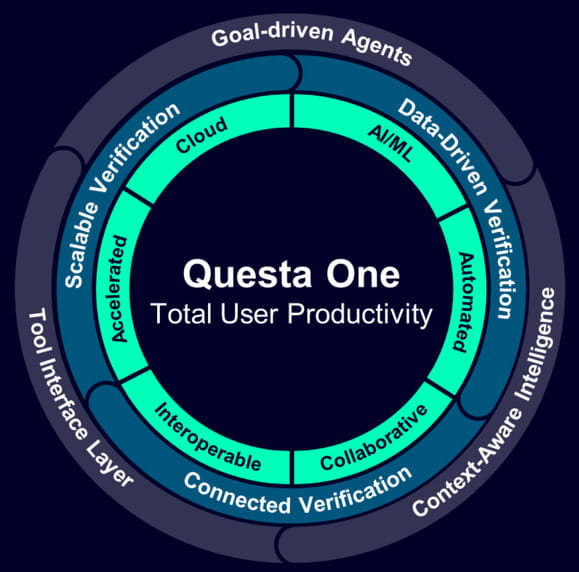
Customers can use Siemens agents or any other agent of their own choice. This is a partner approach, not just another EDA vendor. EDA engines plus apps plus agents make the AI productivity gains possible in Questa One, which includes agents for RTL code, lint, CDC, verification planning and debug.
MediaTek is quoted about how Questa One has allowed new engineers to come up to speed faster with RTL methodology, and address the learning curve challenges. “The Siemens methodology is LLM-agnostic, and allows engineers to leverage their choice of reasoning models. While Siemens frequently utilizes NVIDIA NIM and Nemotron for high-performance reasoning, the architecture is designed to be flexible, giving engineers an AI-driven foundation that adapts to their specific enterprise requirements.”
Siemens has not reached fully autonomous IC design and verification to eliminate engineers, rather using Quest One will amplify engineering judgement and productivity. Using these AI-powered tools will save time by helping your judgement, with a human in the loop approach.
Summary
The first generation of AI-based tools were basically point tools, but in 2026 the AI technology is being used to orchestrate other EDA tools to achieve higher-level objectives. It’s an exciting time to watch the rapid advancements in the EDA space with the advent of agentic AI showing promising results. Siemens has gone all-in with agentic AI for IC design and verification engineers.
Related Blogs
- Siemens Reveals Agentic Questa
- The Siemens Questa plus AI Story Gathers Momentum
- Transforming Functional Verification through Intelligence
- Siemens Proposes Unified Static and Formal Verification with AI
- Smart Verification for Complex UCIe Multi-Die Architectures
- Revolutionizing Simulation Turnaround: How Siemens’ SmartCompile Transforms SoC Verification




Comments
There are no comments yet.
You must register or log in to view/post comments.