





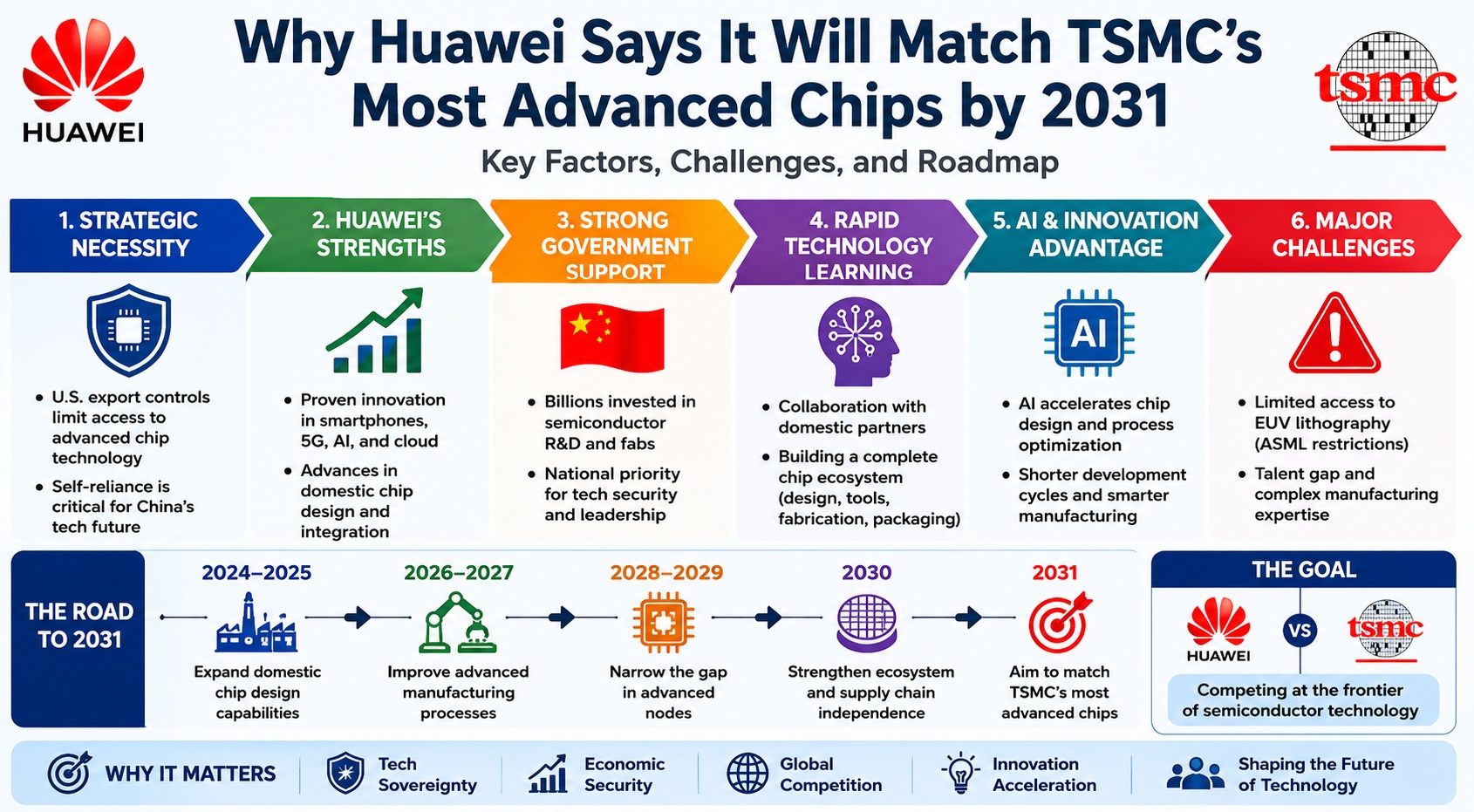
Huawei’s assertion that it could match TSMC in producing the world’s most advanced chips by 2031 reflects both technological ambition and geopolitical necessity. As one of China’s leading technology companies, Huawei has faced significant restrictions on access to advanced semiconductor technology due to U.S. export controls. These restrictions have accelerated China’s determination to develop an independent semiconductor ecosystem, with Huawei positioned at the center of that effort.
TSMC is widely regarded as the global leader in semiconductor manufacturing. The company produces cutting-edge chips for major technology firms, including Apple, NVIDIA, AMD, and Qualcomm. Its advanced process technologies, such as 3nm and future 2nm nodes, are considered among the most sophisticated manufacturing achievements in the world. Matching TSMC’s capabilities is an enormous challenge because semiconductor production requires expertise in materials science, lithography, design software, manufacturing precision, and supply chain coordination.
Huawei’s confidence stems from several factors.
First, the company has demonstrated resilience despite sanctions. Since being cut off from many Western technologies, Huawei has continued to innovate in smartphones, telecommunications equipment, artificial intelligence, and cloud computing. The launch of advanced smartphones powered by domestically produced chips surprised many industry observers and showed that China’s semiconductor industry had made more progress than expected.
Second, Huawei benefits from strong government support. China has identified semiconductors as a strategic industry critical to economic security and technological leadership. Billions of dollars have been invested in chip manufacturing, research institutions, and talent development. This support creates a long-term environment in which companies like Huawei can pursue ambitious technological goals that may take years to achieve.
Third, Huawei believes it can catch up is the rapid pace of technological learning. Semiconductor manufacturing has historically been dominated by a few companies, but technological gaps can narrow when countries commit substantial resources to research and development. Huawei works closely with domestic partners, including chip designers, equipment suppliers, and foundries. Through these collaborations, China is building a more complete semiconductor ecosystem that reduces dependence on foreign suppliers.
Artificial intelligence may also play a role in Huawei’s strategy. AI can improve chip design, optimize manufacturing processes, and accelerate research. By leveraging AI tools, Huawei may be able to shorten development cycles and identify innovative solutions to technical challenges. This could help compensate for some of the disadvantages caused by limited access to certain foreign technologies.
However, achieving parity with TSMC by 2031 remains highly uncertain. TSMC is not standing still. The company continues to invest tens of billions of dollars annually in research, manufacturing facilities, and next-generation technologies. By 2031, TSMC itself will likely have advanced far beyond today’s leading-edge nodes. Therefore, Huawei’s challenge is not merely to catch up to current technology but to compete with where TSMC will be in the future.
One of the biggest obstacles is access to advanced lithography equipment. The most sophisticated chip production relies on extreme ultraviolet (EUV) lithography machines produced by the Dutch company ASML. Export restrictions have limited China’s access to these systems. Developing equivalent domestic alternatives is a complex and expensive undertaking that could take many years.
Talent is another critical factor. Advanced semiconductor manufacturing requires highly specialized engineers and scientists. While China is producing increasing numbers of technical graduates, building a workforce with decades of accumulated expertise comparable to that found at TSMC remains a significant challenge.
Bottom line: Huawei’s statement reflects more than a technological prediction; it represents a strategic vision for China’s semiconductor future. Whether Huawei fully matches TSMC by 2031 remains doubtful, but the company’s progress will be closely watched by governments, investors, and technology companies worldwide. Regardless of the outcome, Huawei’s efforts are likely to accelerate innovation and intensify competition in the global semiconductor industry over the coming decade.
Also Read:
TSMC Expands Use of NVIDIA AI Technologies Across Chip Production Operations
TSMC Pioneers a New Era in AI-Powered Trade Secret Management, Achieving Intelligent Innovation
TSMC Powers Up: 408,000 Batteries Get a Safety Intelligence Upgrade
Share this post via:



Comments
3 Replies to “Why Huawei Says It Will Match TSMC’s Most Advanced Chips by 2031”
You must register or log in to view/post comments.