You are currently viewing SemiWiki as a guest which gives you limited access to the site. To view blog comments and experience other SemiWiki features you must be a registered member. Registration is fast, simple, and absolutely free so please,
join our community today!
The user group events held by EDA companies offer a unique opportunity to hear from designers and CAD engineers who are actually using the EDA tools “in the trenches”. Some user presentations are pretty straightforward – e.g., providing a quality-of-results (QoR) design comparison when invoking a new tool feature added to a recent… Read More
The TSMC OIP Forum was very upbeat this year and now we know why. It wasn’t long ago that some media outlets and a competitor said 7nm would not be a popular node because it is too expensive blah blah blah. People inside the fabless semiconductor ecosystem however know otherwise. As I have said before, 7nm will be another strong node … Read More
ASML reported EUR2.78B in revenues with EUR2.08B in systems. 58% was for memory. EUV was EUR513M with 5 systems. Importantly orders were for EUR2.20B in systems at 64% memory and 5 EUV tools. This was likely better than expectations given the overall industry weakness. EPS of EUR1.60 was more or less in line with expectations. Guidance… Read More
My usual practice when investing is to look at startup companies and try to understand if the market they are looking to serve has a significant opportunity for a new and disruptive technology. This piece compiles the ideas that I used to form an investment thesis in Portable Stimulus. Once collected, I often share ideas to get feedback.… Read More
The “20 Questions with Wally Rhines” series continues
Throughout the history of the EDA industry, pricing models have caused discontinuities in the way the industry operates. For a variety of competitive reasons, individual companies have developed ways to change the pricing model in an attempt to secure competitive… Read More
Tesla Motors CEO Elon Musk pulled a rabbit out of his hat last month making thousands of cars vanish and converting reports of production and delivery hell into market leadership for premium sedan deliveries. Following SEC legal action and a podcast where he appeared to be drinking scotch and smoking marijuana and after surrendering… Read More
I don’t know if it was just me but I left TechCon 2017 feeling, well, uninspired. Not that they didn’t put on a good show with lots of announcements, but it felt workman-like. From anyone else it would have been a great show, but this is TechCon. I expect to leave with my mind blown in some manner and it wasn’t. I wondered if the SoftBank … Read More
Over the past 50 years in our industry, there have been three invariant principles:
- Moore’s Law drives the pace of Si technology scaling
- system memory utilizes MOS devices (for SRAM and DRAM)
- computation relies upon the “von Neumann” architecture
…
Read More
In the wake of TSMC’s recent Open Innovation Platform event, I spoke to Frank Ferro, Senior Director of Product Management at Rambus. His presentation on advanced memory interfaces for high-performance systems helped to shed some light on the evolution of system memory for leading edge applications. System implementers now… Read More
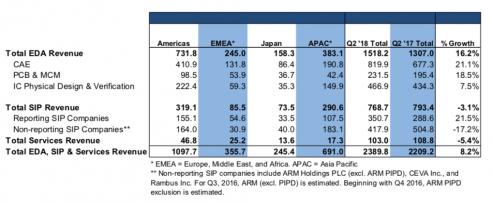
According with ESDA, EDA revenues have grown YoY by 16.2% in Q2 2018, and this is the good news for our industry. The bad news is the decline of SIP (Design IP) revenues, by (3.1%) at the same time. As far as I am concerned, this figure looks weird, so I will try to understand the reason why SIP category can go wrong in a healthy EDA market,… Read More












Five Billion Pulses Later: What DUV Optics Testing Reveals About Semiconductor Tool Uptime