






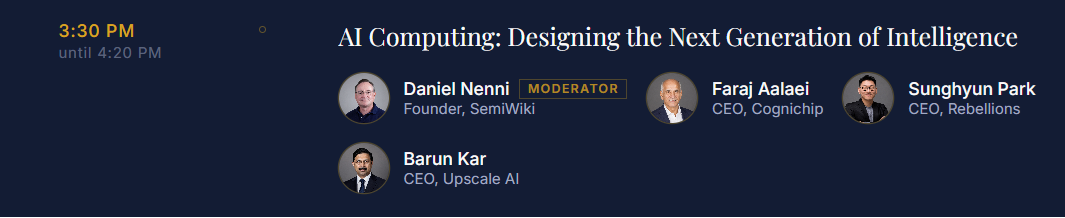
It’s an honor to attend events like this as a guest, and even more so as a speaker. On Friday at 3:30 p.m., I’ll be moderating a panel with the CEOs of three of the hottest AI startups. I definitely have a few questions ready for them! My beautiful wife and I will also be at the banquet. I hope to see you there!
The CASPA CEO Summit arrives with an ambitious premise: The next decade of computing will be shaped by decisions that connect silicon, systems, and artificial intelligence. Scheduled for October 23–24, 2026, at the Santa Clara Convention Center, the event marks the Chinese American Semiconductor Professional Association’s 35th anniversary. Its theme, “Silicon, Systems, and Intelligence: Designing the Next Decade,” captures the central question facing attendees: how can technological advances become useful, scalable, and economically sustainable products?
CASPA describes the summit as its largest gathering of global semiconductor CEOs. The announced program includes an onstage conversation between Intel CEO Lip-Bu Tan and CASPA President Jimmy Cheng, alongside speakers representing established technology companies, emerging AI businesses, venture capital, and engineering organizations. Among the announced participants are leaders from Synopsys, Lumentum, Altera, SambaNova Systems, d-Matrix, and Solidigm. That breadth gives the gathering its potential significance: attendees can hear how different parts of the computing ecosystem understand the same opportunities and constraints.
The summit matters because AI is a physical undertaking as well as a software achievement. Every model depends on hardware that processes instructions, moves information, stores data, and consumes electricity. From that perspective, a useful discussion about AI’s future must ask more than what a model can do. It must also ask what delivering that capability requires, how much it costs, and which technical limitations stand in the way. A gathering spanning chips, systems, and investment offers a setting for examining those questions together.
Consider the choices confronting a company developing an AI product. Should it rely on general-purpose hardware or pursue a specialized architecture? Should computation happen in a large data center or closer to the user? How should performance be weighed against energy consumption, deployment complexity, and cost? These are engineering decisions with business consequences. The summit’s value will depend partly on whether speakers explain such tradeoffs clearly enough to help attendees make better decisions in their own organizations.
The presence of established companies and younger ventures also creates an opportunity to compare competing visions. Large businesses can discuss the demands of serving customers at scale; startups can challenge assumptions about architecture, efficiency, and product design. Neither perspective is sufficient alone. For entrepreneurs, understanding an incumbent’s requirements may reveal a route to adoption. For established firms, listening to emerging competitors may expose ideas that deserve closer attention. The most productive exchanges will make those differences concrete rather than leave them at the level of broad predictions.
Investment adds another essential dimension. A promising technical concept needs resources, a credible market, and a path through development before it can become a durable business. The announced participation of venture capital leaders gives attendees a chance to explore how those judgments are made. Useful conversations would examine what evidence supports an investment thesis, which milestones reduce uncertainty, and how founders can distinguish customer demand from enthusiasm. For engineers considering entrepreneurship, that perspective can connect technical ambition with commercial discipline.
CASPA’s anniversary gives the event a community dimension, too. Bringing executives, researchers, engineers, investors, and students into the same setting can help knowledge travel across career stages and professional boundaries. A student may encounter a field worth pursuing; an engineer may meet a future collaborator; a founder may find someone who understands a difficult design problem. Such outcomes cannot be guaranteed by a speaker lineup, but they are a practical reason to convene people whose work otherwise happens in separate organizations.
Bottom line: The summit’s lasting importance will therefore be measured by what follows: sharper questions, informed decisions, and collaborations that survive beyond the conference. Its promise is to connect the people designing computing’s foundations with those building businesses and applications upon them. If those conversations produce clearer thinking about performance, cost, and real customer needs, CASPA’s anniversary gathering could help attendees turn an expansive vision of the next decade into practical work that improves how technology reaches people everywhere, across industries, institutions, and everyday working lives.
Also Read:
TSMC OIP Ecosystem Forum 2026: Spotlight on Emerging Technologies
TSMC OIP Ecosystem Forum 2026: Broadcom’s View of ASICs and Ecosystems
Designing chips for the AI era: what TSMC’s roadmap means
Share this post via:



The silent killer of analog reliability: Why SPICE misses floating net